

| LCDF Pvt. Ltd.
Summary
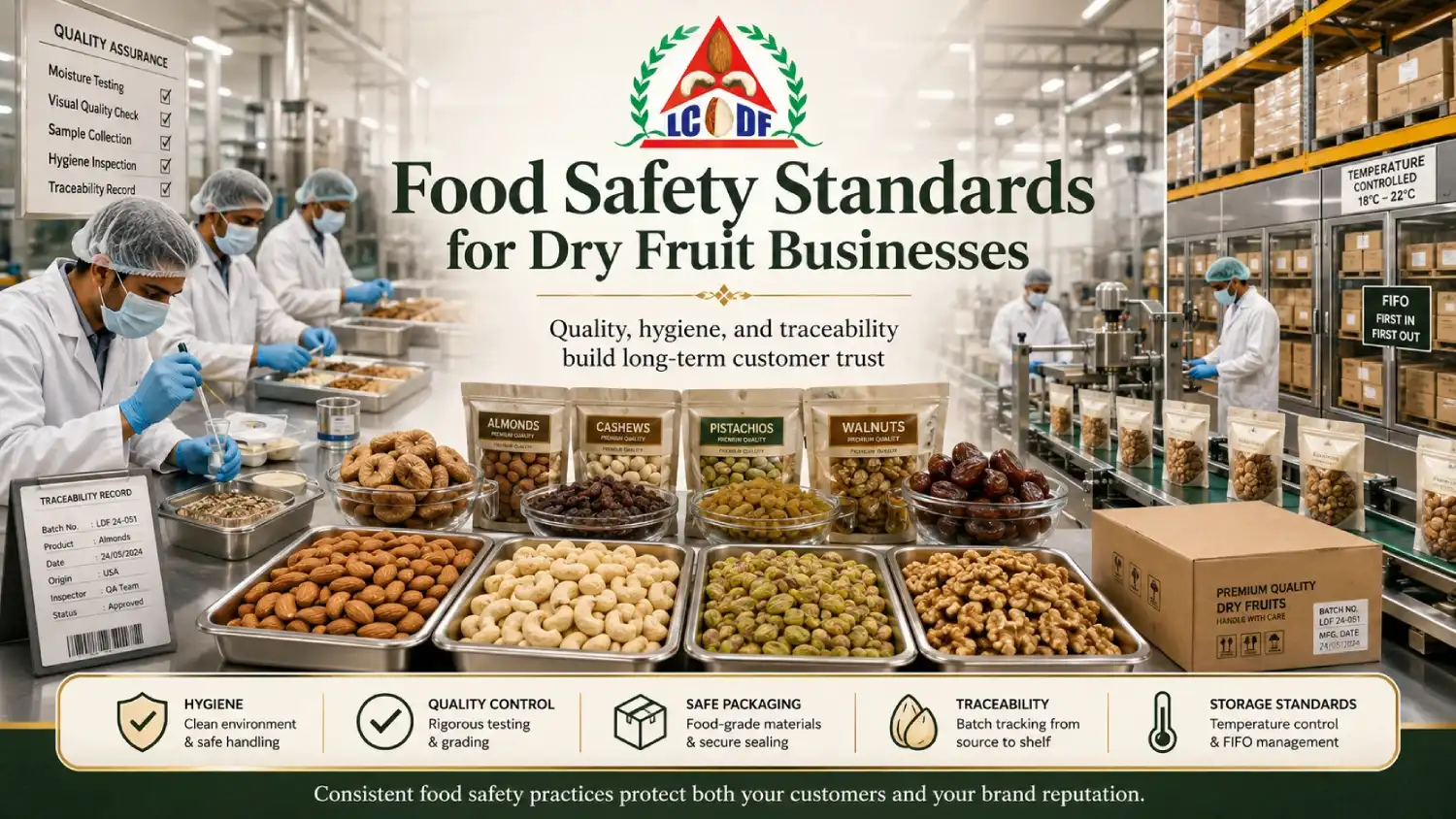
Dry fruits have low moisture, but that does not make them risk free. Aflatoxin, Salmonella, mold, pests, allergens, and mislabeling can all affect a batch if a business skips the basics. This guide covers what every dry fruit business needs in place, including HACCP, Good Manufacturing Practices, FSSAI compliance, and certifications like ISO 22000, FSSC 22000, and BRCGS. It walks through supplier approval, incoming inspection, storage, allergen control, packaging, and transport, along with a daily checklist and a recall action plan. The goal is simple. Prevent problems before they reach a customer, and protect the trust a brand takes years to build.
Key Takeaways
- Use HACCP to catch hazards before they reach a customer, not after.
- Keep facilities and equipment clean through Good Manufacturing Practices.
- Hold the right FSSAI license and stay current with Indian food regulations.
- Vet suppliers properly, checking certificates, lot numbers, and specifications before you buy.
- Keep a tight handle on moisture, allergens, pests, and foreign material at every stage.
- Maintain full lot traceability so you can act fast if something goes wrong.
- Train staff regularly, and do not skip refreshers.
- Run internal audits on a schedule, not just when a customer asks for one.
Introduction
It only takes one mistake to undo years of hard work. A contaminated batch, a wrong label, or a supplier who cuts corners can trigger a recall, invite legal trouble, and quietly chip away at the trust customers have in your brand. Today's buyers want more than good-tasting almonds or plump raisins. They want products that are hygienic, traceable, and made by a business that takes food safety seriously.
Dr. Frank Yiannas, the former FDA Deputy Commissioner for Food Policy and Response, put it simply: food safety isn't something that sets a brand apart from competitors. It's a basic responsibility every food business owes its customers.
That idea applies directly to the dry fruits trade. Whether you deal in almonds, cashews, pistachios, walnuts, raisins, dates, or figs, food safety has to be built into every link of the supply chain, not bolted on afterward.
Dry fruits have low moisture, which makes people assume they're automatically safe. They aren't. Aflatoxin, Salmonella, mold, insects, foreign material, undeclared allergens, pesticide residue, and poor storage can all creep in and affect both product quality and consumer health.
The encouraging part is that almost all of these risks can be managed through careful supplier vetting, clean processing, solid quality checks, and well-trained staff. This guide walks through the standards that matter most for dry fruit businesses: HACCP, GMP, FSSAI compliance, international certifications, supplier approval, storage practices, allergen control, packaging, traceability, and the everyday checklists that keep a business audit-ready and customer-safe.
Key Takeaways
Use HACCP to catch hazards before they reach a customer, not after. Keep facilities and equipment clean through Good Manufacturing Practices. Hold the right FSSAI license and stay current with Indian food regulations. Vet suppliers properly, checking certificates, lot numbers, and specifications before you buy. Keep a tight handle on moisture, allergens, pests, and foreign material at every stage. Maintain full lot traceability so you can act fast if something goes wrong. Train staff regularly, and don't skip refreshers. Run internal audits on a schedule, not just when a customer asks for one.
The Standards Every Dry Fruit Business Should Know
Experience alone isn't a food safety system. Every dry fruit business, whether you manufacture, import, package, distribute, or sell, needs written procedures, trained people, and regular monitoring behind the scenes.
HACCP (Hazard Analysis and Critical Control Points)
HACCP is one of the most widely recognized food safety frameworks in the world. Instead of reacting to problems after they surface, it pushes a business to map out where contamination could occur and put controls in place before it happens.
For a dry fruit business, that might mean watching for mold during storage, metal fragments during processing, allergen cross-contact during packaging, pests in the warehouse, or mislabeled cartons before they ship. Each of these gets a control measure, a monitoring routine, and a paper trail. Businesses that build a HACCP plan around their own operations, rather than copying a generic template, tend to catch problems earlier and face fewer recalls.
Good Manufacturing Practices (GMP)
If HACCP is the strategy, GMP is the daily discipline that makes it work. GMP is about the basics done consistently: employee hygiene, handwashing, protective clothing, sanitized equipment, pest control, proper waste disposal, cleaning schedules, safe storage, clean water, and well-maintained machinery. Even a strong HACCP plan falls apart without solid GMP behind it.
Food Safety Rules for Dry Fruit Businesses Operating in India
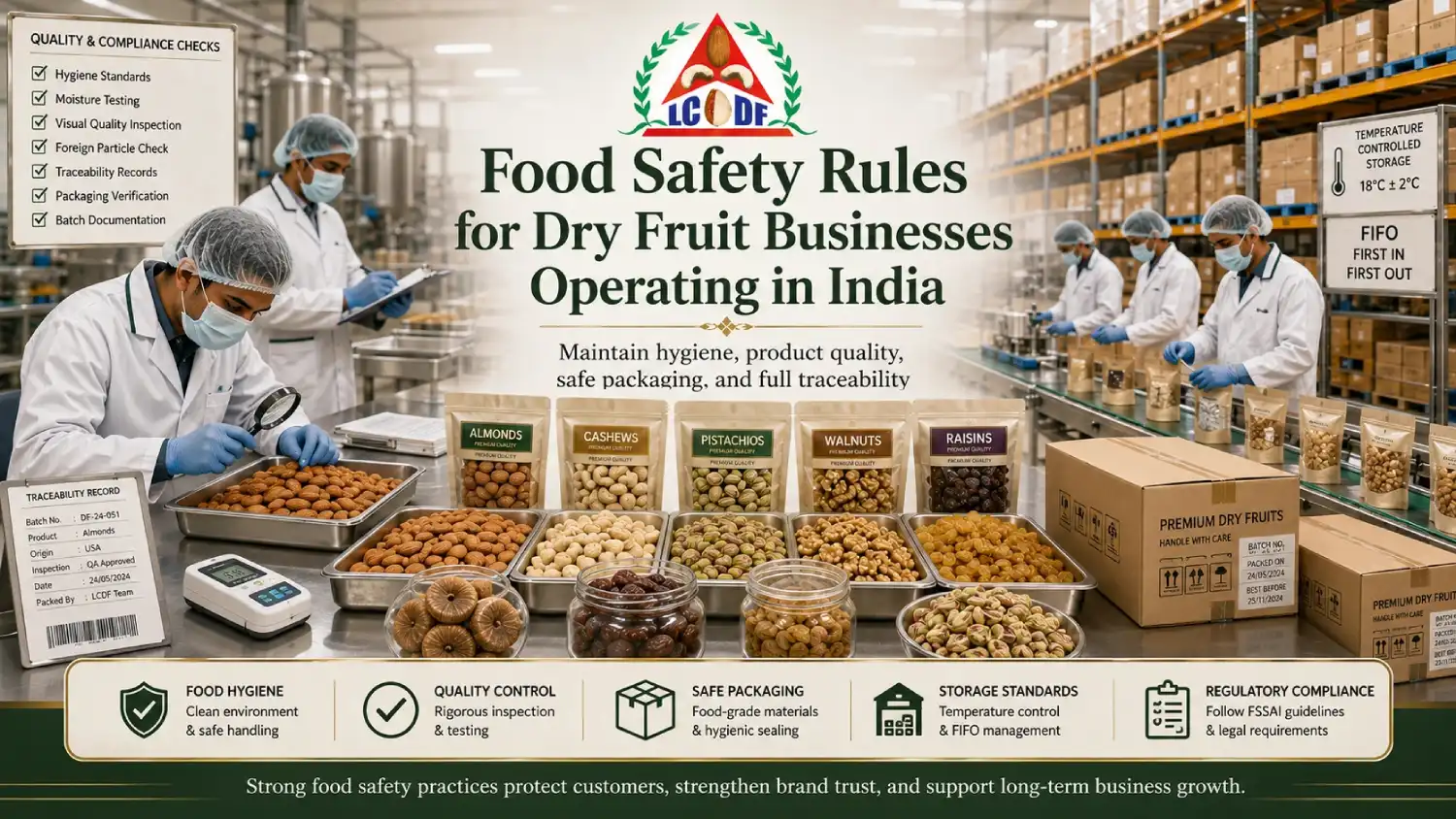
If you're running a dry fruits business in India, you fall under the Food Safety and Standards Authority of India (FSSAI), which governs how food is manufactured, stored, packaged, transported, labeled, and sold across the country. Getting this right does more than keep inspectors happy. It builds credibility with retailers, distributors, and export buyers who won't work with you otherwise.
At minimum, a dry fruit business should hold the correct FSSAI license or registration, follow hygiene rules for its premises, use food-grade packaging, keep storage areas clean, control pests properly, maintain traceability records, follow labeling rules, and cooperate fully during inspections.
What Your Label Needs to Show
Every packaged product should clearly display the product name, ingredient list, nutritional information, allergen declaration, net quantity, batch or lot number, manufacturing date, best before date, FSSAI license number, manufacturer details, storage instructions, and country of origin where relevant. Good labeling isn't just compliance. It's one of the simplest ways to protect both your customers and your business.
Certifications Worth Knowing About
Not every certification is legally required, but many retailers, distributors, and export buyers use them as a shortcut to decide who they trust.
ISO 22000 is an internationally recognized food safety management system that blends HACCP principles with broader management practices to help a business identify and reduce risk across its supply chain.
FSSC 22000 builds on ISO 22000 and is widely used by global food manufacturers and retailers, adding requirements around continuous improvement.
BRCGS is a standard many major retailers ask for by name. It focuses on product safety, quality, operational control, and legal compliance, and it's now used across more than 130 countries.
Third-party HACCP certification and GMP certification both demonstrate, in a more limited but still useful way, that your hazard controls and hygiene practices hold up to outside scrutiny. And for anyone operating in India, FSSAI compliance remains the baseline that most corporate buyers expect before they'll even consider a long-term partnership.
Choosing suppliers who already hold recognized certifications takes a lot of the guesswork out of your own risk exposure, and it opens doors to export markets and premium retail shelves.
Applying These Standards From Supplier to Shelf
Food safety doesn't start when dry fruits arrive at your warehouse. It starts with who you choose to buy from.
Step 1: Vet Your Suppliers Properly
This is the single most important control point in the whole chain. Buying from a supplier you haven't properly checked out is how contamination, inconsistent quality, and labeling problems creep into an otherwise solid operation. Before you approve a supplier, look at their food safety certifications, FSSAI license or equivalent, product specifications, Certificate of Analysis where applicable, aflatoxin test reports for higher-risk products, allergen declarations, batch identification, product origin, and their track record on previous orders.
This isn't a one-time check. Reviewing suppliers periodically, rather than approving them once and forgetting about it, is what separates businesses that catch problems early from ones that find out the hard way. If you want a deeper look at how to build this process out, our piece on building a supplier network for a dry fruits business walks through it in more detail, and what sets professional dry fruit suppliers apart is worth a read if you're trying to tell a reliable supplier from one that just looks good on paper.
Step 2: Inspect Every Incoming Shipment
Never assume a shipment is fine just because it came from a supplier you trust. Check every delivery for torn or damaged bags, wet cartons, broken seals, signs of insects or rodents, unusual smells, mold, foreign material, incorrect labels, or missing paperwork. If anything looks off, isolate it immediately and investigate before it goes anywhere near your regular stock.
Step 3: Store Everything Correctly
Even the best dry fruits lose their edge if storage is sloppy. Keep the space clean, dry, and organized. Nothing should sit directly on the floor or against a wall. Good airflow makes cleaning easier and keeps pests away. Rotate stock using FIFO or FEFO depending on what fits your inventory, keep products out of direct sunlight, separate allergens from everything else, and check for pests daily. We've written more on this in moisture, temperature, and time, the three enemies of dry fruit quality, and a practical breakdown in how to store dry fruits for maximum freshness and longevity.
Typical shelf life (actual life depends on processing, packaging, and storage conditions, so always follow the label): almonds run up to 12 months, cashews around 9 to 12 months, pistachios up to 12 months, walnuts around 6 to 12 months, raisins and dates around 12 to 18 months, and dried figs around 6 to 12 months.
Rather than locking in one fixed temperature or humidity number for every product, base your storage conditions on the specific product, its packaging, and any customer or regulatory requirements that apply. Keep the space cool, dry, well ventilated, and out of direct sunlight, with products on pallets and enough wall clearance for cleaning and inspection. Check conditions daily and rotate stock consistently.
Step 4: Get Ahead of Aflatoxin
Aflatoxin is one of the biggest risks in this industry. It's produced by molds that thrive when nuts and dried foods sit in excess moisture or poor storage for too long, and once it's in a finished product, there's no washing or processing it back out. Prevention is the only real defense: buy from approved suppliers, review lab reports where they matter, control moisture, and inspect high-risk products more closely.
Common Hazards and How They're Controlled
Aflatoxin and Salmonella both carry high risk and are best managed through supplier approval, sanitation, and risk-based testing. Mold growth ties back to moisture control and proper storage. Foreign objects and metal fragments call for visual inspection, sieving, and metal detection where it's justified. Insect infestation needs active pest management and regular warehouse checks. Allergen cross-contact requires dedicated cleaning procedures and physical segregation. Incorrect labels get caught through verification before packing, and moisture damage comes down to dry, monitored storage.
Step 5: Manage Allergens Carefully
Tree nuts are a major allergen in most countries, so if your operation handles more than one type of product, cross-contact is a real risk to plan around. Store allergenic ingredients separately, clean equipment thoroughly between production runs, train staff specifically on allergen handling, and double-check labels before anything gets packaged.
Step 6: Keep Processing Clean
Clean equipment before every run. Keep raw materials away from finished product. Use food-grade containers. Pull damaged product the moment you spot it. Calibrate your weighing and inspection equipment regularly, and keep written cleaning records instead of relying on memory. Depending on your hazard analysis, screens, magnets, metal detectors, or X-ray systems may be worth adding to cut physical contamination risk further.
Step 7: Package With Safety in Mind, Not Just Branding
Good packaging protects against moisture, insects, dust, and contamination during storage and transport. Before any packaging run, confirm the correct product, label, allergen declaration, lot code, and best-before date, along with packaging integrity and seal quality. Mislabeling remains one of the most common reasons products get recalled worldwide, and it's almost always preventable. For more on how packaging affects both safety and sales, see how one packaging change increased dry fruits sales and decoding shelf life through packaging technology.
Step 8: Transport With the Same Care
Food safety doesn't end once a product is packed. Vehicles need to be clean, dry, odor-free, pest-free, and genuinely suited for food transport. Protect shipments from rain, heat, moisture, chemicals, strong odors, and cross-contact with incompatible goods. Keep shipping records, including carrier details, destination, shipment date, and lot numbers, so you can trace anything back if you ever need to. Our post on why traceability matters in the dry fruit business goes deeper into why this record-keeping pays off.
A Daily Food Safety Checklist
Run through this every day: storage area inspected, temperature and conditions checked, warehouse clean and dry, pest inspection done, employee hygiene verified, equipment cleaned and sanitized, incoming products inspected, packaging materials checked, labels verified before packing, lot numbers recorded, FIFO or FEFO followed, cleaning records updated, supplier documents verified, damaged products isolated, and corrective actions documented.
A simple daily habit like this catches small problems long before they turn into recalls.
Lessons From the Real World
Most food recalls aren't caused by one dramatic failure. They're usually the result of several small things going unnoticed at once: a supplier who wasn't properly checked, cleaning that got skipped, a label that wasn't verified, or storage that slipped for a week too long.
One of the clearest examples in food safety history is the 2008 to 2009 Salmonella outbreak tied to the Peanut Corporation of America. According to the CDC's investigation, the outbreak resulted in over 700 confirmed illnesses across dozens of states, and it contributed to several deaths. The products involved were peanut based rather than dry fruits, but the lesson translates directly: when supplier vetting, sanitation, testing, and traceability are weak at just one point in the chain, contamination can spread through hundreds of finished products before anyone catches it.
The takeaways are straightforward. Never buy from a supplier you haven't verified. Keep complete lot traceability. Investigate customer complaints the moment they come in, not weeks later. Check your cleaning procedures regularly. Keep detailed records. Audit suppliers when you can. Train your people continuously, and revisit your own procedures every year rather than assuming they're still adequate.
What Experienced Food Businesses Do Differently
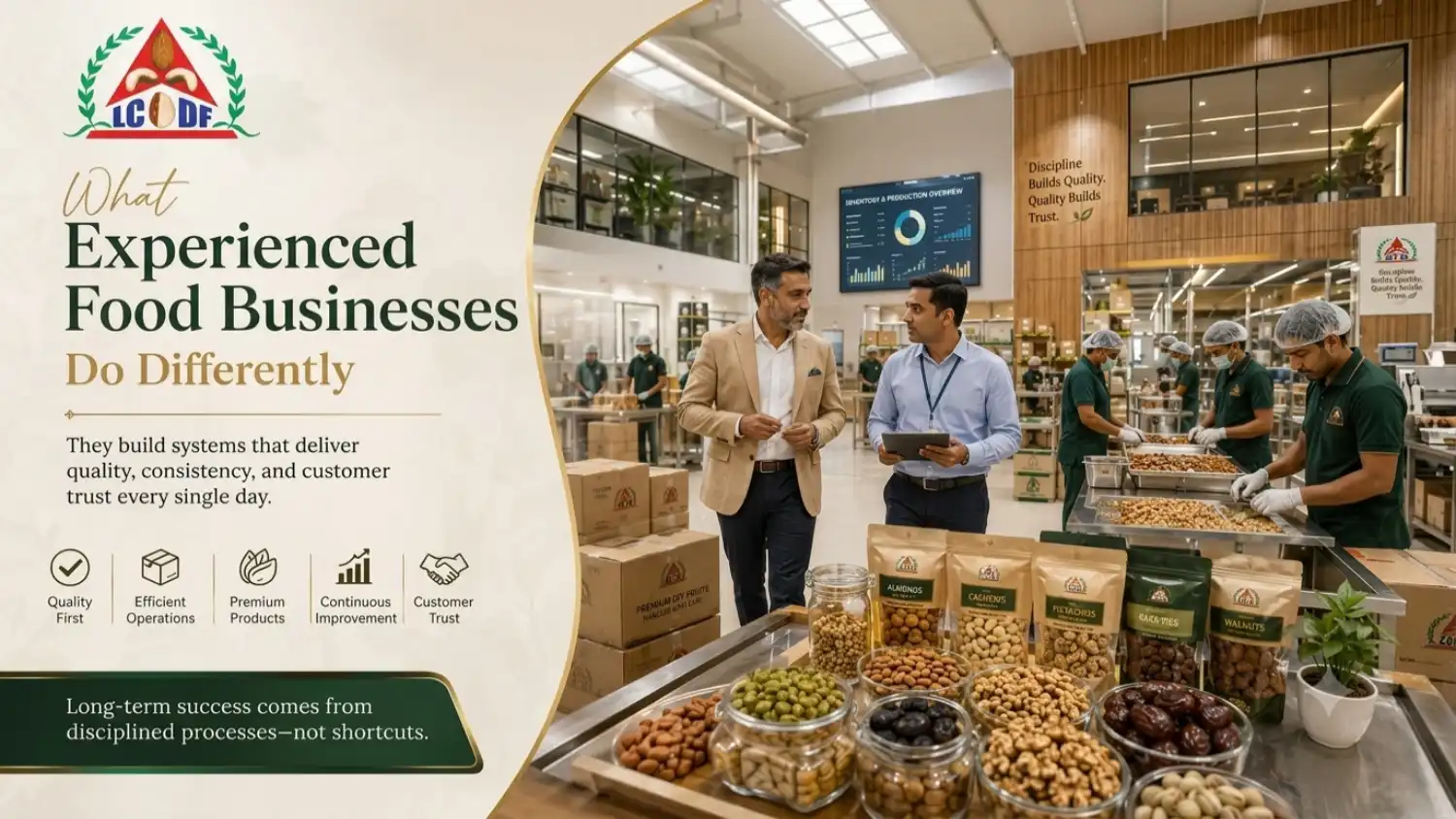
The businesses that rarely deal with recalls tend to focus on prevention rather than correction. They keep an eye on product quality, supplier performance, storage conditions, hygiene, equipment cleanliness, pest activity, packaging, label accuracy, and customer complaints on an ongoing basis, and they run internal audits throughout the year instead of only preparing right before an inspection.
Ten Mistakes Worth Avoiding
Buying from unverified suppliers because the price looked good. Ignoring storage conditions until moisture or heat has already done damage. Letting employee hygiene slide. Mislabeling products, especially missing allergen declarations or wrong batch numbers. Weak traceability that leaves you unable to answer where a batch came from or where it went. Poor pest management. Equipment that doesn't get cleaned and inspected after every run. Mixing allergenic and non-allergenic products without proper separation. Skipping employee training because it feels like it can wait. And treating food safety as paperwork you complete only when someone's checking, rather than something you do every day regardless of who's watching.
If Something Goes Wrong: A Recall Action Plan
Even a strong food safety system should have a recall plan ready before it's ever needed. If a complaint, lab report, or inspection finding raises a concern, identify the affected batch using lot numbers, stop distribution immediately, inform distributors or customers if necessary, notify the appropriate regulatory authority where required, investigate the root cause, put corrective and preventive actions in place, and review your procedures afterward so the same gap doesn't reopen. Having this mapped out in advance means you respond in hours, not days.
Why Training Isn't Optional
No food safety system works without people who understand it. Every employee should know personal hygiene basics, proper handwashing, cleaning and sanitation steps, allergen handling, how to report pests, product inspection, safe storage, label verification, traceability procedures, and what to do in an emergency. Regular refreshers keep this consistent as staff change and processes evolve.
Common Questions
Do all dry fruits need aflatoxin testing?
Not necessarily. It depends on the product's risk level, the supplier's track record, country of origin, and any customer or regulatory requirements. Higher-risk products usually warrant more frequent testing.
Can a final inspection replace proper supplier approval?
No. Final inspection catches visible defects, but it can't reliably detect microbiological, chemical, or allergen hazards. Supplier approval remains one of the strongest controls you have.
How often should storage areas be checked?
Daily, ideally, covering pest activity, leaks, damaged products, housekeeping, stock rotation, and temperature.
Why does traceability matter so much?
Because it lets you isolate an affected batch quickly during a complaint or recall, which limits both the financial damage and the amount of product you have to pull.
How often should staff get food safety training?
At onboarding, with regular refreshers afterward, and additional sessions whenever new equipment, products, or procedures come in.
Which certification is the right fit?
It depends on your customers and goals. Many businesses start with HACCP and GMP, while larger manufacturers and exporters often move toward ISO 22000, FSSC 22000, or BRCGS to satisfy international buyers.
Myths That Need Correcting
Dry fruits are not automatically safe just because they have low moisture. Aflatoxin, Salmonella, allergens, and pests can still affect them. Food safety isn't only a manufacturer's job. Every wholesaler, distributor, retailer, importer, exporter, and packer shares the responsibility. Visual inspection alone won't catch most hazards. Recalls aren't limited to large companies. Any business can face one if its systems fail. HACCP doesn't replace GMP. They work together. And your responsibility doesn't end when a shipment leaves the warehouse. Safe transport, traceability, and customer communication still matter after that.
Closing Thoughts
Food safety is one of the strongest investments a dry fruit business can make. It protects the people buying your product, strengthens your reputation, and supports growth that actually lasts. Whether you're running a wholesale operation, a retail brand, an import or export business, or a processing facility, every batch should move through a system built on proper supplier approval, HACCP, GMP, hygiene, traceability, accurate labeling, and consistent training.
As Dr. Yiannas put it, food safety isn't a competitive edge. It's a responsibility. The businesses that treat it that way, day in and day out, are the ones that earn lasting trust from customers, retailers, and regulators alike.
If you want to see how a business built on these exact principles operates in practice, from sourcing (About Us) to bulk supply and custom packaging (B2B Opportunities), it's worth a look at Lake City Dry Fruits, which has built its 60-plus year track record on exactly this kind of discipline.
Author

LCDF Pvt. Ltd.
Lake City Dry Fruits Pvt. Ltd. has been a pioneer in the dry fruits and spices industry for over 60+ years. From humble beginnings in Udaipur to a pan-India presence, we’ve built a reputation for sourcing the best global produce, ensuring uncompromising quality at every step.