

| LCDF Pvt. Ltd.
Summary
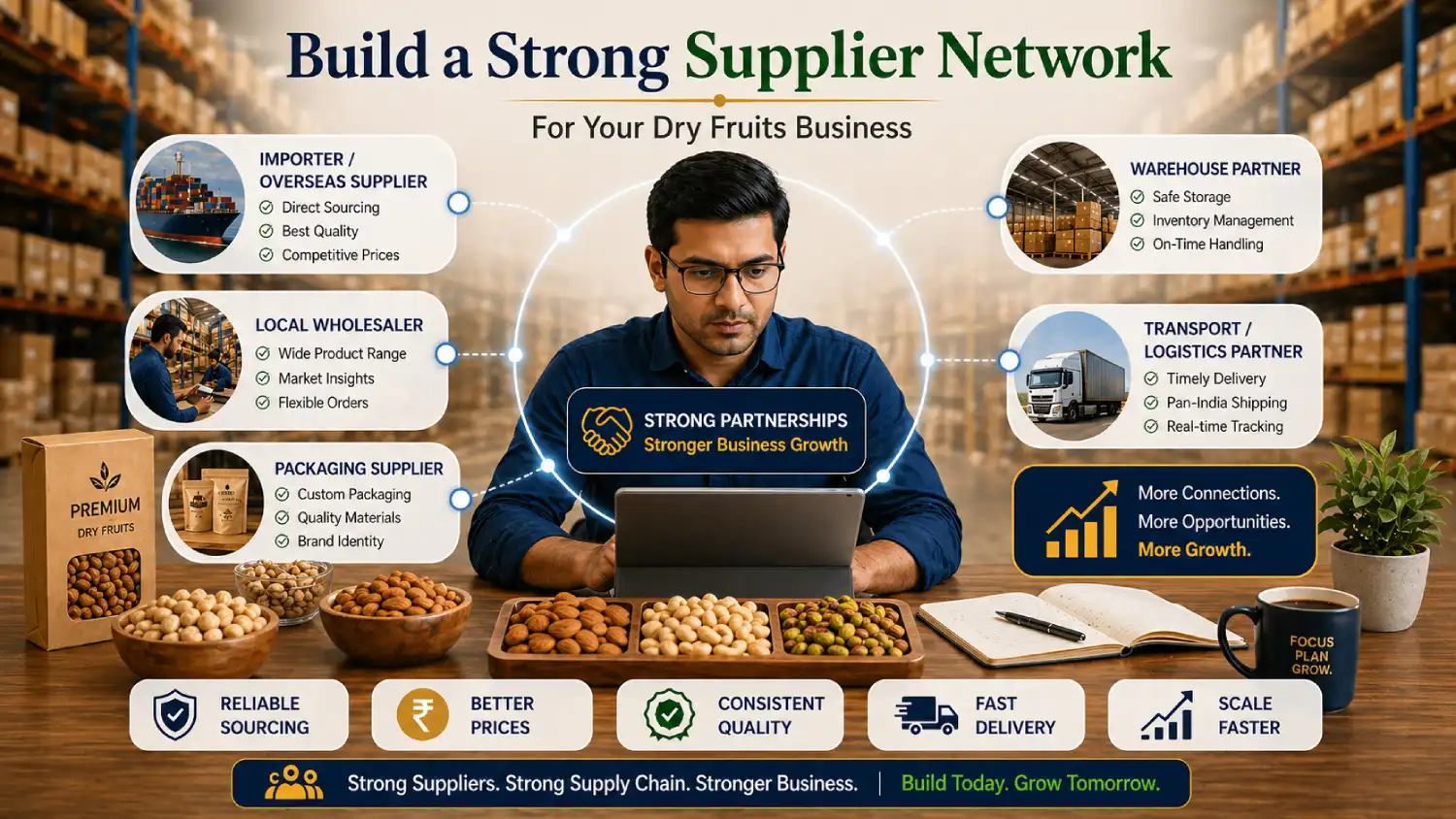
Building a strong supplier network is essential for running a profitable dry fruits business. This guide explains how to find, verify, and manage dry fruits suppliers to ensure consistent quality, stable pricing, and reliable supply. It covers key steps like defining your sourcing plan, selecting the right products, identifying supplier types, and evaluating vendors through samples, certifications, and trial orders. The content also highlights important market insights, including growth trends, demand patterns, and pricing factors. By using a structured approach such as the 3-level supplier model and maintaining multiple suppliers, businesses can reduce risk and improve margins. The guide also includes practical checklists, case studies, and expert tips to help buyers make better decisions. Overall, it provides a complete system to build a scalable, stable, and efficient supplier network in the dry fruits business.
Key Takeaways
- Supplier network is the foundation of a profitable dry fruits business
- Always work with 2–3 suppliers to reduce risk
- Focus on quality, not just price
- Test samples and run trial orders before bulk buying
- Use a 3-level supplier model (primary, backup, opportunistic)
- Verify certifications like FSSAI and check traceability
- Build long-term relationships with reliable suppliers
- Diversify sourcing across regions (India, Turkey, California)
- Use checklists to standardize supplier evaluation
- Strong supplier networks improve margins and customer trust
Introduction
The difference between a profitable dry fruits business and a struggling one often comes down to a single factor: your supplier network.
The global dry fruits market is expanding rapidly, with estimates placing it at around $12 billion and growing steadily each year. In the US alone, the market is already valued at roughly $4 billion, with annual growth of 5% to 7%. This growth is driven by rising demand for healthy snacks, organic products, and ready-to-eat food options.
But here’s the reality most businesses overlook.
Even in a growing market, poor supplier selection leads to inconsistent quality, delayed deliveries, and lost customer trust. As Philip Kotler explains, “The key to success is delivering consistent value to customers.” In the dry fruits business, that value depends directly on the strength of your supplier network.
This guide shows you how to build, verify, and manage a supplier network that supports consistent quality, stable pricing, and long-term growth.
Delhi Dry Fruits Market Context
In India, especially in cities like Khari Baoli and Azadpur Mandi, the dry fruits trade plays a major role in supply chains across the country.
Market Statistics
| Metric | Data | Insight |
|---|---|---|
| Market Growth | 8–10% annually | Demand is steadily increasing |
| Demand Peak | Diwali, wedding season | Sales can rise 30–40% |
| Import Dependency | High for almonds & pistachios | Prices fluctuate globally |
| Buyer Type | 60% B2B | Retailers & wholesalers dominate |
This shows why building a supplier network is critical.
Start with a clear sourcing plan before you contact suppliers
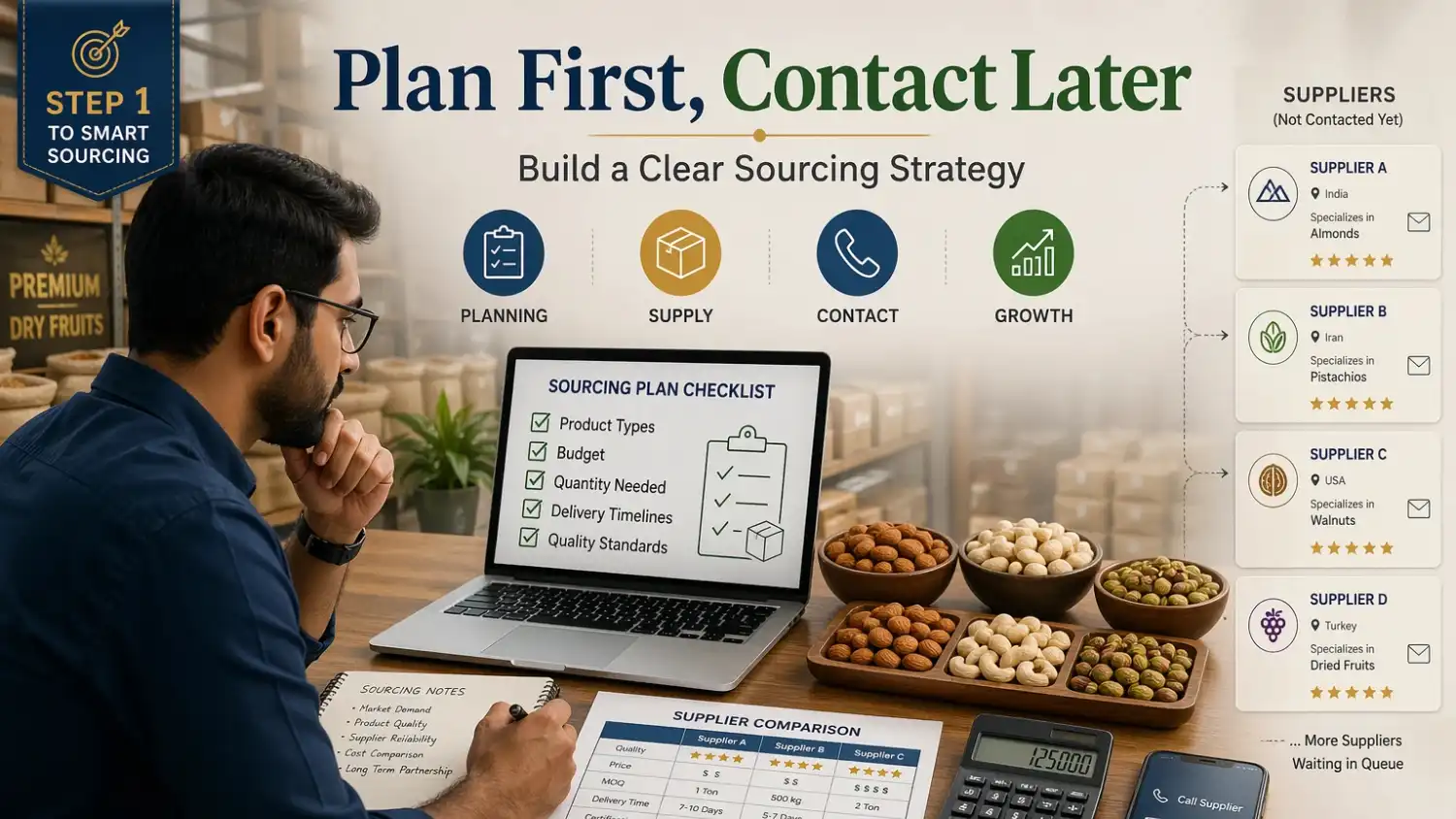
A supplier network is really good when you have a business plan. You need to figure out what things you want to sell who you want to sell them to and how money people are willing to pay for these things. If you have a business that sells gifts you will need different suppliers than a business that sells big amounts of things at a low price.
It is an idea to use suppliers from your own city and also from other countries. Suppliers from your city can help you when you need something right away or when you just need a few things. Suppliers, from countries can help you make more money and sell a wider variety of things.
Choose the dry fruits you want to sell and the quality level you need
Your product list shapes the whole search. California almonds and walnuts are strong choices for US buyers. Turkish apricots are a common pick for premium dried fruit assortments. Indian raisins, dates, and cashews are widely traded across wholesale markets.
Premium lines need tighter checks. That includes organic, no-sulfite, flavored, and private-label packs. These products often bring higher margins, but they also need better traceability, stronger packaging, and consistent batch quality. Current snack trend reviews, such as Torg's dried fruits market overview, show how fast clean-label and convenience products are growing.
Supplier Network Structure
A strong dry fruits business does not depend on one supplier.
Use this 3-level model:
- Primary Supplier: Main source for bulk and regular orders
- Secondary Supplier: Backup for emergencies
- Opportunistic Supplier: Used for price advantage
Set your supplier criteria early, so you can compare vendors fairly
Write your standards before you ask for quotes. That keeps price from becoming the only filter.
What to check
| Factor | Why it matters |
|---|---|
| Certifications and compliance | FSSAI, ISO ensure trust |
| MOQ, lead time, packaging | Matches your business cycle |
| Traceability | Ensures consistency |
The cheapest quote can become the most expensive order if quality slips or stock arrives late.
Types of Dry Fruits Suppliers
| Supplier Type | Best For | Risk Level |
|---|---|---|
| Wholesalers | Bulk buying | Medium |
| Importers | Premium quality | High |
| Local traders | Quick supply | High |
| Reliable brands like Lake City Dry Fruits | Consistency | Low |
Find reliable suppliers through trusted channels, not random listings
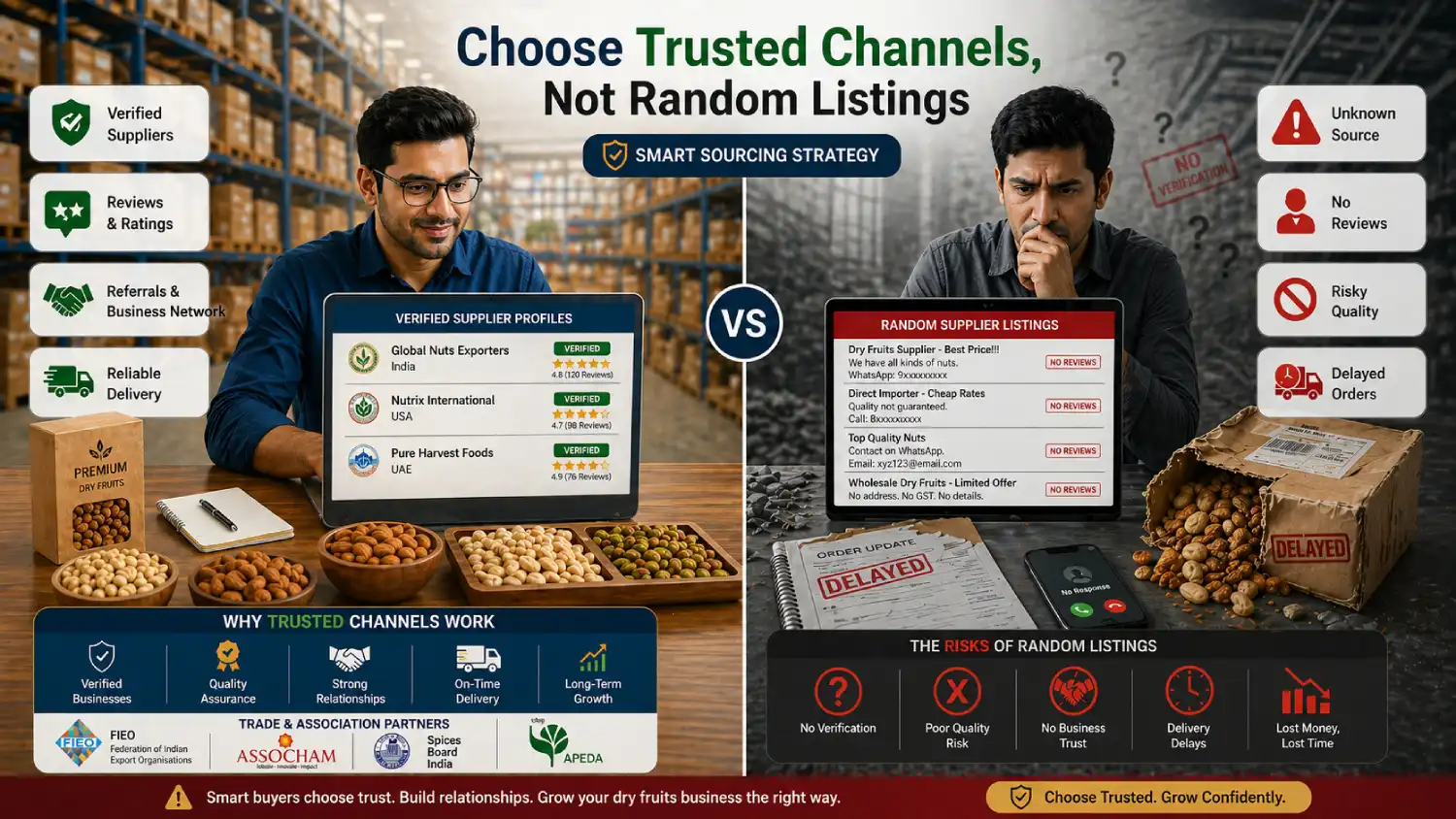
Random supplier lists waste time. Good buyers build a shortlist from channels where business records, product focus, and industry links are easier to check.
Use industry directories, trade events, and B2B platforms to build your first shortlist
The International Nut & Dried Fruit Council is one of the best starting points. Its network includes more than 900 companies across 85 countries, which makes it useful for meeting exporters, processors, and traders with a real market presence.
B2B platforms such as Alibaba and Torg can also help. Still, use them as a search tool, not a trust stamp. Ask for certificates, recent export records, references, and fresh samples before moving forward. Trade events speed up comparison because you can meet several suppliers in one trip and judge their product knowledge face-to-face.
Look at key sourcing regions and supplier types for different products
California is a place for growing almonds, walnuts and raisins. This is because California has a lot of land for farming and good ways of processing these foods. California also makes sure that the food is always of quality.
Turkey is very good at growing apricots and other dried fruits. They are especially good at making quality products that people in other countries want to buy. India is a player when it comes to dates, raisins, almonds, and cashews. India also has a lot of people who want to buy these foods so there is a market for them. This helps India sell a lot of these foods to people, over the world.
Understanding sourcing regions helps you control both quality and pricing. Different regions offer different advantages:
- California: consistent grading and export-quality almonds
- Turkey: premium dried fruits with strong global demand
- India: competitive pricing and wide wholesale availability
Instead of relying on one region, build a diversified sourcing strategy.
Build a mixed supplier network that includes:
- Growers for direct sourcing and better margins
- Processors for uniform quality and standard specifications
- Importers for faster access to premium or seasonal products
- Backup traders for urgent requirements and short-term gaps
A network with only one supplier type is fragile. If supply is disrupted due to weather, logistics, or market changes, your entire business can suffer. A diversified network ensures continuity and flexibility.
Check every supplier carefully before you place large orders
Price matters, but late deliveries or poor-quality stock cost more in the long run. Many businesses lose money not because of high prices, but because of inconsistent supply and quality issues.
Supplier verification should be simple, repeatable, and strict. Create a standard process so every supplier is evaluated on the same criteria.
Request samples, documents, and proof of quality control
Always start with product evaluation. Testing samples helps you understand the real quality before committing to bulk orders.
Check samples for:
- Taste and freshness
- Moisture level (to avoid spoilage)
- Size and uniformity
- Color and appearance
- Cleanliness and absence of foreign particles
- Shelf life and storage stability
Watch for warning signs such as sugar bloom, excess oil, broken pieces, discoloration, or weak packaging seals.
Along with samples, ask for proper documentation:
- Lab reports and quality test results
- Product specifications and grading details
- Packaging and storage information
- Allergen declarations
- Traceability records (origin and batch tracking)
If you are importing, also check export history, hygiene standards, and compliance with food safety regulations. Suppliers who provide clear and quick responses usually have better systems and handle orders more professionally.
Run a small trial order before you commit to a long-term deal
A trial order is the most reliable way to evaluate a supplier. It shows how the supplier performs in real conditions, not just on paper.
During a trial order, evaluate:
- Communication speed and clarity
- Packaging quality and protection during transit
- Damage or wastage rate
- Delivery timelines and consistency
- Invoice accuracy and pricing transparency
- Final landed cost including logistics
This step helps you identify hidden issues early and avoid large losses.
Always compare at least two or three suppliers for the same product. This gives you a clear benchmark for quality, pricing, and service. It also reduces dependency from the beginning and helps you negotiate better terms.
Build long-term supplier relationships that protect your business
Finding suppliers is only the start. The real advantage comes from managing them well.
- Negotiate fairly
- Maintain regular orders
- Communicate clearly
Supplier Score Comparison
| Supplier | Quality | Price | Reliability | Overall |
|---|---|---|---|---|
| Lake City Dry Fruits | 9/10 | 8/10 | 9/10 | 9/10 |
| Happilo | 8/10 | 7/10 | 8/10 | 8/10 |
| Nutraj | 8.5/10 | 7/10 | 8/10 | 8/10 |
Case Study
Case study, how Red River Foods built strength through global and ethical sourcing
Red River Foods shows what broad sourcing can do.
Additional insight:
A Delhi reseller improved repeat orders by 30% after switching to a multi-supplier model.
Supplier Network Checklist
Use this checklist before finalizing any dry fruits supplier. This improves decision-making and reduces risk.
Pre-Sourcing Checklist
- Define your product list (almonds, cashews, raisins, etc.)
- Decide your target market (retail, wholesale, gifting)
- Set your pricing range and margin goals
- Identify supplier types (wholesaler, importer, brand)
Supplier Verification Checklist
- Check product quality (size, color, freshness)
- Test samples before bulk order
- Verify certifications (FSSAI, ISO if applicable)
- Review packaging quality and hygiene
- Confirm traceability and product origin
Pricing & Commercial Checklist
- Compare price per kg from multiple suppliers
- Check MOQ (minimum order quantity)
- Understand bulk discounts and negotiation scope
- Calculate final landed cost (including logistics)
Operational Checklist
- Check delivery timelines and reliability
- Evaluate communication speed and clarity
- Review past customer feedback or references
- Test consistency across multiple orders
Risk Management Checklist
- Avoid depending on one supplier
- Maintain at least 2–3 suppliers per product
- Keep a backup supplier ready
- Monitor market price fluctuations
Long-Term Growth Checklist
- Build relationships with reliable suppliers
- Place regular and predictable orders
- Negotiate long-term pricing agreements
- Track supplier performance over time
Expert-backed tips to make your supplier network stronger
- Focus on quality and traceability
- Treat suppliers as partners
- Build long-term relationships
FAQs
1. What is a supplier network in a dry fruits business?
A supplier network in a dry fruits business means working with multiple dry fruits suppliers, wholesalers, and distributors instead of depending on one source. It helps improve sourcing, pricing stability, and supply chain reliability.
2. How to build a supplier network for the dry fruits business?
To build a strong dry fruits supplier network, identify supplier types, find vendors through B2B platforms and markets, verify quality, compare pricing and MOQ, and build long-term relationships for consistent bulk supply.
3. How many suppliers should a dry fruits business have?
A dry fruits business should ideally have at least 2–3 suppliers per product to ensure supply chain stability, risk management, and pricing flexibility.
4. How to find reliable dry fruits suppliers in India?
You can find reliable dry fruits wholesale suppliers in India through platforms like IndiaMART, TradeIndia, local wholesale markets, and direct sourcing. Always verify quality, certification, and delivery reliability.
5. What factors should be checked before selecting a supplier?
Check product quality, freshness, packaging, pricing, MOQ, certifications (FSSAI), delivery time, and traceability. These factors ensure a reliable supplier network.
6. What is MOQ in dry fruits sourcing?
MOQ (Minimum Order Quantity) is the smallest quantity a supplier allows in bulk buying. It directly affects pricing, inventory planning, and cash flow in the dry fruits business.
7. Why is supplier diversification important in dry fruits business?
Supplier diversification reduces risk. If one supplier fails, others ensure continuous supply. It improves pricing control, supply chain stability, and business scalability.
8. How to check dry fruits quality before bulk buying?
Check size, color, smell, moisture level, and packaging. Always request samples and run a trial order before placing large bulk orders.
9. What is the best supplier model for dry fruits business?
The best model is a 3-level supplier network:
- Primary supplier (main source)
- Secondary supplier (backup)
- Opportunistic supplier (price advantage)
This improves flexibility and reliability.
10. How does supplier network affect dry fruits business profit?
A strong supplier network improves pricing, reduces losses, ensures consistent quality, and increases customer satisfaction, which directly boosts profit margins.
About the Author
Lake City Dry Fruits is a trusted name in the India dry fruits market, with more than 15+ years of experience in sourcing, processing, and supplying premium dry fruits.
The company works closely with growers, processors, importers, and wholesale markets to maintain consistent quality across almonds, cashews, raisins, pistachios, and other dry fruits. It serves retailers, wholesalers, resellers, and corporate gifting businesses across India.
What makes Lake City Dry Fruits different is its focus on:
- Strict quality control across batches
- Reliable bulk supply and sourcing network
- Hygienic and durable packaging
- Transparent pricing and long-term business relationships
This content is based on real industry experience, supplier evaluation processes, and buyer behavior insights from the dry fruits market. The goal is to help businesses make better sourcing decisions and build reliable supplier networks.
Conclusion
Building a supplier network is not just a sourcing task. It is a business system that decides your quality, pricing, and long-term growth.
Many businesses fail because they depend on one supplier, chase the lowest price, and ignore consistency. But successful businesses follow a different approach. They build a structured supplier network, test suppliers properly, and focus on reliability over short-term savings.
This is exactly why this content is written.
It is not created to list suppliers or give basic information. It is designed to help you think like a smart buyer and build a system that works in real business conditions. It combines market data, supplier evaluation, practical steps, and real case patterns so you can avoid common mistakes and make better decisions.
How this content helps you:
- It gives you a clear step-by-step system to build a supplier network
- It shows how to evaluate suppliers beyond price
- It explains how to reduce risk and maintain a consistent supply
- It helps you scale your dry fruits business with confidence
From this analysis, one thing becomes clear:
A strong supplier network is the foundation of a profitable dry fruits business.
If you build your network with the right strategy, multiple suppliers, clear quality checks, and long-term relationships, you gain control over pricing, quality, and growth.
In the end, your success depends on three simple principles:
- Choose consistency over cheap pricing
- Work with reliable and verified suppliers
- Build long-term partnerships, not short-term deals
Follow this approach, and your business will not just survive, it will grow in a stable, scalable, and predictable way. For more information, you can contact us.
Author

LCDF Pvt. Ltd.
Lake City Dry Fruits Pvt. Ltd. has been a pioneer in the dry fruits and spices industry for over 60+ years. From humble beginnings in Udaipur to a pan-India presence, we’ve built a reputation for sourcing the best global produce, ensuring uncompromising quality at every step.