

| LCDF Pvt. Ltd.
Summary
This guide compares the B2B and B2C dry fruits business models to help entrepreneurs choose the right path for long-term success. It explains how wholesale and retail models differ in pricing, packaging, marketing, profit margins, customer relationships, and operations. The article also covers hybrid business strategies, packaging requirements, profit comparisons, and tips for scaling from one model to another. Whether you plan to supply retailers, hotels, and distributors or build a direct-to-consumer brand, understanding these differences can help you make better business decisions. By matching your strengths with the right model, you can create a profitable and sustainable dry fruits business.
Key Takeaways
- A B2B dry fruits business focuses on wholesale supply, bulk orders, and long-term business relationships.
- A B2C dry fruits business emphasizes branding, premium packaging, customer experience, and direct sales.
- A hybrid model combines wholesale and retail channels to diversify revenue and reduce risk.
- B2B businesses often have larger order values but lower per-unit margins and longer payment cycles.
- B2C businesses can achieve higher margins but usually require greater investment in marketing and packaging.
- Packaging expectations differ significantly between business buyers and retail consumers.
- Customer acquisition costs, repeat purchase rates, and cash flow should be considered before choosing a model.
- Premium dry fruits, healthy snacks, and corporate gifting continue to create opportunities for both B2B and B2C businesses.
- Businesses should choose the model that aligns with their budget, expertise, sourcing capabilities, and long-term goals.
- Consistent quality, reliable supply, and strong customer relationships remain the foundation of success in any dry fruits business model.
Introduction
Imagine building a successful dry fruits business only to realize that you chose the wrong business model. You may have excellent products, reliable suppliers, and strong demand, but if your strategy does not match your target customers, growth becomes much harder. The decision between a B2B dry fruits business and a B2C dry fruits business can influence your pricing, profit margins, packaging, marketing, customer relationships, and long-term success.
Management expert Peter Drucker famously said, "The purpose of a business is to create and keep a customer." That idea perfectly applies to the dry fruits industry. Before selling almonds, cashews, raisins, dates, or pistachios, you must decide who your customer is. Are you supplying bulk orders to retailers, hotels, supermarkets, and food manufacturers, or are you building a consumer brand that sells premium dry fruits directly to families through stores and online platforms?
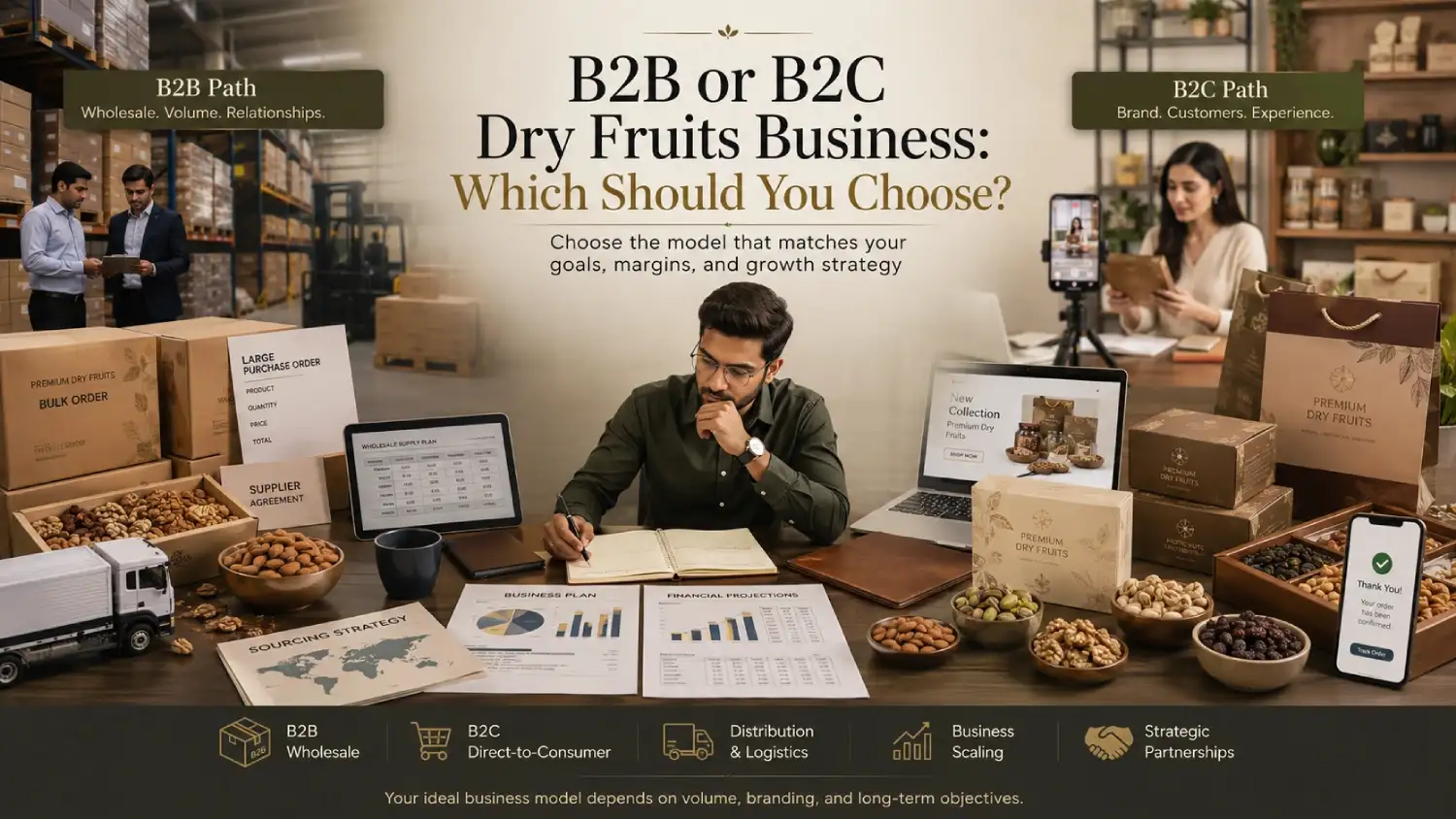
The answer is really important. It changes almost everything. A B2B dry fruits business is about selling dry fruits in large quantities to other businesses getting repeat orders and doing big deals. On the hand a B2C dry fruits business is about creating a brand making the packaging look nice giving customers a good experience and selling directly to them. Some people do both, which is called a model to make more money and be safer.
In this guide you will learn about the differences between B2B and B2C dry fruits businesses. You will compare the things and the challenges of each. You will understand how to package and market your fruits. You will see how much money you can make and figure out which way is best, for you based on how much money you have what you want your business to do and what you want to happen in the long run.
How B2B and B2C dry fruits businesses work
Both models sell the same product class, almonds, cashews, raisins, dates, dried berries, or mixes. What changes is the buyer, the order size, and the path to the sale.
Who buys in each model, and why that matters
In B2B, buyers are retailers, hotels, cafes, wholesalers, and food makers. They want steady supply, clear specs, and easy reordering. Because they buy for resale or production, they care less about flashy packs and more about grade, size, and timing.
In B2C, the buyer is a regular shopper. That person wants taste, freshness, convenience, and trust. As a result, pack size, label design, and customer service matter more.
Order size, pricing, and sales cycle differences
B2B orders are larger, and minimum order quantities are common. Per-unit pricing is lower, but total order value is high. Buyers often ask for samples, compare suppliers, and negotiate credit terms. The U.S. Chamber's guide to B2B and B2C makes the same point, business deals take longer because trust matters more. B2C sales move faster, yet each order is smaller.
The biggest pros and cons of B2B vs B2C dry fruits business
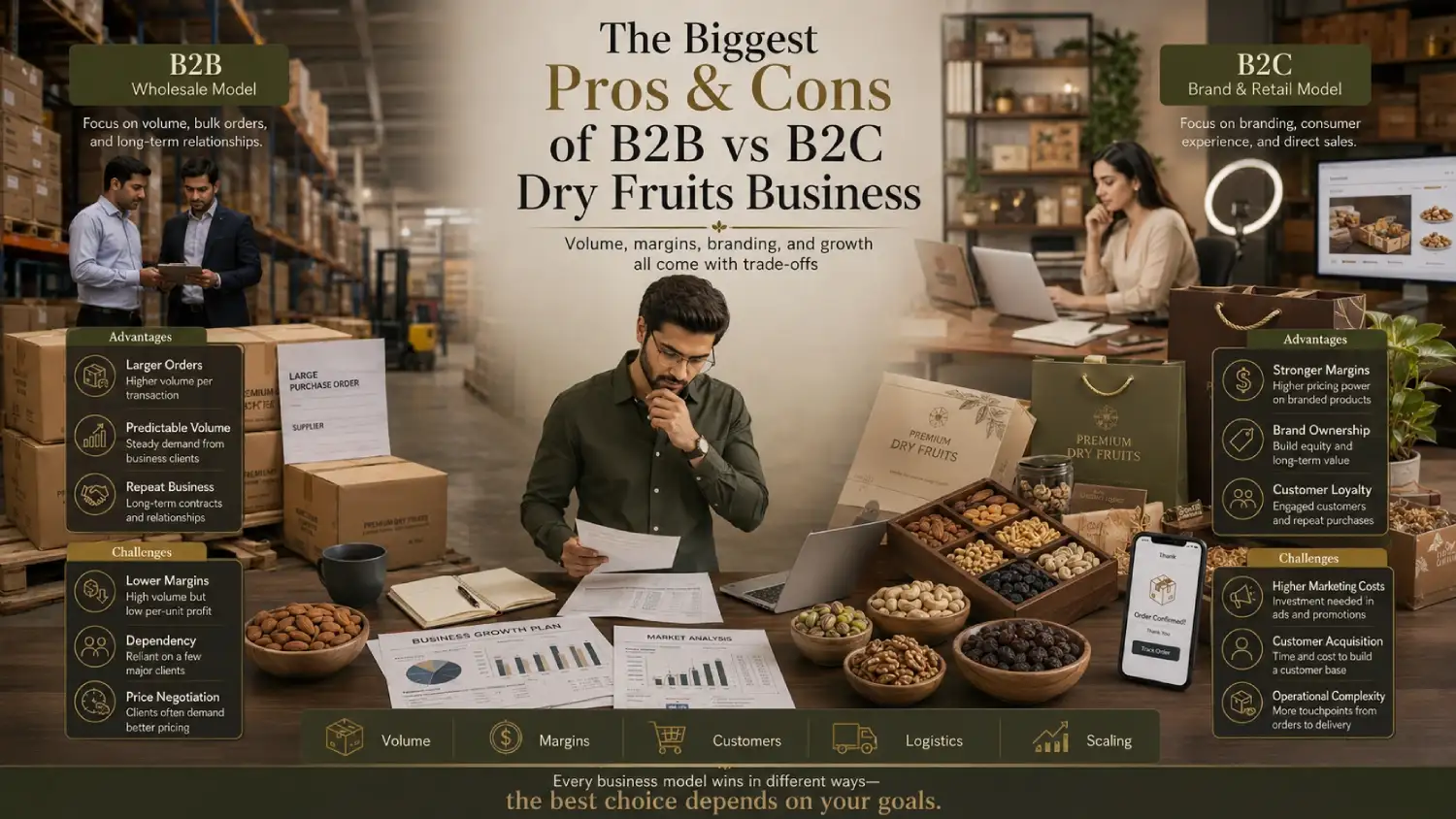
The best model is not the one with the highest sticker price. It is the one with healthier margin, steadier cash flow, and better customer retention.
Why B2B can be easier for steady volume
B2B can bring repeat orders for months, sometimes years. One wholesale account can move more stock than hundreds of retail shoppers. Marketing pressure is lower, because sales come from relationships and supply performance. The weak point is buyer concentration. If one large account leaves, revenue drops fast, and price negotiation is constant.
Why B2C can give stronger brand control
B2C lets you control packaging, story, price and customer experience. You can create a high-end product line introduce gift sets and quickly try out flavors.
However, you have to attract individual small buyers, which requires spending money. Things, like ads, content creation, product photos packaging and handling returns can cut into your profit if customers do not buy from you again.
You need to get repeat purchases to make it work. The cost of getting customers can be high.
How to choose the right dry fruits business model for your goals
Start with a plain test. Match the model to your strongest asset, not your wish list. The LinkedIn overview of B2B and B2C marketing shows why each model needs a different sales funnel and message.
- If your budget is tight, simpler bulk packs may be easier than full retail branding.
- If you can negotiate well, B2B usually gives you a better shot at stable accounts.
- If you know online selling, B2C can grow faster around a clear brand.
Choose B2B if you want volume and repeat supply
B2B fits founders with strong sourcing, bulk storage, and reliable transport. It also fits people who can handle slower sales cycles and strict buyer demands. If wholesale growth is your main goal, B2B usually makes more sense.
Choose B2C if you want brand building and higher retail margins
B2C works best when you have strong packaging, a good website, and social media skill. It is a strong fit for premium, gift, organic, unsweetened, or health-focused snack lines. If you want direct customer control, B2C is the better route.
Packaging, marketing, and operations look very different in each model
Day-to-day work often decides profit more than sales talk. A business can have good demand and still lose money through bad packing, weak storage, or poor inventory control.
What B2B buyers expect from packaging and quality
B2B buyers want large, simple, safe packs. They also ask for product specs, grading, batch consistency, and food safety records. From a buyer's side, reliable supply matters more than shelf appeal. Safe transport matters too, because broken seals, moisture, or mixed grades can cost you the account.
What B2C shoppers notice first
Retail buyers notice the pack first. They look for freshness, taste, easy-open seals, clear nutrition facts, and labels they trust. In 2026, small resealable packs, clean-label claims, and unsweetened options have strong pull because shoppers want healthy snacks they can carry anywhere.
Expert opinion and real-world facts to guide your choice
Experienced sellers track a few hard numbers before they scale. Demand stability, gross margin, customer acquisition cost, storage loss, and order repeat rate tell the truth faster than excitement does. That is why many wholesalers stay small until supply and quality are consistent.
What experienced sellers look at before scaling
If your raw material price swings a lot, B2B contracts can protect volume but squeeze margin. If your ad cost rises, B2C growth can look good while profit gets weaker. The ENEB comparison of B2B and B2C models points to the same issue, the buyer type changes the whole selling approach.
Facts that often decide the winner
In 2026, dry fruit demand is rising with healthy snacking, clean-label foods, online buying, and easy-carry packs. On the B2B side, food makers are using more dried fruit in bakery, cereal, dairy, confectionery, and ready-to-eat items. Business buyers usually want lower unit prices, traceability, and on-time delivery. Consumer buyers usually pay for convenience, taste, and brand trust.
Which Business Model Fits Your Dry Fruits Business?
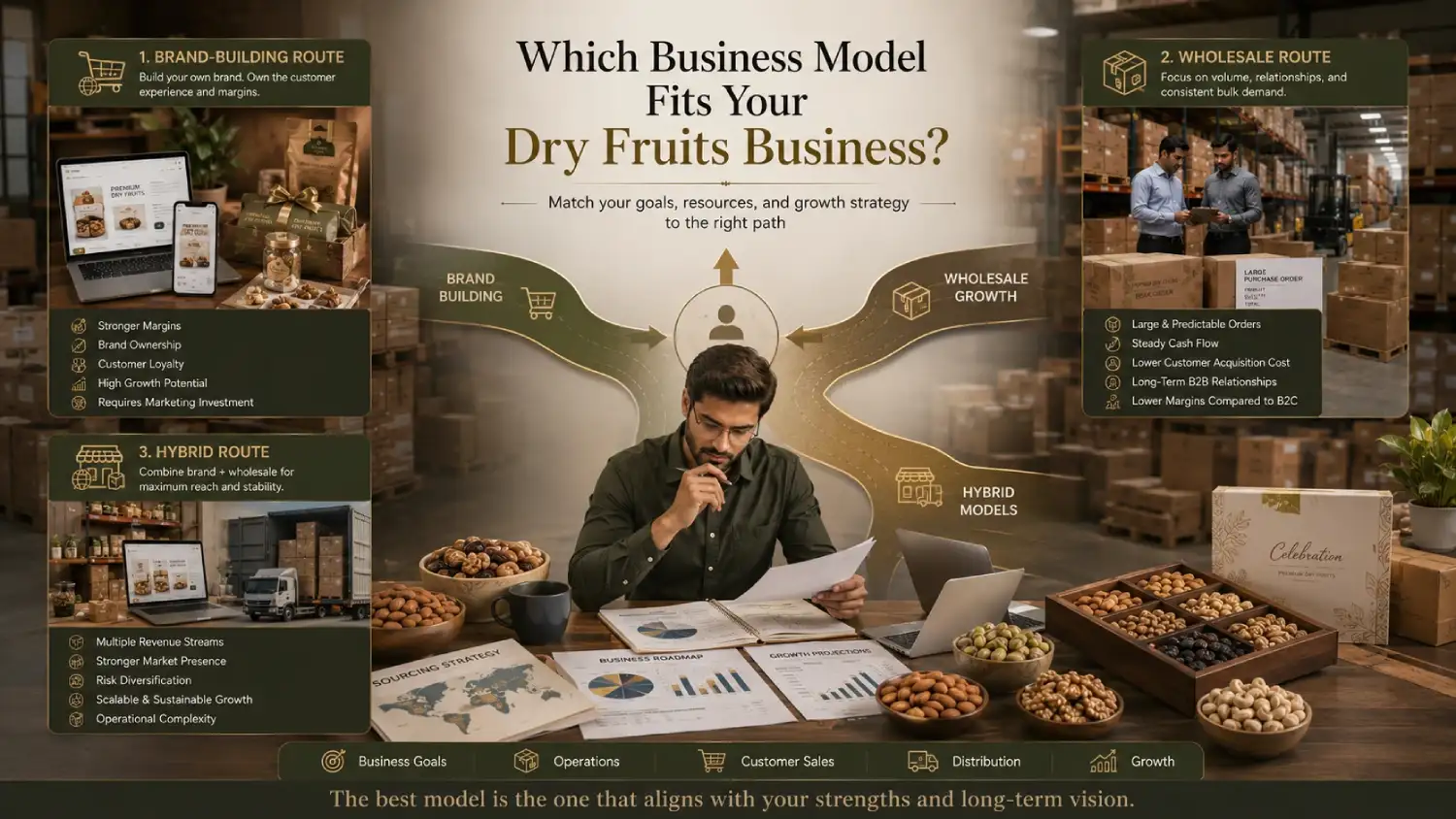
Choosing between a B2B dry fruits business and a B2C dry fruits business depends on your goals, budget, and target customers. There is no single model that works for everyone. The best choice is the one that matches your strengths and long term vision.
If you want to supply products in bulk to retailers, supermarkets, hotels, restaurants, cafes, or food manufacturers, a B2B dry fruits business is often the better option. This model focuses on wholesale dry fruits, bulk orders, consistent quality, competitive pricing, and reliable supply. Businesses that have strong sourcing networks, warehousing facilities, and logistics systems usually perform well in B2B.
If you want to build a brand that people know and buy directly from you a B2C dry fruits business could work well. This way you can make packaging create healthy snacks sell gift baskets and make customers loyal to your brand through your website or online stores. Good branding, online marketing and great customer service are key to success, in B2C.
Some business owners choose to do both wholesale and retail. For instance they might sell quantities of almonds and cashews to stores and also sell, gift boxes and healthy snack packs to customers under their own brand. This approach helps you make money from sources and not rely on just one type of customer.
Which Model Fits Different Business Types?
| Business Type | Recommended Model | Reason |
|---|---|---|
| Wholesale trader | B2B | Focuses on bulk orders and repeat business |
| Retail dry fruits brand | B2C | Builds direct customer relationships |
| Premium gifting company | B2C | Benefits from attractive packaging and branding |
| Private label startup | Hybrid | Combines wholesale supply with brand building |
| Export focused business | B2B | Requires large volume and long term contracts |
| Online dry fruits store | B2C | Sells directly through websites and marketplaces |
| Corporate gifting supplier | Hybrid | Serves both business clients and retail buyers |
Dry Fruits B2B vs B2C Profit Comparison
Many people assume that B2C is always more profitable because retail prices are higher. In reality, profitability depends on gross margin, customer acquisition cost, repeat purchases, packaging expenses, marketing spend, and operational efficiency.
| Factor | B2B Dry Fruits Business | B2C Dry Fruits Business |
|---|---|---|
| Average order size | High | Low to Medium |
| Profit per order | High because of volume | Moderate |
| Profit margin per unit | Usually lower | Usually higher |
| Marketing cost | Lower | Higher |
| Packaging cost | Lower | Higher |
| Customer acquisition | Relationship based | Advertising and branding based |
| Repeat purchase rate | Often high with contracts | Depends on customer loyalty |
| Payment cycle | May involve credit terms | Usually immediate payment |
| Return risk | Lower | Can be higher |
| Brand control | Limited | High |
| Scalability | Strong through wholesale accounts | Strong through brand growth |
If your business can manage high-volume orders and long-term relationships, B2B offers stable growth. If you excel at branding and digital marketing, B2C can generate higher margins and stronger customer loyalty.
B2B vs B2C Packaging Guide for Dry Fruits
Packaging requirements differ significantly between B2B and B2C businesses.
In a B2B dry fruits business, buyers prioritize product quality, food safety, and consistency. They often purchase bulk almonds, cashews, raisins, pistachios, and dates in larger quantities, so practical and durable packaging is more important than decorative designs. Clear labeling, moisture protection, and reliable transportation packaging help build trust with wholesale buyers.
In a B2C dry fruits business, packaging becomes part of the customer experience. Consumers notice premium designs, resealable pouches, transparent windows, nutrition labels, and attractive gift boxes. Good packaging improves shelf appeal, supports healthy snacking trends, and increases the perceived value of premium dry fruits.
Packaging Comparison
| Feature | B2B | B2C |
|---|---|---|
| Main focus | Protection and efficiency | Branding and customer experience |
| Pack size | Bulk packs | Retail packs |
| Design | Simple | Premium and attractive |
| Branding | Minimal | High importance |
| Gift ready | Rarely | Frequently |
| Customization | Basic | Extensive |
| Cost priority | Lower packaging cost | Higher presentation value |
How to Start with One Model and Expand into the Other
Many successful dry fruits businesses do not stay with one model forever. They begin with the model that matches their resources and later expand into additional sales channels.
For example, a wholesaler may start by supplying premium dry fruits to retailers and supermarkets. Once the supply chain becomes stable, the business can launch its own retail brand with customized packaging and sell directly through an eCommerce website.
Similarly, an online brand that begins as a B2C business can later introduce wholesale pricing and supply products to hotels, cafes, corporate offices, and distributors.
A hybrid strategy allows businesses to diversify income, reduce risk, and reach more customers while using the same sourcing and inventory systems.
Which Model Is Better in 2026?
In 2026, both B2B and B2C dry fruits businesses have strong growth potential because demand for healthy snacks, premium dry fruits, corporate gifting, and convenient food products continues to increase.
Choose a B2B dry fruits business if your strengths include sourcing, inventory management, logistics, and relationship building. This model works well for businesses targeting wholesalers, retailers, supermarkets, hotels, restaurants, and food manufacturers.
Choose a B2C dry fruits business if you enjoy building brands, creating premium packaging, running digital marketing campaigns, and selling directly to consumers through websites and social media.
For many entrepreneurs, the most effective strategy is a hybrid business model. By combining wholesale supply with direct-to-consumer sales, businesses can increase revenue streams, improve brand visibility, and reduce dependence on a single market segment.
The best business model is not the one that looks more profitable on paper. It is the one that matches your skills, resources, target audience, and long-term business goals while delivering consistent quality and excellent customer experiences.
Frequently Asked Questions
1. Which is better for a startup: a B2B or B2C dry fruits business?
The best choice depends on your goals and resources. A B2B dry fruits business is ideal if you want to focus on wholesale orders, retailers, hotels, and distributors. A B2C dry fruits business is better if you want to build a consumer brand, sell premium dry fruits online, and connect directly with customers. Many startups eventually adopt a hybrid model to maximize growth.
2. Is a B2B dry fruits business more profitable than a B2C dry fruits business?
Profitability depends on factors such as order volume, profit margins, customer acquisition costs, and repeat purchases. A B2B dry fruits business usually generates larger bulk orders and long-term contracts, while a B2C dry fruits business often earns higher margins through branded products, premium packaging, and direct-to-consumer sales.
3. How much investment is required to start a B2B or B2C dry fruits business?
A B2B dry fruits business typically requires more investment in inventory, warehousing, transportation, and wholesale operations. A B2C dry fruits business often requires spending on packaging, branding, website development, digital marketing, and customer service. The exact investment depends on your product range and business scale.
4. Can I sell dry fruits through both B2B and B2C channels at the same time?
Yes. Many successful businesses follow a hybrid dry fruits business model by supplying bulk products to wholesalers, retailers, hotels, and supermarkets while also selling premium dry fruits directly to consumers through eCommerce websites, marketplaces, and social media. This strategy helps diversify revenue and reduce business risk.
5. What are the best products to sell in a B2B or B2C dry fruits business?
Popular products include almonds, cashews, pistachios, walnuts, raisins, dates, figs, and mixed dry fruits. B2B buyers often prefer bulk packs for resale or manufacturing, while B2C customers usually purchase retail packs, healthy snack mixes, premium gift boxes, and festive hampers with attractive packaging.
6. How do I choose the right business model for my dry fruits startup?
Choose a B2B dry fruits business if you have strong supplier relationships, bulk sourcing capabilities, and experience in wholesale sales. Choose a B2C dry fruits business if you want to build a recognizable brand through digital marketing, premium packaging, and direct customer engagement. If you have the resources to manage both channels, a hybrid model can provide the best balance of recurring revenue, brand growth, and long-term scalability.
About the Author
Lake City Dry Fruits
Lake City Dry Fruits is a trusted name in the Indian dry fruits industry with over 60 years of experience in sourcing, packaging, and supplying premium-quality dry fruits. Since 1964, the company has served wholesalers, retailers, distributors, online sellers, and corporate gifting businesses with a strong commitment to quality, freshness, and consistency.
Lake City Dry Fruits has a lot of products like premium almonds and cashews and pistachios and walnuts and raisins and dates. They also have customized gift hampers and bulk supply solutions. This helps businesses and people find products that're good.
Lake City Dry Fruits does things too. They do labeling and custom packaging and corporate gifting services. This helps businesses grow and have long term partnerships.
Lake City Dry Fruits knows a lot about the dry fruits business. They share what they know about buying fruits in bulk and where to get them and how to package them and make a brand. They also share business ideas. This helps people who start their businesses and people who sell things in stores make good choices and do well in the dry fruits market, with Lake City Dry Fruits.
Conclusion
Choosing between a B2B and B2C dry fruits business is not about finding a universally better model. It is about selecting the model that best matches your strengths, resources, and long-term vision. A well-planned business model can improve profitability, strengthen customer relationships, and create a foundation for sustainable growth.
If your goal is to handle bulk orders, build long-term partnerships, and achieve stable sales volumes, a B2B dry fruits business can be an excellent choice. If you want to create a recognizable brand, connect directly with consumers, and earn higher margins through premium packaging and value-added products, a B2C dry fruits business may offer greater opportunities. Many successful companies eventually combine both approaches, using a hybrid strategy to expand their market reach and reduce business risk.
Before you make a decision think about your budget, how you will get products, where you will store them how you will market them and who your customers are. Don't just think about making money now. Instead focus on building a business that people can trust for a time.
A management expert named Peter Drucker said, "The best way to predict the future is to create it." In the dry fruits business the future is, for companies that always give products have supply chains that work well and change with what customers want.
You can choose to sell to businesses to people or do both. Whatever you choose you will be successful if you give products make your customers happy and build strong relationships that help you grow every year.
For more information you can contact us.
Author

LCDF Pvt. Ltd.
Lake City Dry Fruits Pvt. Ltd. has been a pioneer in the dry fruits and spices industry for over 60+ years. From humble beginnings in Udaipur to a pan-India presence, we’ve built a reputation for sourcing the best global produce, ensuring uncompromising quality at every step.