

| LCDF Pvt. Ltd.

Summary
Most dry fruits businesses do not fail because the market is small or demand is weak. They fail because of a predictable chain of operational mistakes that plays out over roughly two years. It usually starts with overinvesting in too many products too early, followed by storage failures that quietly eat into profit through spoilage. Then comes an overreliance on festive season sales, which leaves the business exposed during the slower months between April and August. By the final stretch, price wars and skipped compliance finish off what storage and cash flow problems already weakened.
To keep survival in this type of businesses for more than 2 years, you need to create a system for this better management comes into place it mostly depends on how you keep your dry fruits stock, from which supplier are you sourcing the dry fruits, have you planned the finances or not for 1-2 year as not most of the businesses got profit at early stage, see that does your business do well only in festive season, have you provide the quality that provide the justice to the price to earn customer. These are some of the pillars for the success for dry fruits business that keep them alive for a longer time.
Key Takeaways
- Nearly 80% of new dry fruits businesses in India shut down within their first 24 months, and the reasons are almost always preventable, not related to weak market demand.
- Stocking 15 to 20 products on day one spreads your investment too thin. Starting with 4 to 5 bestsellers and expanding gradually gives you a much stronger foundation.
- Poor storage is the single biggest silent killer in this business. Without proper humidity and temperature control, businesses lose 15 to 25% of their stock to spoilage every year.
- Every product has a different shelf life. Almonds last 6 to 9 months, cashews 4 to 6 months, and makhana as little as 3 to 4 months, so one storage approach does not work for everything.
- Sourcing from random middlemen offering prices far below market rate is a red flag, not a bargain. It usually means adulterated or low-quality stock that damages your reputation.
- Dry fruits are a trust-driven purchase. One bad batch reaching a customer can permanently cost you that customer and everyone they talk to, since this market runs heavily on word of mouth.
- Relying only on festive season sales creates a dangerous cash flow gap between April and August, when demand drops sharply and many businesses run out of working capital.
- Skipping FSSAI licensing and GST registration might seem harmless early on, but it can lead to fines between ₹1 lakh and ₹5 lakh and stock seizure during inspections.
- Competing purely on price against local mandis and bigger wholesalers collapses your margins to 2 to 5%, which is not enough to sustain rent, storage, and daily operations.
- Businesses that survive past two years track their numbers consistently, compete on quality and certification instead of price, and build their revenue plan around all twelve months, not just the festive rush.
Introduction
Walk through any local market and you will spot at least one dry fruits shop that opened with fresh paint, shiny jars, and a bold banner announcing its grand opening. Give it two years. Chances are, that same shop is either struggling to cover rent or has already pulled its shutters down for good. This is not bad luck. It is a pattern that repeats itself across cities, across business models, and across owners who all started with the same excitement and confidence.
How the businesses are running their business is the most important thing to understand whether your business are going to grow or not, according to the statistics around about 80% of the dry fruit businesses shut down with 24 months, because there is nothing to do with the demand for the dry fruits or whether people are eating the dry fruits or not that’s not the demand because with the growth of healthy diets and diet conscious people the demand is going to grow another factors are corporate gifting festive gifting and rising incomes in india. The market is not the problem. The way these businesses are run is.
This blog breaks down exactly how that failure unfolds, month by month, so you can see it coming before it happens to you. We will walk through the real reasons behind the shutdowns, the mistakes that repeat across almost every failed business, and most importantly, what you can do differently to make sure your business is still standing well past the two year mark.
How Many Dry Fruits Businesses Actually Fail? The Data
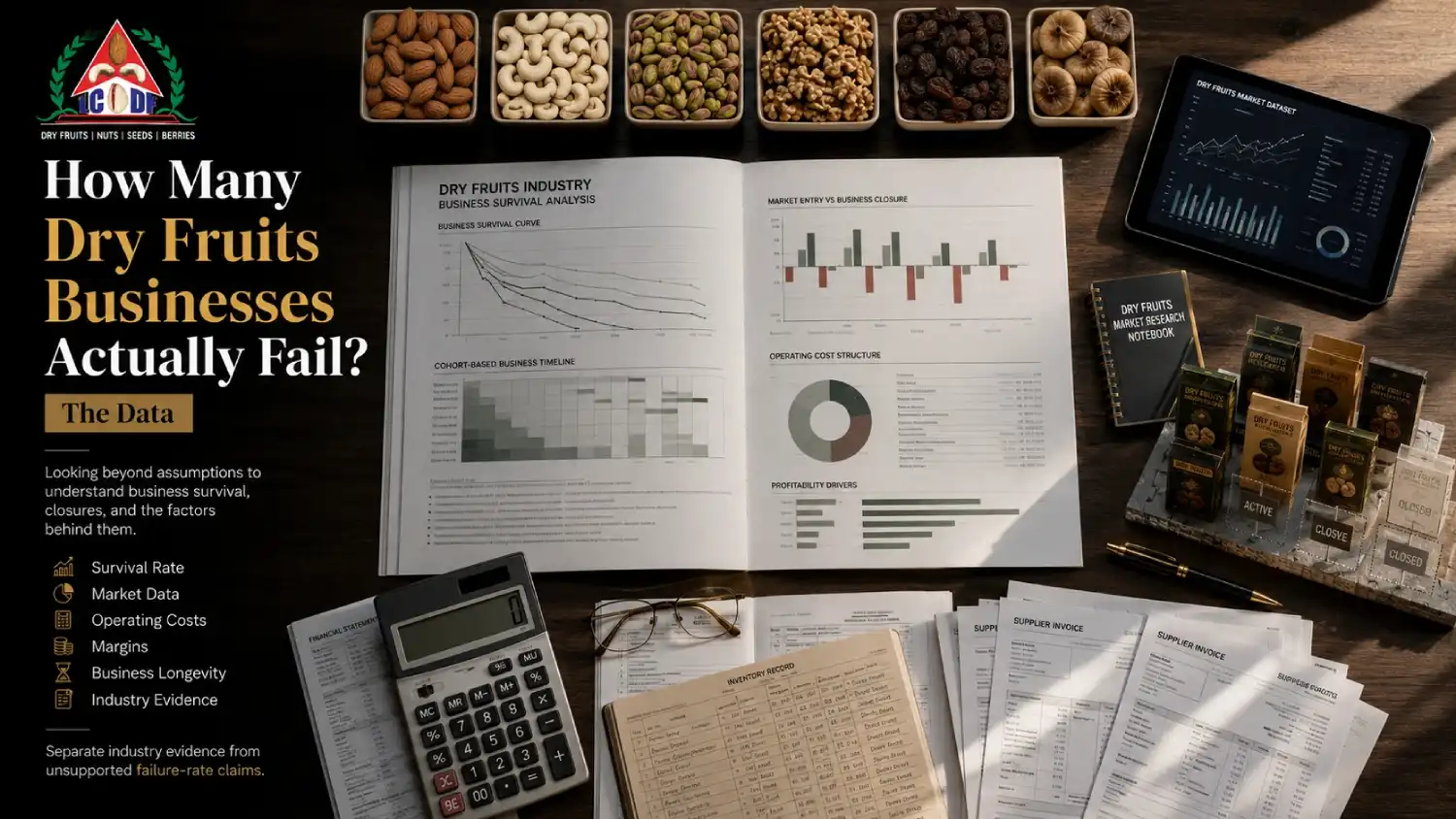
India's dry fruits and nuts market is worth over 8,500 crore rupees and growing at 8 to 12% every year. On paper, this looks like one of the safest food businesses you can start. Demand is rising, health consciousness is at an all time high, and festive gifting alone drives massive seasonal sales.
Yet the survival rate tells a different story. Most new entrants, whether they open a retail shop, start a wholesale supply business, or launch a D2C brand online, do not make it past their second year. The businesses that do survive are the ones that understood one thing early: demand is not the problem. Execution is.
The 2 Year Death Timeline: Why Most Dry Fruits Shops Don't Survive
Every failing dry fruits business goes through the same four stages. If you can recognise which stage you are in right now, you can still change the outcome.
Months 1 to 6: The Excitement Phase
Every new business owner starts here, full of energy and confidence. This is also where the first cracks appear, even if nobody notices yet.
Most beginners stock 15 to 20 different products on day one. Almonds, cashews, walnuts, makhana, dates, pistachios, seeds, everything at once. It feels like a smart move because more variety should mean more customers. In reality, it spreads your investment too thin. You end up with small quantities of everything and enough of nothing, which means your storage, your cash, and your attention are all divided from the very start.
This is also when the startup cost gets locked in. Rent deposits, shelving, initial inventory, licensing, packaging, and a website if you are going online. Most of this money goes out before a single rupee comes back in. Without a clear investment breakdown and a realistic sense of when you will actually break even, this phase quietly sets up the failure that shows up later.
Months 6 to 12: The First Stock Rot
This is where reality hits. The excitement of the first few months fades and the real problems in your supply chain and storage start showing up in your bottom line.
Dry fruits are not like packaged snacks. They are living products with a shelf life that depends heavily on moisture content and humidity control. Almonds can last 6 to 9 months if stored between 15 and 25 degrees Celsius with humidity under 60%. Cashews last only 4 to 6 months. Makhana barely holds for 3 to 4 months before it turns stale. Without proper climate controlled storage, pest control, and the right packaging, whether that is vacuum sealed or nitrogen flushed, you lose 15 to 25% of your stock to spoilage every year. That is not a small leak. That is enough to wipe out your entire profit margin.
At the same time, many new business owners are still figuring out who to trust for sourcing. Buying from random middlemen because they offer a slightly lower price seems smart in month one. By month nine, you realise you are getting inconsistent quality, batches that do not match the sample you were shown, and no real accountability when something goes wrong. Rancid oils, wrong grading, sometimes even adulteration. Once a customer bites into a stale or oily nut, they do not complain. They just never come back. And in a word of mouth driven market like dry fruits, one bad batch can quietly kill months of goodwill you worked hard to build.
Months 12 to 18: The Festival Dependency Trap
By now, your business has survived a year. This next stage is where a lot of otherwise decent businesses fall apart, and almost nobody talks about it openly.
In India there is a time where dry fruits sales at its peak every year that is the festivals time most of the business put more inventory take loans and increase the stock to meet the demand for the seasons like rakhi, diwali, and holi, so at that time the business seem to be doing very good.
Then April arrives. The gifting season is over. Weddings slow down. The heat sets in and people buy fewer dry fruits. Suddenly, the business that felt profitable in December is bleeding cash by June. This off season crunch, usually stretching from April to August, catches almost every new dry fruits business off guard because their entire revenue plan was built around 3 to 4 months of the year instead of all twelve. Working capital runs dry, and there is no cushion left to survive until the next festive cycle.
Months 18 to 24: The Shutdown
This is the final stage, and it is usually a mix of everything that came before, plus one more mistake that finishes the job.
Struggling to hold on to customers, many business owners start competing purely on price. They drop rates to match or beat the local mandi or a bigger wholesaler nearby. This might bring in a short burst of sales, but it also collapses margins down to 2 to 5%, which is simply not enough to cover rent, storage, and other running costs. At this point, even a fully operational shop with steady footfall can be technically losing money on every sale.
Add to this the businesses that never got their FSSAI license or GST registration sorted properly. Operating without proper compliance might work fine for months, until an inspection results in fines between 1 to 5 lakh rupees or a stock seizure. For a small business already struggling with cash flow, this is often the final blow.
By month 24, the shop that opened with so much energy either shuts its shutters permanently or gets sold off at a loss.
The Real Reasons Behind Every Dry Fruits Business Failure
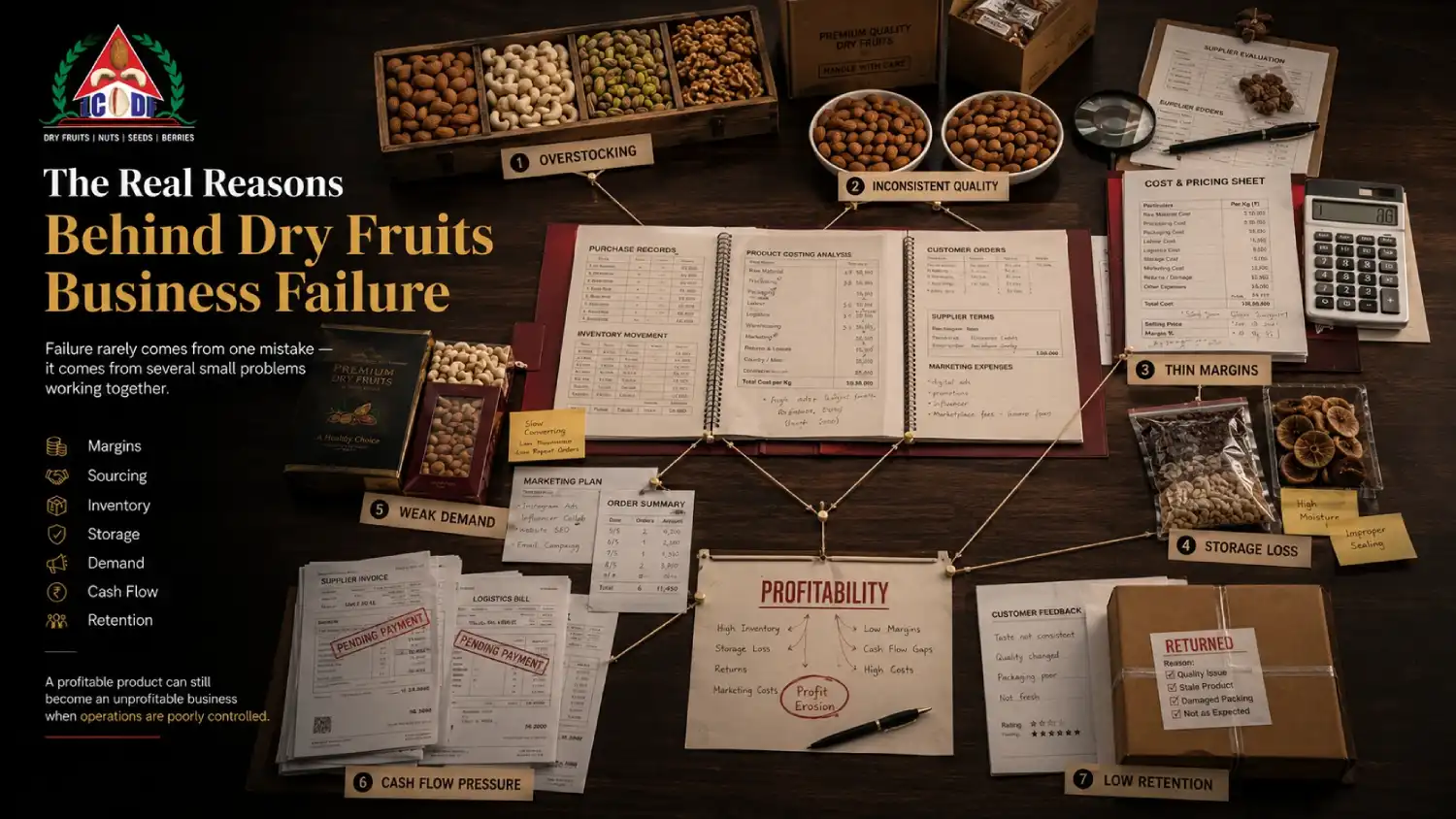
Now that you have seen how the timeline plays out, let's break down the individual causes in more detail, because each one deserves its own attention.
Storage and Spoilage: The Silent Killer
This is the single biggest reason dry fruits businesses lose money without even realising it.
Different products have completely different storage needs and shelf lives.
Almonds need a stable temperature between 15 and 25 degrees Celsius with humidity kept under 60%. Handled correctly, they can last 6 to 9 months. Cashews are more delicate and hold their quality for only 4 to 6 months. Makhana is the most sensitive of all, losing its crunch and flavour within 3 to 4 months if not sealed properly. Dates and raisins can last longer, but they attract moisture quickly if the packaging is not airtight, leading to fermentation and spoilage.
Poor storage is not just about temperature and humidity. It also includes pest control, keeping products off the floor on proper shelving, and testing for aflatoxin levels, which is a serious health hazard when nuts are stored in humid conditions. Businesses that skip investing in basic climate control equipment end up losing a fifth of their stock every single year, and that loss goes straight against their profit.
Sourcing From the Wrong Suppliers
Where you buy from decides how long your business survives. Direct sourcing from farmers is cheaper but comes with large minimum order quantities and inconsistent quality. Wholesale consolidators offer a middle ground with more consistent quality and flexible order sizes. The riskiest option is buying from random middlemen who offer prices 30 to 40% below market rate. That kind of discount almost always means the product has been adulterated, mixed with lower grade stock, or is close to its expiry.
Vetting a supplier properly means checking their FSSAI certificate, visiting their storage facility, and testing samples before committing to a bulk order. Businesses that skip this step to save a little time or money end up paying for it later in returns, refunds, and a damaged reputation.
Zero Brand Trust: One Bad Batch, Gone Forever
This is a mistake almost nobody talks about, but it might be the most damaging one. Dry fruits are a trust based purchase. Customers cannot always tell the quality just by looking at a photo online or a jar on a shelf. They rely on the brand's word.
The moment a customer receives a batch that looks polished, tastes stale, or feels smaller than what was promised, they do not just skip their next order. They tell their friends and family too.
In a market that runs heavily on word of mouth and repeat customers, this kind of trust, once broken, almost never comes back. Businesses that treat quality control as optional are quietly signing their own shutdown notice.
Ignoring FSSAI, GST, and Compliance
Getting an FSSAI license and GST registration might feel like paperwork you can delay while you focus on sales. This is a costly mistake. Dry fruits fall under a specific FSSAI category, and operating without the right license, or without proper labeling that includes manufacturing date, best before date, and net quantity, can invite fines between 1 to 5 lakh rupees along with stock seizure during an inspection. Businesses that treat compliance as an afterthought are gambling with their entire inventory.
No Financial Systems, Flying Blind
Many small business owners run their dry fruits shop purely on instinct, without tracking their actual profit and loss. They know sales feel good during the festive season, but they have no clear picture of their real gross margin after accounting for spoilage, discounts, and operating costs. Without basic financial tracking, whether that is a simple spreadsheet or accounting software, it becomes impossible to know your actual burn rate or when you will genuinely break even. By the time the owner realises the business is losing money, the damage is already too deep to reverse.
Competing Only on Price
When sales slow down, the easiest reaction is to drop prices. It feels like the fastest way to bring customers back. But dry fruits is not a business where you can win on price alone. Bigger wholesalers and local mandis can always go lower because they operate at a scale small businesses cannot match. Competing purely on price drags your margins down to 2 to 5%, and at that level, one bad month can wipe out your entire profit for the quarter.
Local Mandi and Kirana Competition
New online and premium dry fruits brands often underestimate their local competition. As the new brands are directly compete with price but they should focus on more providing the quality, premium packaging and freshness of dry fruits, they should show they passed the quality tests just more importantly they should focus more on increasing the trust of the consumer as they have the direct competition to the ones that are sitting on mandis and kirana they have the trust of peoples for decades, so to compete with them they should provide those things which the kirana’s and mand’s sellers are not providing.
Local Mandi vs Online D2C vs Premium Brand: Who Actually Survives
Each business model carries its own risks and its own path to survival.
Local mandi and kirana sellers survive on low overheads and long standing local trust, but they rarely build a real brand and stay vulnerable to price wars with each other.
Online D2C brands can charge premium prices and build a loyal customer base through content and storytelling, but they carry higher marketing costs and need consistent quality control since customers cannot physically check the product before buying.
Premium branded businesses, the ones investing in FSSAI certification, proper packaging, and a clear positioning around health or purity, tend to survive the longest because they are not competing on price. Customers pay for the trust and consistency, not just the product.
The businesses that survive the past two years, regardless of which model they choose, all share one thing in common. They picked a lane and built systems around it instead of trying to be everything to everyone.
Insider Storage and Sourcing Tips From Inside the Industry
Since we work directly within the dry fruits industry, here are a few things that rarely make it into generic business guides.
Always test a new supplier's batch for moisture content before committing to a bulk order, not after. A simple hygrometer reading can save you from months of slow spoilage you might not notice until it is too late.
Keep different products in separate storage zones. Almonds, cashews, and seeds all release natural oils that can transfer smell and moisture between products if stored together, even in the same climate controlled room.
Build a supplier scorecard from day one. Track delivery timing, quality consistency, and pricing for every supplier you work with. This becomes invaluable once you start scaling, because you will already know exactly who to trust with a larger order.
Rotate your stock using a first in, first out system religiously. It sounds basic, but a huge number of businesses lose money simply because older stock sits at the back of the shelf while newer stock gets sold first.
How to Build a Dry Fruits Business That Survives Past Year 2
Understanding why businesses fail is only half the job. Here is how to make sure you are not one of them.
Start with 4 to 5 bestsellers instead of 15 to 20 products. Expand your range only after you cross a stable revenue milestone, not before.
Invest in proper climate controlled storage early, even if it means starting smaller. The money you save on storage will be lost many times over in spoilage.
Build your revenue plan around all twelve months, not just the festive season. Set aside a portion of your festive season profits specifically to cover the slower months between April and August.
Get your FSSAI license and GST registration sorted before your first sale, not after your first inspection notice.
Track your numbers weekly. Know your actual profit margin after spoilage and discounts, not just your gross sales figure.
Compete on quality, certification, and consistency rather than price. A slightly higher price with guaranteed freshness and trust will always outlast a race to the bottom.
Invest time in local SEO, a proper Google Business listing, and consistent content on Instagram and WhatsApp Business. Most repeat revenue in this business comes from trust built over time, not one time ads.
The 5 Point Survival Self-Audit
Ask yourself these five questions honestly.
Are you stocking more products than you can properly store and sell within their shelf life?
Do you know the exact moisture and humidity conditions your storage space maintains right now?
Have you vetted your current suppliers with an FSSAI certificate check and a sample test, or are you buying purely on price?
Does your revenue plan account for the slow months between April and August, or does it rely entirely on the festive season?
Are you tracking your actual profit margin every month, or are you estimating based on how busy the shop feels?
If you answered no to two or more of these, your business is likely somewhere in that 2 year death timeline right now. The good news is, every stage of that timeline can still be reversed if you catch it early enough.
Frequently Asked Questions
Why do dry fruits businesses fail?
Most dry fruits businesses fail due to a combination of poor storage leading to spoilage, sourcing from unreliable suppliers, overdependence on festive season sales, competing purely on price, and skipping proper FSSAI and GST compliance.
What percentage of dry fruits businesses fail?
Close to 80% of new dry fruits businesses in India fail within their first 24 months, largely due to preventable operational mistakes rather than lack of market demand.
Is the dry fruits business profitable in India?
Yes, the dry fruits business can be highly profitable, with gross margins ranging from 15% for wholesale to 30 to 40% for premium D2C brands. Profitability depends heavily on proper storage, supplier quality, and avoiding price wars.
How much investment is needed for a dry fruits business?
A small retail shop typically requires 5 to 15 lakh rupees, covering rent, initial inventory, licensing, storage equipment, and basic marketing. Wholesale and distribution businesses require higher investment due to larger storage and inventory needs.
How to prevent dry fruits spoilage in storage?
Maintain storage temperature between 15 and 25 degrees Celsius with humidity below 60%, use proper shelving at least 45 cm above the floor, invest in vacuum sealed or nitrogen flushed packaging, and follow a strict first in, first out inventory rotation.
What are common mistakes in the dry fruits business?
The most common mistakes include stocking too many products too early, ignoring proper storage conditions, sourcing from unverified suppliers, depending entirely on festive season sales, and competing on price instead of quality and trust.
What causes small food businesses to shut down?
Small food businesses typically shut down due to cash flow problems, inconsistent product quality damaging customer trust, poor financial tracking, and an inability to survive slow sales periods without proper working capital planning.
Is it better to start a dry fruits business alone or with a partner?
Starting with a trusted partner can help spread the workload, especially since this business demands attention across sourcing, storage, sales, and compliance all at once. That said, partnerships only work well when responsibilities are divided clearly from day one, whether that is one person handling suppliers and storage while the other focuses on sales and marketing. Going solo is completely possible too, as long as you build simple systems early instead of trying to manage everything from memory.
What is the biggest difference between a dry fruits business that survives and one that fails?
The businesses that survive treat every part of the operation, storage, sourcing, pricing, and compliance, as something to actively manage rather than something to figure out later. The ones that fail usually run on instinct and festive season momentum, only realising too late that spoilage, unpaid dues, or a compliance gap has quietly built up. Survival almost always comes down to consistency in the boring, day to day details rather than one big lucky break.
Should a new dry fruits business focus on retail customers or bulk B2B orders first?
Most new businesses find it easier to build steady cash flow through B2B orders to local retailers, restaurants, and offices before scaling up retail or online sales. B2B relationships tend to bring repeat, predictable orders once trust is established, which helps smooth out the seasonal ups and downs that retail alone cannot manage. A good approach is starting with a mix of both, using B2B for stability while slowly building a retail or online customer base for higher margins over time.
About the Author
This blog is brought to you by the team at Lake City Dry Fruits, a name trusted across India since 1964 for premium quality almonds, cashews, walnuts, makhana, dates, and more. We are not outside observers writing about an industry we read about online. We live inside this business every single day, sourcing directly from trusted growers, running our own HACCP and ISO certified processing facility in Ahmedabad, and working closely with retailers, distributors, and customers who expect nothing less than the best.
Over the decades, we have seen firsthand what separates a dry fruits business that thrives from one that quietly shuts down within a couple of years. We have watched suppliers get vetted the hard way, storage mistakes turn into real losses, and festive season highs mask problems that show up months later. That experience is exactly what shaped this blog. Every insight here comes from real practice, not just theory.
At Lake City Dry Fruits, our goal has always been simple. Bring people dry fruits they can trust, sourced the right way and stored the right way, every single time. We share what we know because we believe a stronger, more informed dry fruits industry in India benefits everyone, from the small shop owner just starting out to the customer opening a fresh pack at home.
Conclusion
Every dry fruits business that shuts down within two years follows a version of the same story. It starts with too much excitement and too little planning, moves through storage losses nobody tracked properly, gets pulled apart by a festive season that could not carry the whole year, and finally collapses under a price war it never needed to fight. None of this happens because the demand for almonds, cashews, or makhana suddenly disappeared. It happens because the business was never built to survive the slow months, the wrong supplier, or the one bad batch that quietly cost it a loyal customer.
The good news is that every single stage of this timeline can be avoided. Stocking fewer products and managing them well, investing in proper storage from day one, choosing suppliers you have actually vetted, planning your finances across all twelve months, and staying compliant with FSSAI and GST from the start are not complicated fixes. They are simple habits that most failing businesses just never got around to building.
If you are currently running a dry fruits business, or planning to start one, treat this less like a warning and more like a checklist. Go back to the five point self-audit, be honest about where you stand, and fix whatever needs fixing before the next stage of the timeline catches up with you. The businesses that last are not the ones that got lucky. They are the ones that paid attention early and built systems around the things that actually matter. That is the real difference between a shop that survives past year two and one that becomes just another closed shutter in the market.
Author

LCDF Pvt. Ltd.
Lake City Dry Fruits Pvt. Ltd. has been a pioneer in the dry fruits and spices industry for over 60+ years. From humble beginnings in Udaipur to a pan-India presence, we’ve built a reputation for sourcing the best global produce, ensuring uncompromising quality at every step.