

| LCDF Pvt. Ltd.
Summary
This blog explains how moisture affects dry fruits, going far beyond basic storage advice. It breaks down the real science using water activity versus moisture content, gives a complete moisture danger table for eight major dry fruits, and covers what actually happens when moisture increases including mold, aflatoxin risk, rancidity in nuts, and fermentation in sugar rich fruits like raisins and dates. It also separates the spoilage story into two clear tracks, oil based nuts versus sugar based dried fruits, adds an India specific monsoon and city wise humidity section, gives readers a simple do it yourself moisture test they can use at home, and positions Lake City Dry Fruits as the authority behind the science by tying it back to the brand's 60 plus years of processing expertise, certifications, and factory scale. The piece closes with ten FAQs targeting real search queries, and a conclusion that reinforces trust in the LCDF brand.
Introduction
It is seen that the time for dry fruits to last longer are for months because of the drying process they have been going through. Yet almost every household has opened a pack of almonds or raisins only to find them soft, sticky, or covered in a strange white film. The reason behind this is almost always the same. Moisture has quietly entered the picture.
At Lake City Dry Fruits Pvt. Ltd, we have 60+ years of experience, we know everything about sourcing, processing and packaging of dry fruits. We have found that the single biggest enemy for dry fruit quality. It does not see that because it works invisibly and when you notice it it's been late as the damage is already done. In this blog we have provided you the information on exactly how moisture affects dry fruits, what happens inside the fruit when moisture creeps in, and how you can protect your almonds, cashews, raisins, and other favourites from going bad before their time.
Key Takeaways
- Moisture is the single biggest cause of dry fruit spoilage, ahead of both heat and time.
- Water activity, not moisture percentage alone, is the more reliable indicator of real spoilage risk.
- Every dry fruit has its own safe moisture threshold, and crossing it sharply increases the chance of damage.
- High moisture does not just cause mold, it can also trigger the formation of aflatoxins, which pose genuine health risks.
- Nuts spoil mainly through oil based rancidity, while sugar rich dried fruits spoil mainly through fermentation and mold.
- India's climate, especially during monsoon, makes moisture control more urgent than in drier regions of the world.
- Simple home tests like the squeeze test, tear test, and smell test can catch moisture damage early.
- Airtight containers combined with cool, dry storage remain the most effective everyday defence against moisture.
- Professional processing and certified packaging, like the standards followed at Lake City Dry Fruits, significantly reduce moisture risk before the product ever reaches your home.
- When texture, smell, or appearance seem off, it is always safer to discard the batch than to take a chance.
How Moisture Affects Dry Fruits: The Science Behind Spoilage, Mold, and Shelf Life
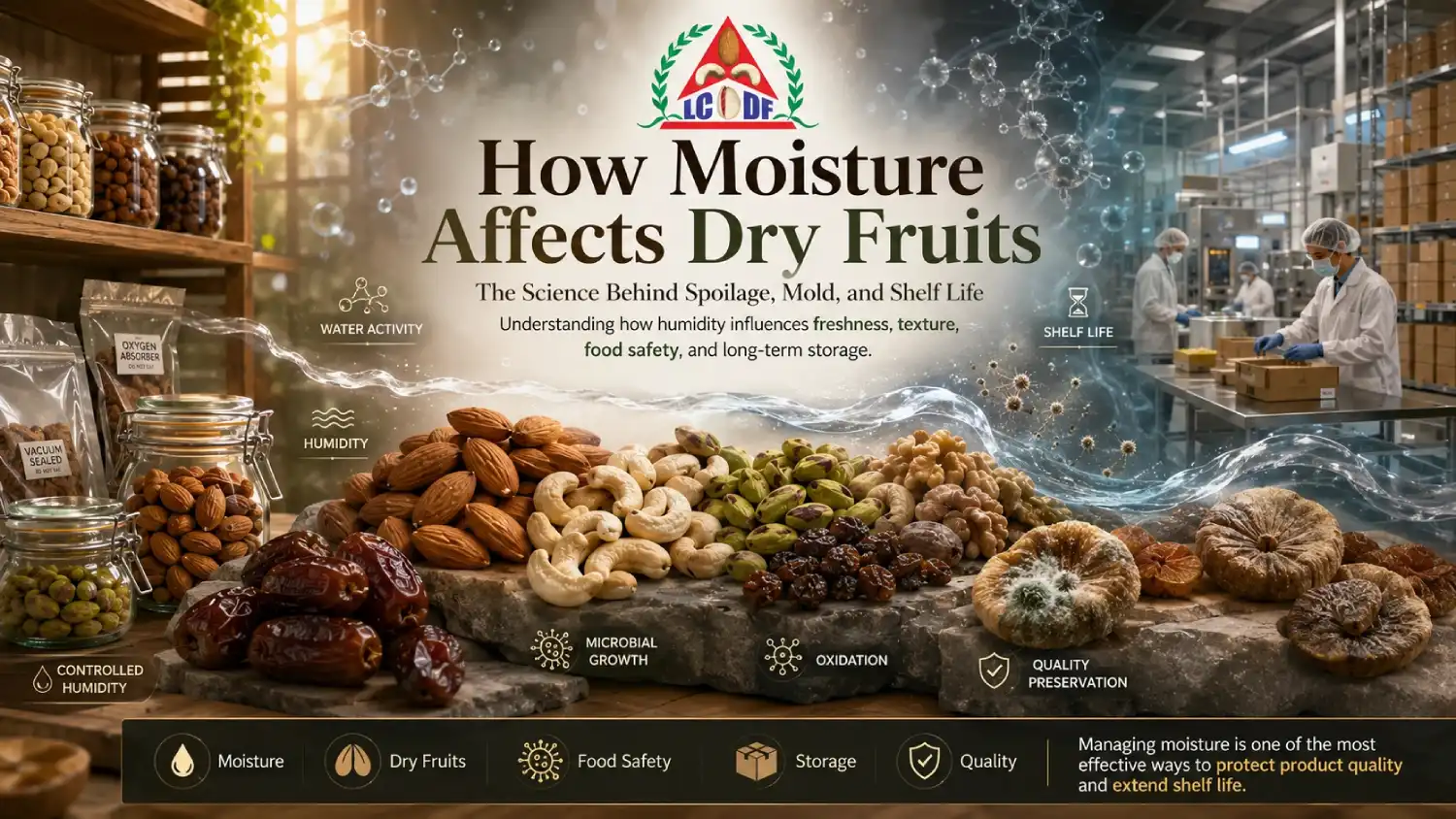
Dry fruits are supposed to last for months. That is the whole point of drying them. Yet almost every household has opened a pack of almonds or raisins only to find them soft, sticky, or covered in a strange white film. The reason behind this is almost always the same. Moisture has quietly entered the picture.
At Lake City Dry Fruits Pvt. Ltd, we have been sourcing, processing, and packaging dry fruits for over 60 years. In that time, we have learned that moisture is the single biggest threat to dry fruit quality. It is invisible, it works slowly, and by the time you notice it, the damage is already done. This blog breaks down exactly how moisture affects dry fruits, what happens inside the fruit when moisture creeps in, and how you can protect your almonds, cashews, raisins, and other favourites from going bad before their time.
Why Moisture Is the Real Enemy of Dry Fruits
When fresh fruits and nuts are dried, most of their natural water content is removed. This is what makes them shelf stable. Bacteria, yeast, and mold need water to survive and multiply, so removing that water is nature's own preservation method.
Now we need to know how the moisture finds a way to get back in. Some of the reasons for this are humid air, damp storage containers, condensation, or simply leaving the packet for a longer time. Dry fruits have a nature like a sponge that pulls moisture out of the surrounding air. The more sugar or oil a dry fruit contains, the faster it absorbs the moisture.
There are two things: moisture content and water activity. Most people think like they are the same things but they are not. It is closely related but not the same thing. Moisture content is that how much percentage of water is present in the dry fruit, and the water activity is like it shows you how much of the water is actually available for the microbes to use.
Think of it like this. A spoonful of honey and a spoonful of watery fruit pulp might contain a similar percentage of water. But the honey is so sugar dense that its water is locked up and unavailable to bacteria, while the fruit pulp's water is free and ready to feed mold. That is the difference between moisture content and water activity, and it is why food scientists consider water activity the more reliable indicator of spoilage risk. Research on nut storage has shown that mold and yeast growth becomes visible once water activity crosses roughly 0.65 to 0.75, and by the time it consistently sits below 0.53, most dry fruits and nuts stay stable for the long term.
The Moisture Danger Table
| Dry Fruit | Ideal Moisture Level | Danger Threshold | What Happens Above the Threshold |
|---|---|---|---|
| Almonds | Below 6 percent | Above 8 percent | Studies published in the Journal of Food Science found that spoilage risk in almonds increases sharply once moisture crosses 8 percent. |
| Cashews | 5 to 7 percent | Above 8 percent | Softening, mold growth, and rancid smell develop quickly. |
| Pistachios | 5 to 7 percent | Above 8 percent | Highly prone to mold and considered one of the more aflatoxin-sensitive nuts. |
| Walnuts | 4 to 6 percent | Above 8 percent | High oil content means moisture speeds up rancidity alongside mold risk. |
| Raisins | 15 to 18 percent | Above 20 percent | Fermentation begins, sugars convert to alcohol, and texture turns sticky. |
| Dates | 20 to 26 percent | Above 30 percent | Naturally higher moisture but excess humidity still triggers mold on the skin. |
| Dried Figs | 18 to 24 percent | Above 30 percent | Considered one of the most vulnerable dried fruits to mold and mycotoxin formation. |
| Dried Apricots | 15 to 20 percent | Above 24 percent | Becomes sticky, develops sour smell, and attracts fermentation. |
Every dry fruit has its own safe moisture range. Once that range is crossed, the risk of spoilage rises sharply. As simple as that according to this table, some of the dry fruits like dried figs and dates carry more moisture than nuts, but that does not mean they are safer. In fact, according to many researches, food safety researchers have selected figs as one of the more aflatoxin prone dried fruits because of their huge moisture content creates a friendly environment for mold when storage conditions disturbs.
What Happens When Moisture Increases

Mold and Fungal Growth
This is the most visible and most common effect of moisture damage. Once water activity rises past a certain point, fungal spores that are naturally present in the air or on the surface of the fruit begin to germinate. You will usually notice this as white, green, or black fuzzy patches, sometimes accompanied by a musty smell. Common mold genera found on nuts and dried fruits include Aspergillus, Penicillium, and Rhizopus.
Aflatoxin Risk
Aflatoxin risk are known to be as the toxic producing risk in dry fruits and this is the risk that most people new heard about, Certain molds, particularly Aspergillus flavus, they don't just change the taste and appearance of the dry fruits but also create the toxic compounds.
Aflatoxins are recognised by health authorities including the World Health Organization as a serious health concern, since long term exposure has been linked to liver damage. Regulatory bodies around the world take this seriously. The European Union permits a maximum of around 4 to 10 parts per billion of total aflatoxins in nuts depending on the type, and similar limits apply in other markets. Research from South Asia has repeatedly found that pistachios, walnuts, peanuts, and dates carry a higher risk of aflatoxin contamination when storage conditions are poor, particularly when moisture and warm temperatures combine.
This is exactly why moisture control is not just about taste and texture. It is a genuine food safety issue, and it is a big part of why we take drying and packaging so seriously at every stage of our process.
Rancidity in Nuts
Nuts like walnuts, cashews, and pistachios are naturally high in oil. When moisture enters the picture, it speeds up the chemical breakdown of these oils, a process called oxidation. This is what gives spoiled nuts that sharp, paint like or crayon like smell. Unlike mold, rancidity does not always come with a visible sign, which makes it easy to miss until you actually taste the nut.
Fermentation in Sugar Rich Dried Fruits
Raisins, dates, and figs work differently from nuts because they rely on sugar rather than oil. When these fruits absorb excess moisture, the natural sugars inside them start to ferment, essentially turning into alcohol through the action of naturally occurring yeasts. This is why over moist raisins sometimes smell faintly like alcohol and develop a gritty, crystallised texture as sugar and water separate unevenly.
Texture and Taste Degradation
Even before mold or fermentation becomes obvious, moisture quietly changes how dry fruits feel and taste. Almonds and cashews lose their crunch and turn chewy or rubbery. Raisins and dates can become unpleasantly sticky and clump together. Once texture changes this way, it is a strong early warning sign that moisture has already been absorbed.
Nuts vs Dried Fruits: Two Different Spoilage Stories
It helps to remember that nuts and dried fruits do not spoil in the same way, even though moisture is the trigger for both.
Nuts are oil based. Their biggest enemy is rancidity, a chemical oxidation process that moisture accelerates. Think walnuts, cashews, pistachios, and almonds.
Dried fruits are sugar based. Their biggest enemy is fermentation and mold, both driven by moisture feeding natural yeasts and fungal spores. Think raisins, dates, figs, and apricots.
Understanding this distinction changes how you store each category. Oily nuts benefit hugely from refrigeration because cold slows down oxidation. Sugar rich dried fruits benefit most from strict humidity control because their biggest risk is moisture absorption rather than oil breakdown.
Moisture Risk Across India: A Season by Season Reality
India's climate makes moisture control far more urgent than in drier parts of the world. A typical Indian kitchen can see temperatures between 28 and 38 degrees Celsius for most of the year, and that alone creates favourable conditions for spoilage once moisture is added to the mix.
Some cities have a humidity level at 70 percent for several months like the coastal region such as Mumbai and Chennai mostly throughout the monsoon season between June and September. Delhi has a different seasonal swings, there will be very dry in winter season, with high humidity in monsoon which actually creates a different but equally tricky challenge, since heated indoor spaces during winter can dry out packaging seals and let moisture sneak in through tiny gaps.
Kolkata, sitting close to the coast, deals with consistently high humidity for a large part of the year.
This is precisely why our approach at Lake City Dry Fruits accounts for regional conditions across our hubs in Udaipur, Pune, Delhi, and Mumbai. What works for storage in a dry city like Udaipur simply does not translate to a humid city like Mumbai, and treating India as one uniform climate zone is one of the biggest mistakes in dry fruit storage advice.
How to Test Moisture in Dry Fruits at Home
You do not need a laboratory to get a rough sense of whether your dry fruits have picked up excess moisture. Try these simple checks.
Step one, the squeeze test. Gently squeeze a piece of dried fruit like an apricot or a fig. If moisture visibly seeps out or the fruit feels unusually soft and spongy, it has likely absorbed excess humidity.
Step two, the tear test. Tear a piece in half and look at the centre. If the middle looks wet, glassy, or noticeably different from the outer surface, moisture has penetrated deeper than it should.
Step three, the smell test. Fresh nuts smell mild and slightly sweet, almost like marzipan for almonds or cream for cashews. A sour, musty, or paint like smell is a clear red flag.
Step four, the silica gel trick. If you want to actively protect a batch you already have, drop a food grade silica gel packet into the storage container. If the packet changes colour faster than expected, it confirms that moisture levels in the container are higher than ideal.
Step five, the visual check. Look closely for any powdery residue, tiny webbing, or discoloured spots, especially near the edges of dates and figs. These are early warning signs of both moisture damage and pest activity.
If any of these tests raise a red flag, it is safer to discard that batch rather than risk consuming it.
How Lake City Dry Fruits Controls Moisture at Every Stage
Moisture control is not something we leave to chance. Over six decades, we have built a process that treats moisture as a risk to be actively managed rather than something to deal with after the fact.
Our facility in Ahmedabad, Gujarat spans 100,000 square feet and processes up to 9,000 kilograms of dry fruits every single day using a mix of semi-automated technology and skilled manual checks. Moisture levels are monitored closely during drying, sorting, and packaging, since even a small deviation at this stage can affect the final shelf life of the product. Our packaging is designed specifically to act as a barrier against humidity during transit and storage, which matters even more given how far some of our products travel, sourced from origins including the USA, Australia, Afghanistan, and Iran.
We are certified under HACCP, ISO, and FSSAI standards, which means our processes are independently verified against strict food safety benchmarks, including moisture and contamination control. This is the same standard of care we bring to both our B2B partners and our 20-20 Dry Fruits consumer brand.
Quick Storage Tips to Prevent Moisture Damage
Once dry fruits reach your home, a few simple habits go a long way in protecting them.
Always store dry fruits in airtight containers rather than the thin plastic bags they sometimes come in. Keep containers in a cool, dry place away from direct sunlight and heat sources like the stove or a sunny windowsill. During the monsoon months, move oily nuts like walnuts and cashews to the refrigerator, since cold slows down both moisture absorption and oxidation.
Never use wet hands or a damp spoon to scoop out dry fruits, since even a small amount of moisture transferred this way can start the spoilage process. If you buy in bulk, divide your stock into smaller airtight containers so that only one batch is exposed to air at a time.
Frequently Asked Questions
Is it safe to eat dry fruits with visible moisture?
No. If dry fruits feel unusually soft, sticky, or show any sign of dampness beyond their natural texture, it is best to avoid eating them. Visible moisture often means mold growth has already begun even if you cannot see it yet.
Why does fungus grow on dry fruits?
Fungus grows on dry fruits when moisture levels rise high enough to reactivate mold spores that are naturally present in the environment. Warm temperatures combined with humidity create the perfect breeding ground for this fungal growth.
What is the ideal moisture percentage for dry fruits?
It varies by type. Most nuts like almonds, cashews, and walnuts should stay below 6 to 8 percent moisture, while naturally moister fruits like dates and figs have a higher safe range, typically between 15 and 26 percent depending on the fruit.
Can moisture in dry fruits cause health issues?
Yes. Beyond ordinary spoilage, excess moisture can encourage the growth of Aspergillus flavus, a mold that produces aflatoxins. Long term exposure to aflatoxins has been linked to liver health concerns, which is why food safety regulators set strict limits on aflatoxin levels in nuts and dried fruits.
How do I know if my dry fruits have absorbed moisture?
Look for softness in normally firm nuts, stickiness or clumping in raisins and dates, a musty or sour smell, and any visible white or coloured spots. A simple squeeze or tear test at home can also reveal internal dampness.
Does refrigeration increase or decrease moisture risk in dry fruits?
Refrigeration decreases moisture related risk as long as dry fruits are stored in a properly sealed airtight container. Without an airtight seal, refrigerated dry fruits can actually absorb moisture and odours from the fridge environment.
What is water activity and why does it matter more than moisture percentage?
Water activity measures how much of the water inside a food is actually available for microbes to use, rather than just how much water is present overall. Two foods can have similar moisture percentages but very different water activity levels, which is why water activity is considered a more accurate predictor of spoilage risk by food scientists.
Which dry fruits are most vulnerable to moisture damage?
Figs, dates, raisins, and pistachios tend to be among the most vulnerable due to either their naturally higher moisture content or their sensitivity to mold and aflatoxin formation. Oily nuts like walnuts are especially vulnerable to rancidity once moisture is introduced.
Can moisture damaged dry fruits be saved or dried out again?
In some cases, dry fruits that have only slightly softened due to low humidity exposure can be re-dried in a low temperature oven. However, if there is any visible mold, sour smell, or fermentation, the batch should be discarded rather than reused, since toxins produced by mold are not eliminated by drying or cooking.
How does the monsoon season in India specifically affect dry fruit storage?
Monsoon season brings sustained humidity levels above 65 to 70 percent across much of India, which is well past the threshold where most dry fruits start absorbing moisture from the air. This significantly raises the risk of mold, fermentation, and pest activity, making airtight storage and refrigeration far more important during these months than during drier seasons.
Conclusion
Moisture works quietly, but its effects on dry fruits are anything but small. What starts as a slightly soft almond or a faintly musty smelling raisin can, under the wrong conditions, turn into a genuine food safety concern. Understanding the science behind moisture, from water activity to aflatoxin risk, gives you the tools to catch problems early and store your dry fruits the right way, especially in a climate as humid and varied as India's.
At Lake City Dry Fruits, moisture control has never been an afterthought. It is built into every stage of our process, from sourcing and drying to packaging and storage, backed by over 60 years of experience and certifications including HACCP, ISO, and FSSAI. When you choose dry fruits that have been handled with this level of care, you are choosing a product that has already fought the moisture battle before it ever reaches your kitchen. That is what 60 plus years of trust looks like in practice, and it is a standard we intend to keep for the next 60 years as well.
About the Author
This blog is written by the team at Lake City Dry Fruits Pvt. Ltd, a name trusted across India for over 60 years in sourcing, processing, and packaging premium dry fruits and nuts. Our insights come from real, hands-on experience at our Ahmedabad facility, where strict moisture and quality checks happen at every stage of processing. We're certified under HACCP, ISO, and FSSAI standards, so what we share here isn't just theory, it reflects how we actually handle dry fruits day to day.
Author

LCDF Pvt. Ltd.
Lake City Dry Fruits Pvt. Ltd. has been a pioneer in the dry fruits and spices industry for over 60+ years. From humble beginnings in Udaipur to a pan-India presence, we’ve built a reputation for sourcing the best global produce, ensuring uncompromising quality at every step.