

| LCDF Pvt. Ltd.
Summary
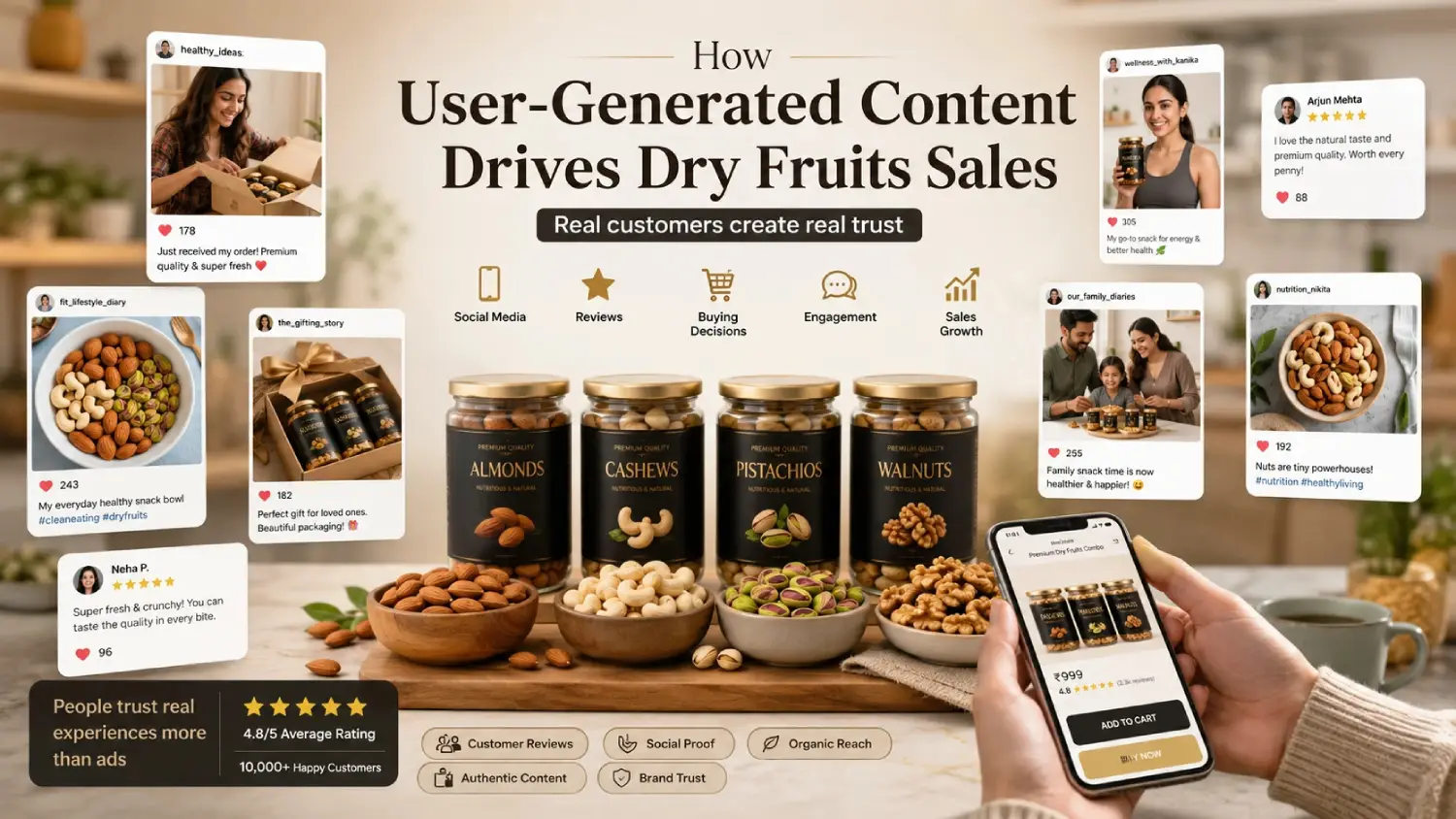
User-generated content (UGC) has become one of the strongest growth drivers for dry fruits brands because it replaces the missing in-store experience online. This guide explains how reviews, recipe photos, unboxing videos, Q&A sections, and branded hashtag campaigns help build trust, improve SEO, increase conversion rates, and lower customer acquisition costs.
It also covers the psychology behind social proof, the role of visual authenticity in food eCommerce, and practical systems for collecting and repurposing UGC across product pages, ads, and email marketing. With real research, conversion data, and implementation strategies, this guide shows why modern dry fruits brands can no longer treat UGC as optional marketing.
Key Takeaways
- UGC builds trust faster than traditional advertising
- Reviews and ratings improve dry fruits conversion rates
- Unboxing videos reduce freshness-related buying hesitation
- Recipe photos help buyers visualize product usage
- Q&A sections significantly improve product page conversions
- UGC improves SEO through natural keyword-rich content
- Customer-generated visuals increase engagement and trust
- Real customer experiences outperform polished branded content
- UGC lowers customer acquisition costs in Meta ads
- Consistent UGC collection creates long-term brand authority
Introduction
“People don’t buy dry fruits online because of ingredients. They buy because they trust the experience.”
That single insight is changing how modern dry fruit brands grow online.
According to a study by Bazaarvoice, product pages with authentic user-generated content (UGC) can increase conversions by up to 161%. In food and wellness categories, customer photos, reviews, and unboxing videos influence buying decisions more than brand-written descriptions.
Customers cannot touch the almonds. They cannot smell the freshness of walnuts. They cannot hear the crunch of cashews through a screen. So before they buy, they look for one thing:
Proof from real people.
Marketing psychologist Robert Cialdini explains this through the principle of “social proof”, when buyers are uncertain, they follow the actions and experiences of others. That is exactly why customer reviews, Instagram reels, recipe videos, and unboxing content outperform traditional branded ads in the dry fruits industry.
In fact, research from PowerReviews found that 98% of shoppers read reviews before purchasing food products online, and products with authentic customer content convert dramatically better than products with only professional images.
Today, the brands winning the dry fruits market are not necessarily the brands with the biggest ad budgets.
They are the brands showing real customers, real reactions, and real experiences.
Research backs this up directly. Ninety percent of shoppers read online reviews before buying, and forty percent will not complete a purchase if there is no UGC on the product page. A product page with strong UGC converts at rates 74 to 161 percent higher than one without it.
This guide gives you the complete playbook: which types of UGC work best for dry fruits, how to collect them at scale, where to display them for maximum impact, and how to turn them into paid ad creative. You will also get a 30-day launch plan you can start immediately.
Why Dry Fruits Need UGC More Than Almost Any Other Product Category
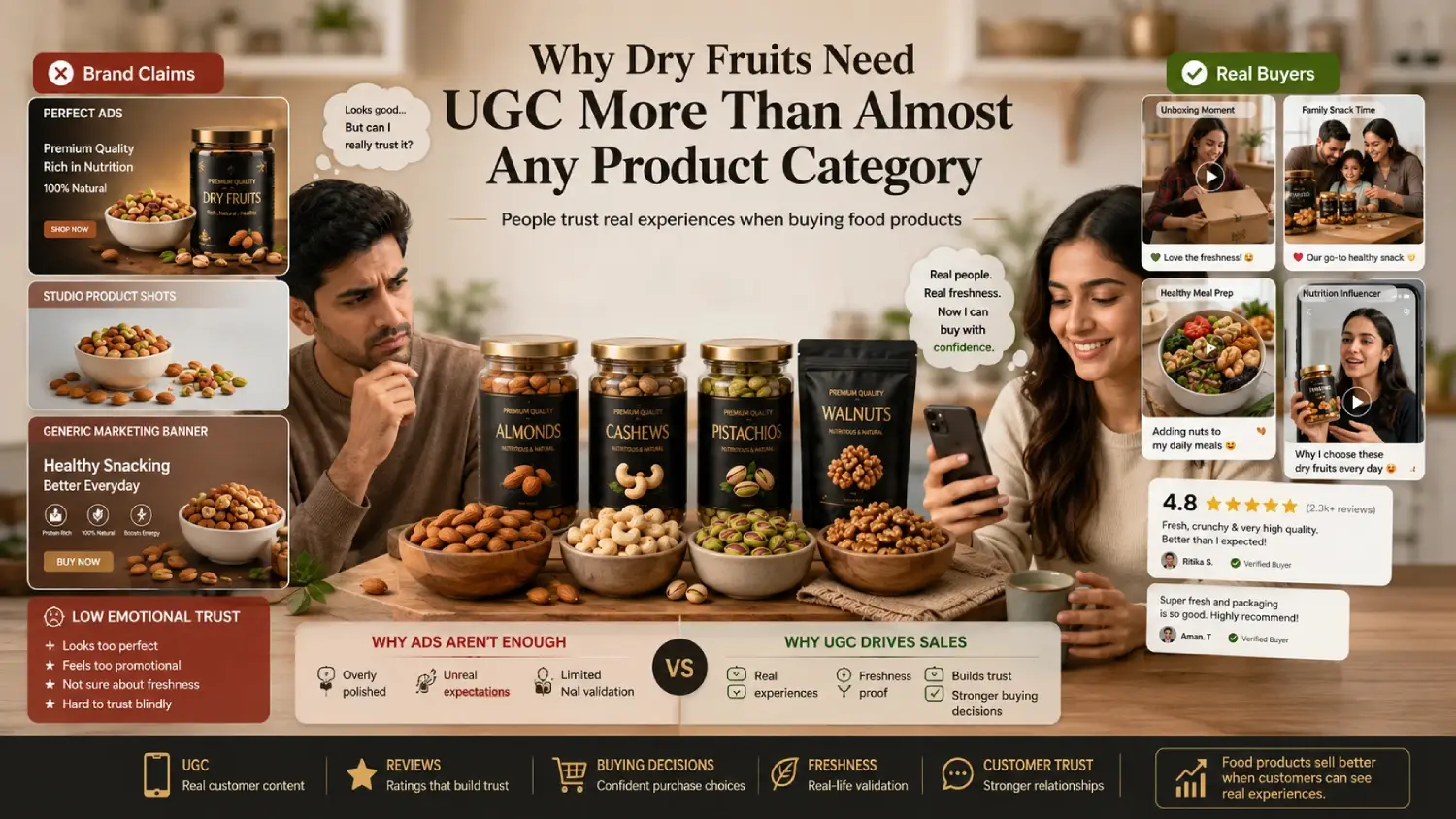
Most articles about user-generated content treat food the same as fashion or electronics. That is a mistake. Dry fruits sit in a uniquely difficult position in online retail, and understanding why changes how you build your UGC strategy.
Freshness and quality cannot be verified until after purchase
When someone buys a laptop online, they can read the spec sheet and know exactly what they are getting. When someone buys a pair of jeans, returning them is easy if the fit is wrong. Dry fruits work differently. If a customer receives a bag of cashews that tastes stale or feels soft, the experience is over. There is no return that fixes the disappointment. No spec sheet guarantees freshness.
The only way to bridge that verification gap before purchase is to show the customer what other real people received and experienced. That is UGC.
The repeat purchase opportunity is enormous, but only if the first order converts
A dry fruits customer who has a great first experience often becomes a high-frequency buyer. They reorder monthly. They buy multiple SKUs. They recommend you to family members. One converted customer can be worth eight to ten orders over their lifetime.
UGC that earns that first purchase does not just drive one conversion. It starts a loyalty cycle.
This makes every piece of UGC you collect far more valuable than its immediate conversion impact suggests.
Visual proof substitutes for sensory experience
Eighty-four percent of millennials report that UGC influences their food purchase decisions. The reason is straightforward: seeing a real person photograph your almonds after receiving them, showing the seal, the fill level, and the product colour, substitutes for the physical experience of inspecting it in a store. A short video of someone opening a resealable bag of walnuts and showing the contents is more persuasive than any product description you will ever write.
Dry fruits brands that understand this build UGC strategies around visual authenticity. The brands that do not are left competing on price alone.
What the Data Shows: UGC's Impact on Conversion Rates
Before building a UGC strategy, it helps to know exactly which types of UGC produce which results. The data here is specific and significant.
Conversion lift by UGC type
Any UGC interaction on a product page produces a 3.8 percent baseline lift in conversion rate compared to zero engagement. That is the floor. The impact grows substantially with more specific interactions:
Shoppers who engage with customer reviews convert at a rate 102 percent higher than shoppers who do not interact with any UGC. Shoppers who use a product Q&A section convert at a rate 177 per cent higher. This is the single most underused UGC feature in dry fruits e-commerce, and the data on its impact is not even close.
Product pages with customer photo galleries convert at 3.7 times the rate of pages without them, and average order value increases by 21.8 percent on those pages (based on the Naturitas food brand case study).
Even negative review interactions drive conversions: shoppers who read one-star reviews convert 71.9 percent more than average, because they are doing genuine due diligence rather than impulse browsing.
The inverse is equally important. Forty per cent of shoppers will not buy from a product page with no reviews at all.
Beyond conversion: engagement and loyalty metrics
Sites with UGC keep visitors 90 percent longer than those without it. UGC-supported customers show 30 percent lower return rates, because the content sets accurate expectations before purchase. Repeat purchase rates increase as customers who bought based on real peer content feel more confident reordering.
When UGC is used in paid advertising, the results are equally strong. Ads using real customer photos and video generate four times higher click-through rates and cost 50 percent less per click than ads using branded creative. Email campaigns featuring UGC drive 78 percent higher click-through rates.
The compounding effect matters: every piece of UGC you collect makes your product pages more convincing, your ads cheaper to run, and your email more effective. It is not one conversion tool. It is the foundation of your entire customer acquisition funnel.
The 5 UGC Types That Work Hardest for Dry Fruits
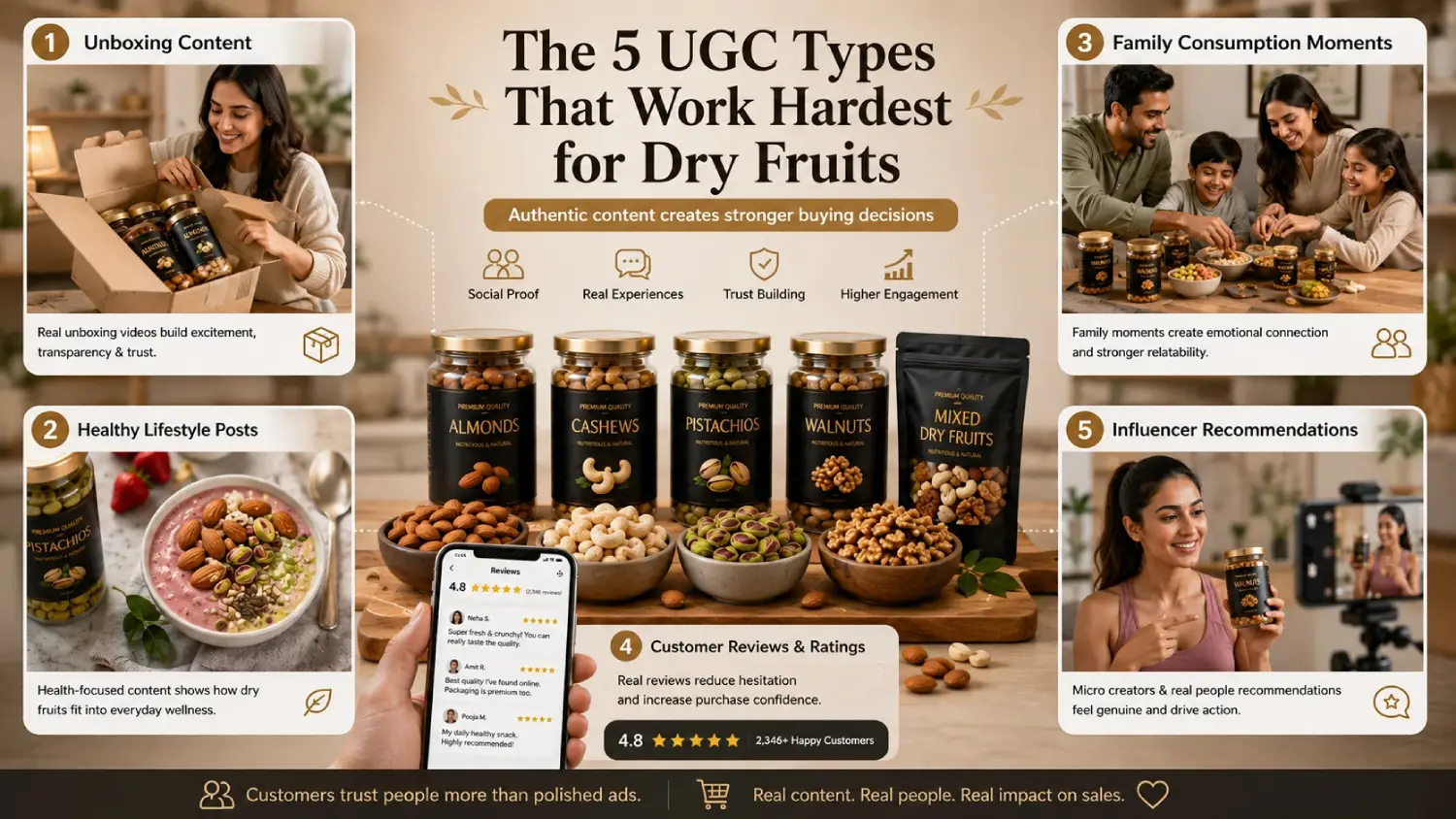
Not all User-Generated Content (UGC) performs equally. Some formats create trust faster, improve SEO better, and increase conversions more effectively than others.
For dry fruits specifically, these five types consistently produce the strongest results because they directly solve the biggest online buying problem: customers cannot physically verify freshness, crunch, texture, or quality before ordering.
Below are the highest-performing UGC formats ranked by effectiveness, ease of implementation, and long-term ROI.
1. Star Ratings and Text Reviews
This is the foundation of every successful dry fruits eCommerce store.
Before customers watch videos, check Instagram posts, or explore recipes, they look at one thing first:
The rating.
If your product page has no reviews, many shoppers immediately assume the product is untested, risky, or unpopular. Research consistently shows that products with visible customer reviews convert significantly better than products without them.
But the real power is not the star rating alone.
It is the specificity inside the reviews.
Generic reviews create weak trust:
- “Good quality”
- “Nice product”
- “Fast delivery”
Specific reviews create buying confidence:
- “The almonds arrived fresh and crunchy with zero broken pieces.”
- “Packaging was airtight and the resealable zip lock kept them fresh for weeks.”
- “The walnuts tasted buttery and fresh, not stale like local market packs.”
These details answer the exact concerns future buyers already have in their minds.
Why This Works So Well for Dry Fruits
Dry fruits are sensory products. Buyers care about:
- Freshness
- Crunch
- Smell
- Texture
- Packaging quality
- Shelf life
Detailed customer reviews simulate that missing sensory experience online.
According to persuasion expert Robert Cialdini, social proof becomes strongest when people see relatable, specific experiences instead of vague praise.
That is why detailed reviews outperform polished marketing copy.
Pros
- Builds immediate trust
- Improves SEO with natural keyword-rich content
- Increases conversion rates
- Helps products rank for long-tail searches
- Reduces customer hesitation
- Low-cost and easy to collect
Cons
- Requires active review collection systems
- Negative reviews become public
- Generic reviews provide little value
- Fake reviews can damage credibility
Pro Tip
Instead of asking:
“Please leave a review.”
Ask:
“How was the freshness, crunch, and packaging quality?”
The better your prompts, the better your reviews.
2. Recipe and In-Use Photos
This is one of the most underrated UGC formats for dry fruits brands.
Customers showing your products in real-life situations:
- mixed into oatmeal,
- added to smoothies,
- used in protein bowls,
- sprinkled over desserts,
- or included in homemade Diwali sweets,
does something extremely powerful psychologically:
It helps future buyers visualize ownership.
Instead of seeing a packet of almonds, they start imagining healthy breakfasts, family recipes, fitness meals, and festive gifting.
This shifts the product from “just dry fruits” to a lifestyle product.
Why It Converts So Well
One of the biggest objections in dry fruit purchases is:
“What will I actually do with 500g of walnuts or pistachios?”
In-use photos remove this friction instantly.
When customers see 20 different ways real people use the product, the purchase feels more practical and valuable.
It also increases perceived versatility, which can increase average order value.This helps product pages rank for informational searches alongside transactional keywords.
Pros
- Makes products feel relatable
- Expands usage imagination
- Creates highly shareable social content
- Improves Instagram and Pinterest engagement
- Supports recipe-based SEO traffic
- Increases average order value
Cons
- Requires active customer participation
- Some photos may be low quality
- Needs moderation for consistency
- Harder to scale initially
Expert Insight
Marketing expert Seth Godin often emphasizes that modern consumers buy stories and experiences, not products alone.
Recipe and lifestyle photos create exactly that emotional connection.
3. Unboxing and Freshness Videos
This is arguably the highest-trust UGC format in the dry fruits industry.
And surprisingly, very few brands are using it properly.
A simple 15–30 second customer video showing:
- package delivery,
- seal opening,
- freshness reaction,
- crunch sound,
- product texture,
- or resealable packaging
can outperform professionally shot advertisements.
Why?
Because raw phone-shot videos feel authentic.
Customers trust imperfect reality more than polished advertising.
Why This Format Is So Powerful
Dry fruits have one massive online trust issue:
Customers cannot verify freshness before buying.
An unboxing video bridges that gap better than any product description ever can.
It answers questions buyers subconsciously ask:
- Did it arrive safely?
- Does it actually look premium?
- Is the packaging genuine?
- Are the nuts fresh and crunchy?
- Is the quantity accurate?
This recreates the “physical inspection experience” that shoppers normally get in offline stores.
Conversion Psychology
Behavioral marketing expert Nir Eyal explains that visual triggers create emotional certainty faster than written information.
That is exactly why unboxing videos perform so well in food eCommerce.
Pros
- Extremely high trust factor
- Powerful for Meta and Instagram ads
- Increases product authenticity
- Excellent for reels and short-form content
- Boosts engagement and watch time
- Repurposable across multiple channels
Cons
- Harder to collect consistently
- Requires customer motivation
- Video moderation takes time
- Some customers feel camera shy
Best Practice
Include a QR code inside packaging saying:
“Show us your unboxing and get featured.”
This makes participation frictionless.
4. Q&A Threads on Product Pages
This may be the most profitable yet underused UGC feature in dry fruits eCommerce.
Research cited in the original study showed that shoppers interacting with Q&A sections converted at rates up to 177% higher than average users.
Why does this happen?
Because Q&A sections capture buyers exactly at the moment of hesitation.
The customer is ready to leave the page because they are unsure about:
- freshness,
- shelf life,
- roasting method,
- country of origin,
- storage instructions,
- allergy concerns,
- or packaging quality.
Then they see someone asking the same question and getting a clear answer immediately.
Trust increases instantly.
Questions Every Dry Fruits Product Page Should Include
- “How long do these stay fresh after opening?”
- “Are these roasted in oil or dry roasted?”
- “Is the packaging resealable?”
- “What is the country of origin?”
- “Are preservatives added?”
- “Is this suitable for gym diets?”
- “Can children consume this daily?”
Pros
- Extremely high conversion impact
- Reduces buyer hesitation
- Improves on-page SEO
- Increases dwell time
- Builds transparency and authority
- Creates evergreen customer support content
Cons
- Needs moderation
- Requires regular updates
- Unanswered questions hurt trust
- Empty Q&A sections look inactive
Important Tip
Never leave a Q&A section empty.
Seed the first 5–10 questions yourself to encourage participation.
An active-looking Q&A section grows naturally over time.
5. Branded Hashtag Campaigns
Branded hashtags turn customers into long-term content creators.
This creates a compounding marketing engine where every buyer potentially becomes future advertising material.
A simple packaging insert saying:
“Share your healthy snack moments with #YourBrandName”
can generate:
- Instagram posts,
- story mentions,
- recipe videos,
- unboxing reels,
- testimonials,
- and lifestyle content.
Over time, this becomes a massive trust asset.
Why Hashtag UGC Works
People trust communities more than advertisements.
When customers see real users publicly posting your products, your brand starts feeling socially validated and popular.
This also creates “fear of missing out” (FOMO), especially among younger health-conscious buyers.
Best Incentives
- Monthly dry fruit hampers
- Discount coupons
- Social media features
- Giveaway entries
- Fitness collaboration shoutouts
Pros
- Generates continuous organic content
- Increases social proof
- Improves Instagram discoverability
- Builds community around the brand
- Reduces long-term content creation costs
- Creates viral marketing opportunities
Cons
- Takes time to build momentum
- Requires active engagement from the brand
- Participation may initially be slow
- Needs consistent moderation and reposting
How to Collect UGC at Scale Without Annoying Your Customers
Most brands either never ask for UGC or ask for it once in a generic way and get a poor response. A structured collection system changes that completely.
The three-email post-purchase sequence
This sequence runs automatically after every order. It costs nothing beyond the initial setup.
Email one goes out three to five days after confirmed delivery. The subject line is a simple check-in: "Did everything arrive in good shape?" The body is brief. You are not asking for a review. You are showing the customer you care about their experience. This email builds goodwill and also catches any delivery issues early.
Email two goes out seven to ten days after delivery. This is the review request. Be specific in what you ask: "Tell us about the freshness and crunch, your honest experience helps the next customer decide." Offer a 10 to 15 percent discount on their next order as a thank-you.
Research shows this incentive level produces approximately 20 percent higher submission rates than no incentive.
Email three goes out 14 days after delivery, only to customers who did not respond to email two.
This time, shift the ask to a photo or short video: "Got a minute? A quick photo or clip of how you used our product goes a long way, we feature real customers on our product pages."
Change the incentive to a giveaway entry rather than a discount. Different customers respond to different motivations.
Packaging inserts with QR codes
Every order ships with a small card. The card has your branded hashtag, a single sentence of instruction ("Scan to share your experience and get 10% off your next order"), and a QR code that goes directly to your review or photo submission page, not your homepage.
This captures the unboxing moment, which is when buyer enthusiasm is at its highest and the sensory experience of the product is freshest. A customer who loves what they received and sees a frictionless submission path will often contribute content immediately. The same customer, receiving a follow-up email a week later, has moved on emotionally.
Seeding Q&A to prime participation
An empty Q&A section on a product page generates no questions and no traffic. A seeded one generates both.
Write the first five questions yourself, framed as things a genuine buyer would want to know.
Answer them completely and honestly, as the brand. Mark them clearly. Once the section shows existing activity, real customers start engaging. The psychological principle here is simple:
nobody wants to be the first to ask a question, but many people are happy to be the sixth.
Hashtag contest mechanics
Launch the hashtag campaign with a clear announcement, a real prize, and a specific end date for the first round.
Feature the first winner prominently, on your website homepage, in your next email, and across your social channels. That visibility is the primary incentive for most participants.
Keep the submission rules to one sentence. The more conditions you add, the fewer entries you get.
Where to Display UGC on Product Pages for Maximum Conversion
Collecting UGC is half the work. Where and how you display it determines whether it actually converts browsers into buyers.
Star rating and review count above the fold
The aggregate star rating and total review count must appear in the top section of every product page, near the product title and price, before the description. If a visitor has to scroll to find reviews, most will not find them. Position the rating where no user can miss it within the first view.
Customer photo gallery below the hero image
Place the customer photo gallery directly beneath your primary product image, not in a secondary tab, not at the bottom of the page, and not on a separate reviews page. Tabs kill engagement because they require an intentional click most users never make. The gallery should be visible without any action, in the natural reading flow of the page.
Custom review filters for dry fruits
Standard star filtering (filter by 1 to 5 stars) is a minimum baseline.
For dry fruits specifically, add category-specific filter tags:
- freshness
- taste
- packaging quality
- value for money
- texture
These tags let buyers filter for exactly the dimension they care about most, and shoppers who use filtering tools convert at significantly higher rates than those who scroll through unfiltered reviews.
Verified buyer and authenticity badges
Small visual indicators, "Verified Buyer," "Authenticity Checked," "Confirmed Purchase", increase trust in the UGC itself.
They signal that the content is from real customers, not planted reviews.
Place these badges directly on each review and photo card, not in a footnote or policy page.
Mobile-first submission flow
More than 70 percent of food UGC is submitted from a mobile device.
If your photo upload process takes more than three taps to complete, you are losing the majority of potential contributors.
Test the submission flow on your own phone before launching any campaign.
Remove every unnecessary step.
Default sorting: most helpful, not most recent
Set your review section to display the most helpful reviews by default.
Your best social proof should lead the section, not your newest review which may have very little context.
Most recent sorting benefits platforms with high daily review volume.
For most dry fruits brands, most helpful sorting ensures the best content is always visible first.
Repurposing UGC Across Ads and Email
The most valuable thing about UGC is that you collect it once and use it everywhere.
UGC in paid advertising
Ads using real customer photos and short video clips generate four times higher click-through rates and cost 50 percent less per click than ads using branded creative.
For dry fruits brands advertising on Meta or Instagram, this is a significant cost advantage that compounds over time.
The most effective format is a customer's unboxing or in-use video as a Reel ad, with a genuine review quote as the caption.
This format performs well because it looks native to the platform, does not feel like an advertisement, and carries the social proof of a real person's endorsement within the creative itself.
Test one UGC ad against your current best-performing branded ad.
In most food categories, the UGC version wins within the first two weeks of running.
UGC in email campaigns
Email campaigns that feature a real customer photo in the header, instead of a product shot generate 78 percent higher click-through rates.
Place the UGC element above the fold in the email body.
A review quote paired with the customer's first name and a star rating in the email header is enough to produce a measurable lift.
The repurposing lifecycle
One strong review travels further than most brands realise.
A single review that reads "Arrived fresh, perfectly sealed, crunch was exactly what I expected, best cashews I have ordered online" becomes:
- The headline copy in a Meta ad
- The header quote in a monthly email campaign
- A callout on the homepage hero section
- A caption on an Instagram organic post
- A pull quote on the product page itself
Map this lifecycle explicitly for your team.
Every piece of UGC you collect has a long useful life across multiple channels.
Treat it as a content asset, not a one-time feature.
Legal requirement before repurposing
Before using any customer photo, video, or review in paid advertising, you need explicit written permission from that customer. A checkbox at the point of submission ("I agree that [Brand] may use this content in marketing materials") is sufficient. A direct message to the customer on social media with a clear yes/no request also works. Do not skip this step. The liability for using someone's content without permission in a paid placement is real, regardless of how positive the content is.
Mini Case Study: What Before and After Actually Looks Like
Consider a dry fruits product page in its original state: one stock product photograph, a 3.1-star aggregate rating from nine reviews, no Q&A section, no customer photos, and a description written entirely in brand voice.
That page converts at a rate typical of unverified food products online, low, with high bounce rates and low time on page.
Now apply a structured UGC system over 60 days. The same page has 34 verified customer reviews averaging 4.7 stars, a customer photo gallery with 22 real images showing the product in use, a Q&A section with 11 answered questions covering freshness, storage, sourcing, and allergen information, and a filter system that lets buyers sort by texture and freshness specifically.
The results follow a consistent pattern documented in food e-commerce UGC studies: conversion rates increase substantially, average order value rises as buyer confidence grows, time on page increases as visitors engage with the content, and return rates fall as customer expectations are set accurately before purchase.
The change is not cosmetic. The UGC replaces the brand's voice with the customer's voice. And in food e-commerce, customers trust other customers more than they trust any brand.
A review that drives this kind of performance sounds like this: "Ordered the mixed nuts box expecting average quality. What arrived was properly sealed, smelled fresh when I opened it, and the cashews had that satisfying crunch I was hoping for. Already on my third order." That specificity, sensory detail, honest expectation, and repeat behaviour converts the next buyer more effectively than any product description.
Your 30-Day UGC Launch Plan
This plan requires no new technology beyond what most Shopify or WooCommerce stores already support. Start on day one.
Week one: build the foundation
Add a star rating and review section to your five highest-traffic product pages if you do not already have one. Seed each product page Q&A section with five relevant questions and answer each one completely. If you are on Shopify, apps like Judge.me, Okendo, or Yotpo handle this with minimal setup time.
Send a one-time review request email to every customer from the past 90 days who has not yet left a review. Keep the email short. Reference their specific order, ask one specific question about their experience, and offer a genuine thank-you incentive.
Week two: automate collection
Set up the three-email post-purchase sequence (days 4, 8, and 14 after delivery) so that every new order going forward triggers automatic review and photo collection. This runs without ongoing effort once it is configured.
Design and order the packaging insert card with your QR code. This takes one week to produce and ships with every order from that point forward.
Week three: launch the hashtag campaign
Announce your branded hashtag across your social channels. Identify three to five customers who have already posted about your product organically and reach out to them personally — offer to feature them as the founding contributors to your UGC gallery. Feature the first winner immediately, even before you have received contest entries. That early social proof drives participation.
Week four: put UGC into paid advertising
Take your three strongest customer reviews and your best customer photo. Build one Meta ad using the photo as the visual and a review quote as the primary text. Run it against your current best-performing ad with a modest daily budget. Measure click-through rate, cost per click, and conversion rate over seven days. Let the data guide the next iteration.
At the end of week four, you will have a functioning UGC collection system, content appearing on your product pages, an active hashtag campaign, and your first data point from UGC-powered advertising. The compounding has begun.
FAQ
Does UGC help if my dry fruits brand only has a few reviews?
Yes, and the threshold effect is lower than most brands expect. Research shows that even five genuine reviews produce a measurable conversion lift compared to zero. The first three to five reviews are the hardest to collect and the most important to display prominently. Use the post-purchase email sequence to accelerate early review collection. Once you cross ten reviews, the social proof effect compounds because buyers see proof of consistent quality rather than a single data point.
What if a customer posts a low-quality photo or a negative review?
Manage your UGC, but do not sanitise it. Set submission guidelines upfront (photos should show the product clearly, content should be family-appropriate) and moderate against those guidelines consistently. For negative reviews, respond publicly and professionally: acknowledge the issue, explain what you did about it, and offer a resolution. Buyers who see a brand respond thoughtfully to criticism trust that brand more than one that shows only five-star reviews. A mix of ratings signals honesty. Only five-star ratings signals manipulation.
Can I legally use customer photos in my paid advertising?
Only with explicit permission. The safest approach is a checkbox at the point of submission that reads: "I agree that [Brand Name] may use this content in marketing and advertising." For content collected via social media tagging, send a direct message before using the content in paid placements: "We love this photo and would like to use it in an upcoming campaign — do we have your permission?" Keep a record of every permission granted. This takes one minute and protects you from real liability.
How long does it take for UGC to impact conversion rates noticeably?
Typically four to eight weeks from the start of a structured collection system. The first two weeks produce content. Weeks three and four see that content appear on product pages. By weeks five through eight, you have enough volume to see statistically meaningful changes in conversion metrics. Track conversion rate by product page weekly from the day you launch. The signal appears faster on high-traffic pages and slower on lower-traffic SKUs.
Which UGC type should a small dry fruits brand start with?
Start with reviews and Q&A. They have the lowest collection barrier, the highest proven conversion lift (especially Q&A at +177 per cent), and they require no photo moderation or video editing.
Once you have a base of text reviews and an active Q&A section on your top five products, layer in a photo collection through the packaging insert and post-purchase email sequence. Video UGC comes last, it is the most powerful format, but also the most effort to encourage and moderate. Build the foundation first.
About the Author
Lake City Dry Fruits is one of India’s trusted dry fruits and spices companies, with a legacy that began in 1964 in Rajasthan. Over the last six decades, the company has grown from a small retail venture into a large-scale dry fruits and spices business serving wholesalers, retailers, distributors, hospitality businesses, and consumers across India.
The company is famous for getting good almonds, cashews, pistachios, raisins, walnuts, dates and spices from places they trust all around the world, like the USA, Australia, Afghanistan and Iran. Lake City Dry Fruits uses ways of doing things and new machines to keep their products fresh, clean and the same every time they make a batch.
They work in different cities like Rajasthan, Delhi, Pune, Mumbai and Ahmedabad. This means Lake City Dry Fruits can sell to businesses and to people like you and me. They do this by selling amounts to other companies making special labels, for some products and putting things in custom packages. They also have their brand called "20-20 Dry Fruits" that people can buy from.
Lake City Dry Fruits focuses on:
- Premium sourcing and quality control
- Hygienic processing and packaging
- Long-term supplier relationships
- Transparent business practices
- Reliable bulk supply systems
- Modern branding and packaging strategies
The company also operates a large manufacturing and packaging facility in Gujarat with semi-automated systems designed for precision, hygiene, and scalable production.
This content is created using practical industry experience, consumer buying psychology, dry fruits market research, packaging trends, branding insights, and modern eCommerce strategies observed across the premium dry fruits industry.
UGC & Dry Fruits eCommerce Statistics Table
| Metric | Data / Insight | Impact on Dry Fruits Brands |
|---|---|---|
| Shoppers reading reviews before buying | 90%+ | Reviews heavily influence purchase decisions |
| Buyers avoiding products with no reviews | 40% | No UGC reduces trust and conversions |
| UGC conversion lift | 74%–161% | Strong product page conversion improvement |
| Conversion lift from Q&A interactions | Up to 177% | Highest-performing UGC feature |
| Customer photo gallery impact | 3.7x higher conversion | Visual proof improves trust |
| Increase in average order value with UGC | 21.8% | Buyers spend more when confidence increases |
| Time spent on sites with UGC | 90% longer | Better engagement and SEO signals |
| Lower return rates from UGC-supported buyers | Around 30% | Better expectation setting |
| UGC ad performance | 4x higher CTR | Better Meta and Instagram ad efficiency |
| Email campaigns using UGC | 78% higher CTR | Customer content improves email engagement |
Sources & Citations Used for Research
Consumer Trust, Reviews & UGC Research
1. PowerReviews Conversion Impact Study
Used for:
- Review impact on conversion rates
- Shopper review behavior
- UGC influence on food product purchases
- Statistics around review engagement and buying decisions
2. Bazaarvoice Shopper Experience Index
Used for:
- UGC conversion lift data
- Consumer trust and review statistics
- Product page engagement insights
- Customer content behavior research
3. Flowbox Food & Beverage UGC Report
Used for:
- Food brand UGC case studies
- Product photo and customer gallery impact
- Naturitas conversion and engagement examples
- UGC influence on eCommerce performance
4. 5WPR Consumer Culture Report
Used for:
- Consumer buying behavior trends
- Brand trust and social proof insights
- Millennial and Gen Z purchase behavior
5. Stackla Consumer Content Report
Used for:
- UGC trust statistics
- Consumer preference for authentic content
- Influence of customer-generated visuals on purchases
Conclusion
The biggest challenge in selling dry fruits online is not getting traffic. It is building trust. Unlike offline shopping, customers cannot touch the almonds, check the crunch of walnuts, smell the freshness, or inspect the packaging before placing an order. That uncertainty creates hesitation, and hesitation reduces conversions.
This is exactly where user-generated content changes the game.
A real customer review describing freshness, an unboxing video showing properly sealed packaging, or a recipe photo using your products in daily meals creates a level of trust that traditional advertising struggles to achieve. These experiences feel authentic because they come from real buyers instead of brand-written claims.
As Robert Cialdini explains through the principle of social proof, people trust the experiences of other people more than direct marketing messages. That principle is now one of the strongest growth drivers in food and dry fruit e-commerce.
This is why the best-performing dry fruit brands are no longer relying only on polished product photography or discount-based marketing. They are building systems that continuously collect reviews, customer photos, recipe content, Q&A interactions, and unboxing videos. Every piece of user-generated content reduces uncertainty for the next buyer and increases overall purchase confidence.
The impact goes far beyond conversions alone. Strong UGC improves SEO, increases time on page, lowers customer acquisition costs, strengthens repeat purchases, and improves long-term brand loyalty. A single customer review can become a lot of things. It can be a testimonial on a product page a headline for a Meta ad, a post on Instagram, something you use in an email campaign and a way to show people they can trust your product.
That is why customer reviews become more and more valuable to you over time. The companies that figure this out on are able to build stronger relationships with their customers, make them trust the company more and make more money from each customer. The companies that do not do this usually have to spend a lot of money on advertising. They still have a hard time getting people to buy their products.
The good thing is that you do not need a lot of money or a special team to make customer reviews work for you. You can start by doing simple things all the time. You can ask your customers questions when you want them to write a review, you can ask them to send you photos you can add a question and answer section to your product pages and you can make your customers feel like they are a part of your company.
Over time, these small systems create a powerful trust engine.
In the end, user-generated content is not just another marketing tactic for dry fruits brands. It is the closest replacement for the in-store shopping experience online. And in a category built around freshness, quality, and trust, that makes UGC one of the most valuable growth tools a brand can build.
Fore information you can contact us.
Author

LCDF Pvt. Ltd.
Lake City Dry Fruits Pvt. Ltd. has been a pioneer in the dry fruits and spices industry for over 60+ years. From humble beginnings in Udaipur to a pan-India presence, we’ve built a reputation for sourcing the best global produce, ensuring uncompromising quality at every step.