

| LCDF Pvt. Ltd.
Summary
At the end of the day, the number on your supplier's invoice was never the whole story. The real cost of dry fruit inventory shows up later, in a walnut batch that turned before it sold, in cash that sat locked up in stock for three months longer than it needed to, in a monsoon week that quietly halved your shelf life without anyone noticing until the smell gave it away. Most retailers only find this out the hard way, after the loss has already happened.
The businesses that get ahead of this aren't necessarily buying smarter deals, they're simply tracking the full picture: what each item actually costs to hold, how fast it moves, and how the weather outside their storeroom is working against them every single day. That's the difference between a healthy gross margin on paper and real profit at the end of the year.
At Lake City Dry Fruits, we've built our sourcing and storage around exactly this understanding, because we'd rather absorb that complexity ourselves than pass along stock that's already lost part of its quality by the time it reaches you. If you're running a dry fruits business, big or small, the single best thing you can do this month is sit down with your own numbers and work out your true cost per kilo. It's a humbling exercise the first time, but it's also the fastest way to find margin you didn't know you were losing.
Key Takeaways
- The purchase price on your invoice is never the real cost of your stock, it's just the starting point. Storage, spoilage, and locked-up capital all add to the number that actually matters.
- Not every dry fruit behaves the same way in storage. High-oil nuts like walnuts and pistachios spoil fast, while sugar-preserved items like dates and raisins can sit safely for months, so treating your whole inventory the same way is a costly habit to break.
- Bulk buying isn't automatically the smart move. It works well for slow-spoiling items, but for something like walnuts, a bulk discount can quietly get wiped out by spoilage before the stock even sells.
- India's climate makes this harder than most markets. Heat, humidity, and monsoon conditions accelerate rancidity, and the damage can be far worse in coastal cities than in drier regions, so your storage strategy needs to account for where you actually operate.
- Festival demand around Diwali, Raksha Bandhan, and Eid creates real planning pressure. Stocking too early ties up cash and risks spoilage, stocking too late risks losing sales, and getting this timing right is genuinely worth the effort.
- Spoilage isn't a small side issue, it can account for ten to twenty percent of annual stock loss when storage isn't managed properly. That's a number worth taking seriously, not writing off as an unavoidable cost of doing business.
- There are hidden costs most retailers never add up, packaging, labour, transport, pest control, insurance, and platform commissions if you sell online. Each one is small on its own, but together they shape your real margin.
- Simple habits make a real difference. A strict first-in-first-out approach, right-sized storage for each item, and demand forecasting based on your own sales history can meaningfully bring your true cost down over time.
- Your working capital is a cost too, even if it never shows up on a receipt. Money tied up in unsold stock is money that isn't working anywhere else in your business, and that opportunity cost deserves a place in your calculations.
- Once you calculate your true cost per kilo honestly, the picture usually looks different from what your invoices alone suggest, and that gap is exactly where the real, recoverable margin in a dry fruits business tends to be hiding.
Introduction
If you've ever run a dry fruits business, you already know the price you pay per kilo when your supplier's invoice lands in your hand. What almost nobody sits down and works out is what that same kilo actually costs by the time it either sells, or quietly turns rancid in a corner of the storeroom nobody checked in on for a few weeks.
That invoice price is just the entry point. The real number, the one that actually decides whether your business is genuinely profitable or just looks profitable on paper, includes everything that happens to that stock after it walks through your door. How you store it. How fast it starts to spoil. How much cash it ties up while it's sitting there. And eventually, how much of it you have to write off and quietly forget about.
Most dry fruit businesses in India never track this properly, not because they don't care, but because nobody's ever laid it out in a way that's easy to actually calculate. And that gap is exactly where margin slips away, kilo by kilo, month after month, until it shows up as a smaller profit than the sales numbers suggested it should be.
This guide is our honest attempt to change that. We'll walk you through exactly what goes into the true cost of dry fruit inventory, why this category is genuinely trickier to manage than most other retail products, and how you can start calculating and controlling this cost in your own business, starting with the very next batch of stock you order.
What Is the True Cost of Dry Fruit Inventory?
If you run a dry fruits business, you already know the price you pay per kilo to your supplier. What most retailers never sit down and calculate is what that stock actually costs by the time it either sells or, worse, sits unsold in a corner of the storeroom quietly losing value. The invoice price is just the entry ticket. The real number, what we can call the true cost of inventory, includes everything that happens to that stock after it arrives at your shop: how you store it, how fast it spoils, how much cash it ties up, and how much of it you eventually have to write off. Most dry fruit businesses in India never track this properly, and it quietly eats into margins that should be far healthier than they are.
This guide breaks down exactly what goes into that number, why dry fruits are one of the trickiest categories to manage inventory for, and how you can start calculating and controlling this cost in your own business.
What "True Cost" Actually Means
When people talk about inventory carrying cost, they usually mean one simple idea: holding stock is never free, even if it's sitting untouched on a shelf. Every kilo you buy locks up your working capital, takes up storage space, and carries the risk of going bad before it sells.
A simple way to think about it is this formula:
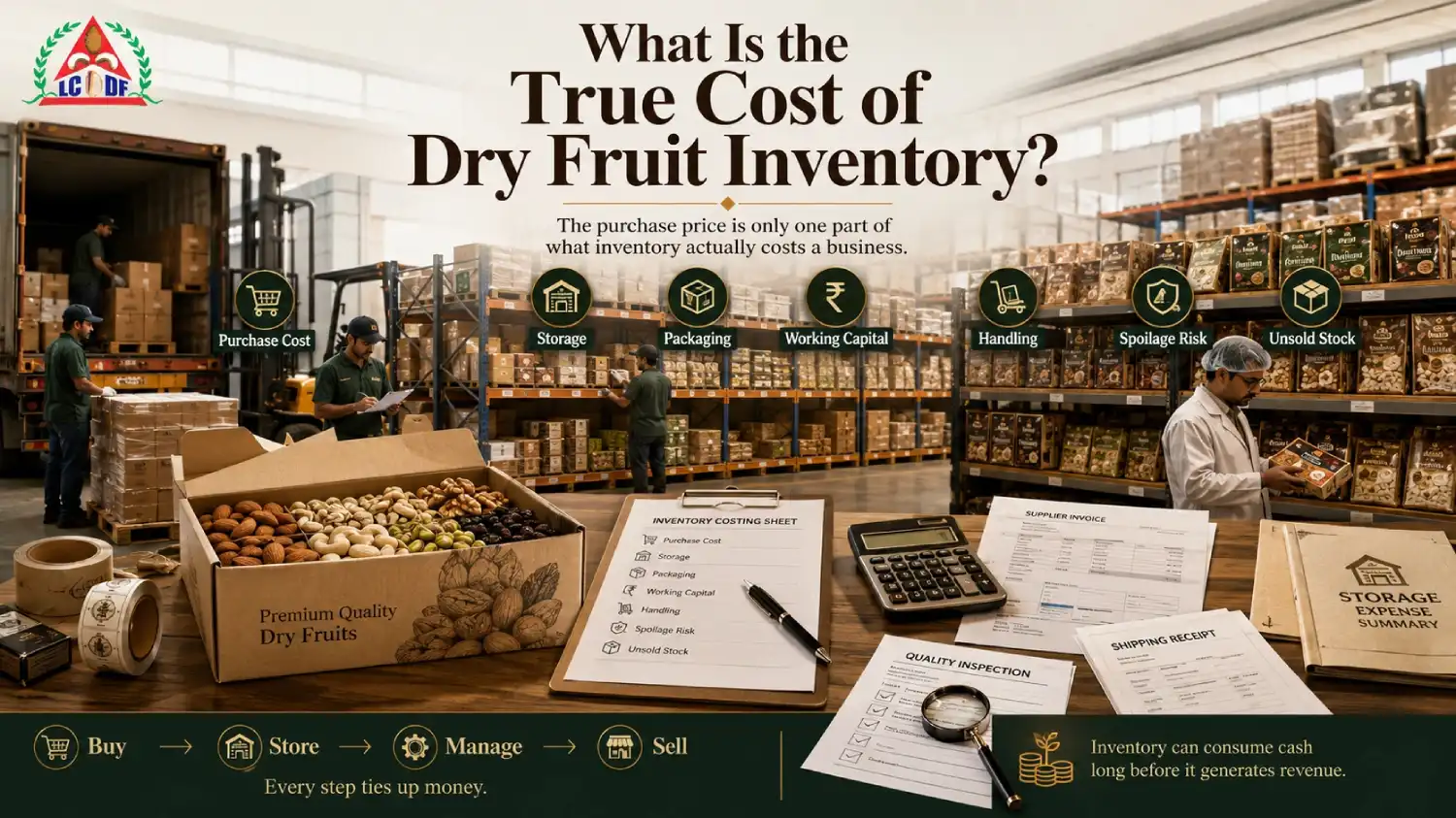
Purchase Price + Storage or Carrying Cost + Spoilage Loss (as a percentage) + Capital Lock-up Cost + Handling and Repackaging Cost = your True Landed Cost per kg
The purchase price is the easy part, it's on your invoice. The rest is where most businesses lose track. Storage cost includes rent, electricity for cooling, and humidity control. Spoilage loss is the stock that quietly turns rancid or infested before you can sell it. Capital lock-up cost is the money sitting in unsold bags of cashews that could have been used elsewhere in the business. And handling cost covers labour for sorting, repackaging, and moving stock around. Add all of that to the purchase price, and you get a far more honest picture of what a kilo of stock is actually costing you.
Item-by-Item: Not All Dry Fruits Cost the Same
One of the biggest mistakes retailers make is treating "dry fruits" as one uniform category. In reality, every item behaves differently once it's on your shelf, and that difference directly affects your true cost.
Almonds and cashews are relatively forgiving. Kept in a cool, airtight setup, they can comfortably last six to nine months without major quality loss, which makes them lower risk from a spoilage standpoint.
Walnuts are the opposite story. They have the highest unsaturated fat content of any common nut, which means they oxidise fast. At warm room temperature, walnuts can turn rancid in as little as four to six weeks. If you're not refrigerating your walnut stock in the Indian summer, you're likely losing more of it than you realise.
Pistachios sit somewhere in between, needing a cool, airtight environment for daily stock and refrigeration for anything held in bulk.
Dates and figs behave very differently because of their high natural sugar content, which acts as a built-in preservative. A good batch of dates can sit at room temperature for close to a year without major issues, making them one of the lowest-risk items in your inventory.
Raisins follow a similar pattern, thanks to their sugar content, and can last close to a year in a sealed, dry environment.
Makhana is a separate challenge altogether. It's porous and absorbs moisture easily, which means during monsoon it can turn soggy within weeks if it isn't stored in a tightly sealed, moisture-controlled setup.
The point here is simple: your storage strategy, and therefore your true cost, should never be identical across your entire inventory. High-oil nuts need active cooling. High-sugar items can be treated more casually. Getting this wrong is one of the fastest ways to quietly bleed margin.
The Bulk-Buying Trap
Almost every guide on starting a dry fruits business tells you the same thing: buy in bulk to bring down your per-unit cost. It's not wrong, but it's incomplete advice, and taken at face value it can actually hurt your margins rather than help them.
Here's the trap. Say you buy walnuts in bulk during a seasonal price dip and save fifteen percent on the purchase price. That sounds like a win on paper. But walnuts are one of the fastest items to go rancid. If that bulk stock doesn't move fast enough and twenty percent of it turns before it sells, you haven't saved money at all, you've actually lost more than you gained.
The fifteen percent price advantage gets wiped out, and then some, by spoilage loss you didn't account for.
This is why bulk buying only makes financial sense when it's matched against how fast that specific item moves and how quickly it degrades. For slow-spoiling items like dates, raisins, or almonds, bulk buying is usually a safe bet. For high-oil, fast-spoiling items like walnuts, buying smaller quantities more frequently, even at a slightly higher per-unit price, often works out cheaper once you factor in the real cost of holding that stock.
India's Climate Problem
Indian weather makes inventory management for dry fruits genuinely harder than it is in most other markets. Heat, humidity, and monsoon conditions all accelerate spoilage, and the impact varies quite a bit depending on where in the country you're operating.
In coastal cities like Mumbai and Chennai, humidity stays above seventy percent for large parts of the year. That kind of moisture in the air is exactly what accelerates mould growth and softens texture in nuts, and it also speeds up the chemical process that causes rancidity. In drier regions like Delhi, the challenge shifts more toward heat, kitchen and storeroom temperatures can swing well past thirty degrees for months at a time, which again pushes oxidation along faster.
Monsoon is the toughest stretch for almost every dry fruits retailer in the country. Studies and industry estimates suggest that poor storage practices can lead to stock losses of ten to twenty percent annually, and a large chunk of that damage happens in the humid monsoon months specifically. Shelf life that would normally hold for two months at room temperature can effectively get cut in half once humidity climbs.
The practical takeaway is that climate-controlled storage isn't a luxury add-on for a dry fruits business in India, it's one of the biggest levers you have to control your true inventory cost. Every rupee spent on humidity control or a proper cold storage setup is usually recovered many times over in reduced spoilage.
Festival Season Inventory Planning
Dry fruit demand in India isn't steady through the year, it spikes hard around specific occasions, Diwali, Raksha Bandhan, Eid, and the broader corporate gifting season. This seasonal pattern creates a genuine planning dilemma for retailers and wholesalers.
Stock up too early and you're carrying inventory, and its associated carrying cost and spoilage risk, for weeks or months before it actually sells. Stock up too late and you risk running out right when demand and prices are at their peak, losing sales to competitors who planned better.
The businesses that handle this well tend to time their bulk purchases closer to the demand window for fast-spoiling items, while building safety stock earlier only for the slower-spoiling categories like dates, raisins, and packaged gift assortments that can comfortably wait. It's a balancing act, but treating all your festival stock with the same timeline is one of the more expensive mistakes a growing dry fruits business can make.
The Hidden Costs Checklist
Beyond the obvious purchase price, here's what actually contributes to your true inventory cost, and what most retailers forget to track:
- Rent and storage space for holding stock
- Electricity and equipment for humidity and temperature control
- Packaging and repackaging materials
- Labour for sorting, cleaning, and repacking
- Transport and logistics from supplier to store
- Spoilage and shrinkage percentage across each item
- Management and infestation-related losses
- Insurance on stored stock, where applicable
- The opportunity cost of capital tied up in unsold inventory
- Platform commissions if you're selling through Amazon, Flipkart, or JioMart
If you're only tracking the first item on this list, you're likely underestimating your real cost per kilo by a significant margin.
How to Reduce Your True Inventory Cost
The good news is that most of these costs are manageable once you know where to look. A strict FIFO approach, first in, first out, ensures older stock always sells before newer stock, which directly reduces spoilage losses. Right-sizing your storage means not over-investing in space and cooling for items that don't need it, while putting real investment behind the items that do, like walnuts and pistachios.
Demand forecasting based on your own sales history, rather than gut feeling, helps you avoid both the bulk-buying trap and the festival-season stockout problem. And building stronger relationships with your suppliers, so you can reorder in smaller, more frequent batches without losing your pricing advantage, is one of the most underrated ways to bring your true cost down over time.
How Lake City Dry Fruits Manages This
At Lake City Dry Fruits, this exact thinking shapes how we source and store our stock. We work closely with trusted domestic suppliers to keep our sourcing cycles tight, which means less time between harvest or import and the point of sale, and less time for quality to drift. High-oil items are handled with far more storage discipline than sugar-preserved items like dates and raisins, because we know they simply don't behave the same way once they're off the tree or out of the ground. It's this attention to the true cost behind every kilo, not just the price tag, that lets us keep quality consistent for our customers.
Frequently Asked Questions
Why is inventory the biggest cost in a dry fruits business?
Because dry fruits combine a high purchase price with a real risk of spoilage. Unlike many retail products, the stock itself can lose value simply by sitting on a shelf too long, which makes inventory management directly tied to profitability in a way it isn't for many other categories.
How much stock loss happens due to spoilage in dry fruits?
Industry estimates suggest poorly managed storage can lead to annual losses of ten to twenty percent of stock, though this varies significantly by item, with high-oil nuts like walnuts at much higher risk than sugar-preserved items like dates.
What is the ideal inventory turnover for a dry fruit shop?
It depends on the item. Fast-spoiling, high-oil nuts should ideally turn over within weeks to a couple of months. Slower-spoiling items like dates and raisins can be held longer without significant risk.
How do you calculate the true cost of holding dry fruit stock?
Add your purchase price to storage and carrying costs, spoilage loss as a percentage of stock value, the opportunity cost of capital tied up in that stock, and handling or repackaging costs. The total gives you a far more accurate cost per kilo than the purchase price alone.
Does bulk buying dry fruits actually save money?
Sometimes, but not always. It works well for slow-spoiling items like almonds, dates, and raisins. For fast-spoiling items like walnuts, buying in smaller, more frequent batches often costs less overall once spoilage risk is factored in.
What is the difference between gross margin and profit margin in a dry fruits business?
Gross margin looks at the difference between selling price and purchase price alone. Profit margin accounts for all the additional costs, storage, spoilage, handling, and overheads, which is why a business can have a healthy gross margin on paper while actually running on thin real profit once the true cost of inventory is factored in.
About the Author
This article was put together by the team at Lake City Dry Fruits, drawing on years spent actually sourcing, storing, and selling dry fruits across India, not just writing about them from the outside.
We work directly with growers and domestic suppliers, which means we see the true cost of inventory up close every single day, in the storage decisions we make, the stock we sometimes lose to a bad monsoon week, and the planning that goes into getting festival-season timing right. This isn't theory for us, it's the everyday reality of running a dry fruits business in a country where heat and humidity work against you almost year-round.
We write these guides because we'd rather share what we've actually learned than let retailers, resellers, and fellow dry fruits businesses figure it out the hard way, the same way we once had to. If something in this article doesn't quite match your own experience, or you think we've missed something worth adding, we genuinely want to hear it. That kind of honest feedback is how these guides get better over time.
For more on how we source and store our own stock, or to explore our range, you can always reach out to us directly at Lake City Dry Fruits.
Conclusion
Running a dry fruits business comes with a kind of pressure most other retail categories don't have to deal with. You're not just managing shelves and sales, you're racing against oxidation, humidity, and a shelf life that never stops ticking, whether you're watching it or not. It's easy to feel like spoilage and storage losses are just the cost of doing business, something you absorb quietly and move on from.
But it doesn't have to stay that way. Once you understand where your true cost is actually coming from, item by item, season by season, you gain something most competitors in this space never bother to build: control. Control over what you stock, when you stock it, and how you store it, instead of just reacting to whatever's left over after spoilage has already taken its share.
We've shared everything in this guide with genuine intent, not to sell you a formula, but because we believe a healthier dry fruits business in India starts with retailers and sellers actually understanding the numbers behind their stock. If even one part of this changes how you plan your next order, that's exactly what we hoped for.
And if you ever want to talk through your sourcing or storage setup, or simply see how we handle it on our end, Lake City Dry Fruits is always happy to have that conversation. We'd rather build trust through transparency than through a sales pitch, and that starts with being honest about what inventory really costs.
For More Info Contact Us
Author

LCDF Pvt. Ltd.
Lake City Dry Fruits Pvt. Ltd. has been a pioneer in the dry fruits and spices industry for over 60+ years. From humble beginnings in Udaipur to a pan-India presence, we’ve built a reputation for sourcing the best global produce, ensuring uncompromising quality at every step.