

| LCDF Pvt. Ltd.
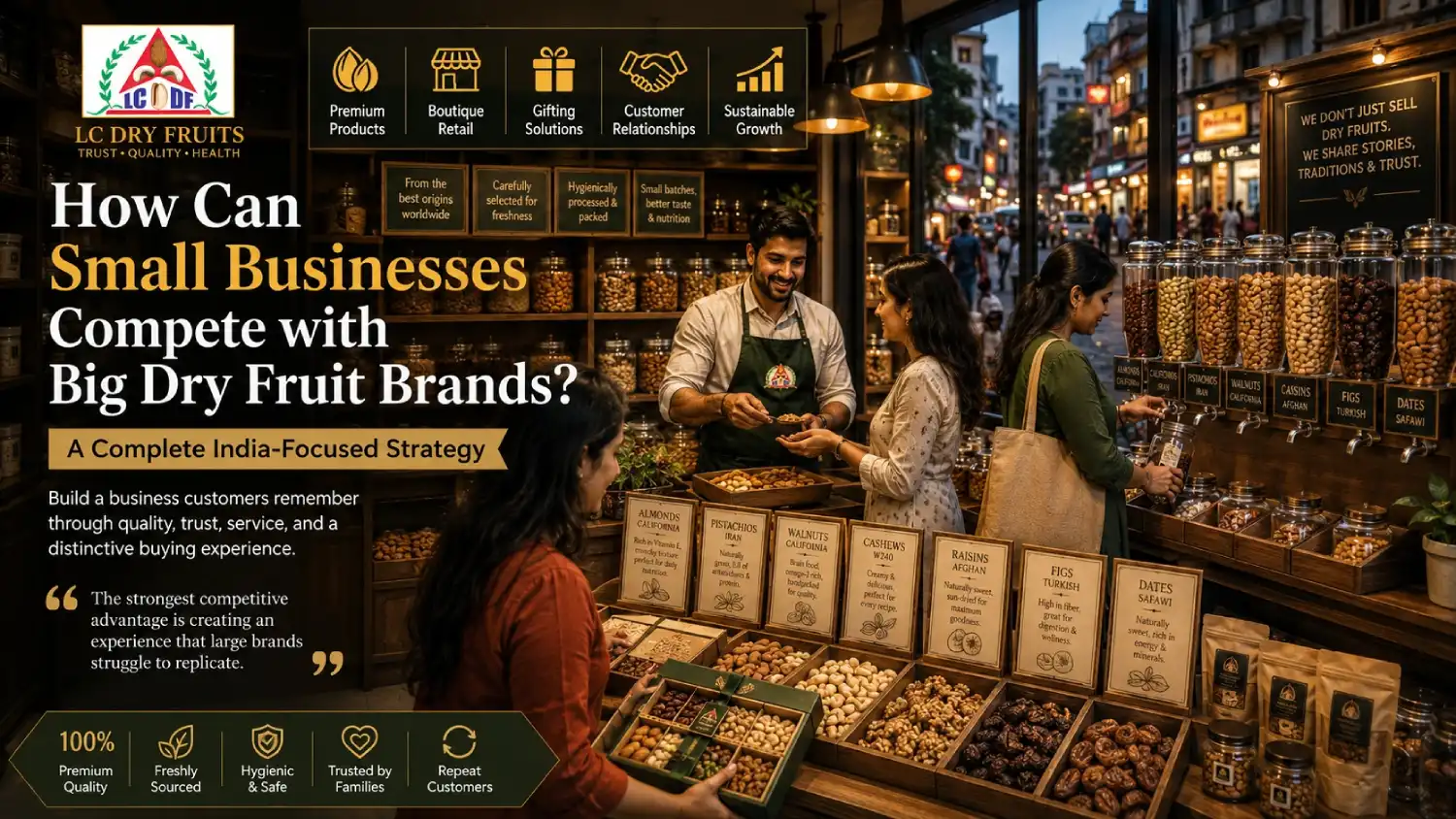
How Can Small Businesses Compete with Big Dry Fruit Brands? A Complete India-Focused Strategy
Summary
Nutraj, Happilo, Rostaa, they've got the budgets, the shelf space, the name people say without thinking twice. What they don't have is a real relationship with the person actually buying the almonds, and once a brand gets big enough, that's almost impossible to get back. This piece is about that exact gap, and where it quietly shows up: a batch that tastes different from the one you bought last month, a sourcing story so generic it could belong to anyone, a complaint that takes three days to get a reply when it should've taken three minutes.
This isn't about convincing yourself you can out-budget a national brand, because you can't, and trying to is a losing game before it even starts. It's about being honest about where you actually have the upper hand, and then not being quiet about it. Talk openly about your quality checks instead of assuming customers will just trust you. Put your FSSAI license somewhere people can actually see it. Use what's already free, your WhatsApp catalog, your own neighborhood, the relationships you're already building one order at a time, instead of waiting until you can afford ads to start earning trust.
And show up hardest in the moments big brands move too slowly for: Diwali gifting, wedding hampers, a corporate order that needs to feel considered instead of catalog-standard. That's where personal attention beats scale, every single time.
If there's one thing worth remembering after everything else in this blog fades, it's this: you're not trying to out-scale the big names. You're trying to out-trust them. And trust isn't something they can simply buy more of, no matter how big their next funding round is.
Key Takeaways
- Big dry fruit brands win on price and distribution, but they lose on consistency, freshness, and personal connection, and that gap is exactly where small brands can compete.
- Batch inconsistency is a common complaint against big brands. Small businesses working with smaller batches can genuinely promise (and deliver) more consistent quality.
- A single-origin sourcing story is far more compelling to customers than "sourced from multiple suppliers," and it's something big brands can't easily copy at scale.
- Displaying your FSSAI license clearly on your website, packaging, and social profiles builds instant credibility, and most small sellers overlook this simple trust signal.
- Transparency sells. Real photos and videos from your sourcing process build more trust than polished stock images ever will.
- WhatsApp Business catalogs cost nothing and are often where the actual buying decision happens for Indian customers, especially repeat ones.
- Hyperlocal marketing works better early on than trying to go national. Win your own neighborhood, then expand.
- Festive season and corporate gifting are windows where big brands are slow and impersonal. Small brands that offer customization here can win business consistently.
- Smart, simple packaging choices like kraft paper or reusable jars can look just as premium as big-brand packaging, often at a lower cost.
- Long-term brand loyalty isn't built through one good sale. It's built order after order, through personal service and consistency that big brands simply aren't structured to offer.
Introduction
There was a time when dry fruits only came out for Diwali, or when guests were coming over and you wanted to look a little more put-together. That's not how India eats anymore. Almonds go into morning smoothies now, dates get packed into gym bags, and a bowl of mixed dry fruits has quietly become a daily habit for a lot of households. That's genuinely good news if you're in this business, but it comes with a catch: the market has gotten crowded fast, and names like Nutraj, Happilo, and Rostaa have already claimed most of the shelf space, the top search results, and the trust that comes with being a familiar name. So if you're running a small dry fruit business, the real question isn't whether these big brands can be beaten. It's how you go about it without burning through a budget you don't have. And the honest answer is, you don't beat them by trying to out-spend them. You beat them by being the kind of brand they've grown too big to be, one that actually knows its customers, stands behind what it sells, and earns trust the slow, real way, one order at a time.
Why Small Dry Fruit Brands Struggle Against Big Names
Let's not sugarcoat it. Big brands buy in massive volumes, which means they lock in supplier prices a small business simply can't touch. They've also spent years building distribution that stretches across Amazon, Flipkart, Zepto, Swiggy Instamart, and general trade shelves, so wherever a customer looks, one of these names is already there waiting. And beyond price and reach, there's something harder to compete with: familiarity. Say "dry fruits" to most people, and a big brand name is probably the first thing that pops into their head, not because it's necessarily the best, but because it's the one they've seen the most.
Then there's the neighborhood kirana store, which adds its own layer of competition. A lot of customers still walk in there out of pure habit, the same shop they've bought from for years, without really thinking twice. So yes, on paper, the odds look stacked against a small brand. But here's the thing worth holding onto: buying power and shelf space are not the same as trust. Trust isn't something a big brand can simply buy more of, and that's exactly where a small business still has real room to win.
The Big Brand Blind Spots - Where Scale Actually Hurts Them
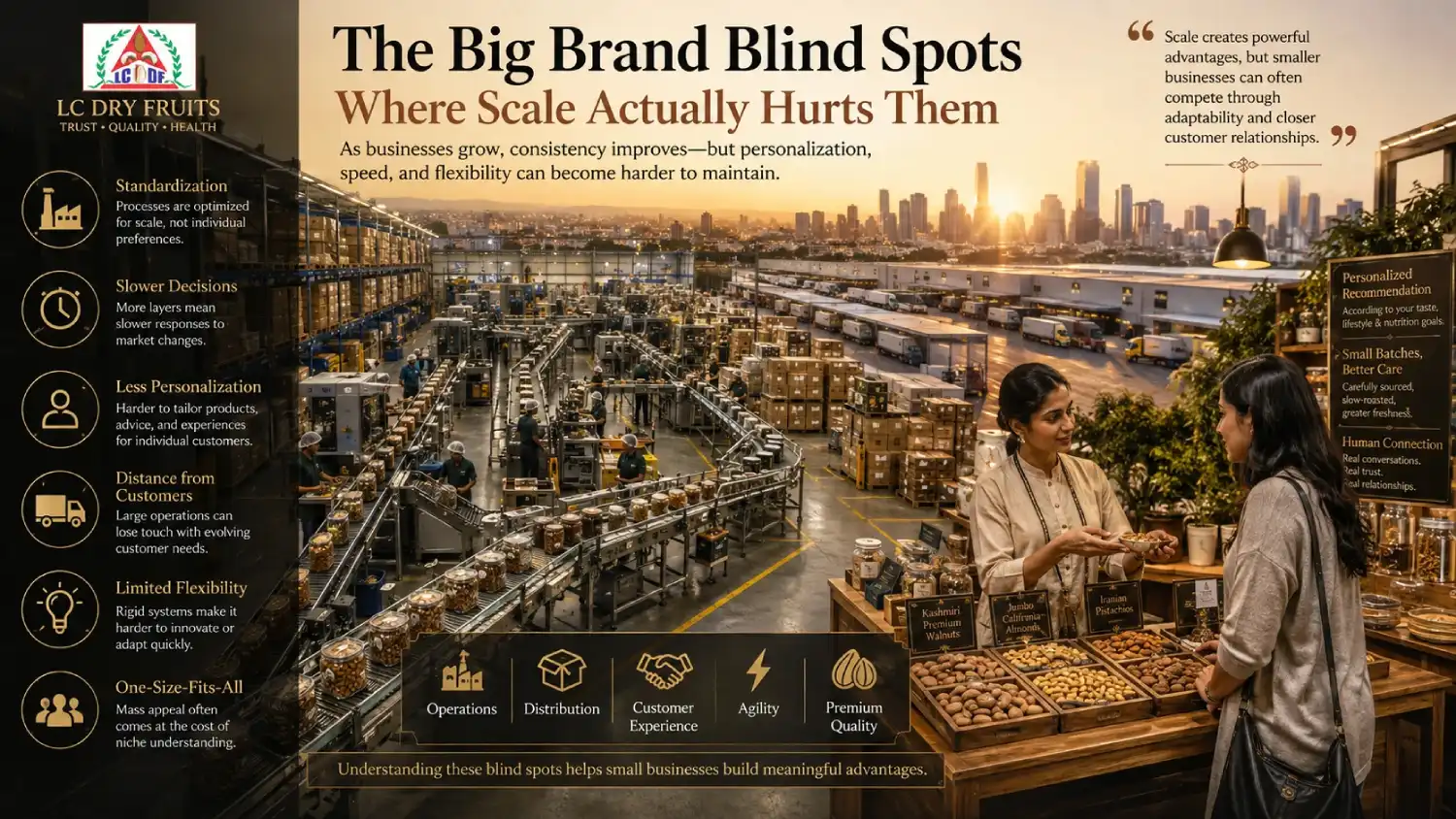
Here's something most small business owners don't realize: the same scale that gives big brands their advantage also creates real weaknesses. And these weaknesses are exactly what you should be building your brand around.
Batch Consistency Is a Real Problem for Big Brands
When you're processing dry fruits at a massive scale, keeping every single batch identical is genuinely hard. Customers who buy from big brands regularly often notice the difference. One month the almonds taste fresh and crunchy, the next month they're slightly bitter or the size is off. This isn't a rare complaint. It's one of the most common reasons people start looking for alternatives. As a small brand, you're working with smaller batches, which means you can actually taste-check and quality-check what goes out. That consistency becomes your selling point.
Generic Sourcing vs a Single-Origin Story
Big brands source from wherever gets them the best bulk price, often mixing origins to meet volume needs. As a small business, you can do the opposite. You can pick one trusted source, one region, one relationship with a farmer or supplier, and build your entire brand story around it. A "single-origin almonds from Kashmir" story is more interesting and more trustworthy than "sourced from multiple suppliers."
Customer Service That Actually Feels Personal
Here's that section rewritten with a more human, trust-forward tone:
Customer Service That Actually Feels Personal
Try this sometime. Message a big dry fruit brand with a complaint and time how long it takes to get an actual human response, not an auto-reply, an actual answer from someone who read what you wrote. Now think about the last time you messaged a small business on WhatsApp. Chances are the owner or someone on their small team got back to you in minutes, sometimes while they were still packing your order.
That's not a coincidence, and it's not something a bigger brand can fix by hiring more people. When you're managing thousands of orders a day across multiple cities, personal replies stop being possible no matter how good your intentions are. As a small brand, this is genuinely one of your biggest advantages, and it costs you nothing extra. You're already replying fast because there's no layer of call centers and support tickets between you and your customer. That's worth saying out loud in your marketing instead of treating it as just how you naturally operate.
There's a second, quieter advantage hiding in the same place. Big brands move products through long chains, warehouses, transit hubs, distribution centers, and every extra day in that journey is a day where humidity and storage conditions can quietly damage a batch of dry fruits. By the time it reaches a customer, freshness has already taken a hit, even if nothing looks visibly wrong. A small brand with a shorter, tighter supply chain doesn't have that problem in the same way. Your product moves from sourcing to packing to the customer's hands faster, which means it's fresher when it actually arrives.
Don't keep that to yourself either. Tell your customers why your almonds taste better, why your dates haven't dried out, why a bag opened three weeks after ordering still feels like it was packed yesterday. That's not a small detail. That's the difference a shorter supply chain makes, and it's exactly the kind of thing big brands can't shorten their way into, no matter how much they invest.
Build Trust the Way Big Brands Can't
In this category, trust is the actual currency you're trading in, more than price, more than packaging. And it's not built through a tagline. It's built through small, specific things a customer can see for themselves.
Show Your FSSAI License, Don't Hide It
Every food business in India is required to have an FSSAI license, yet most small dry fruit sellers tuck it away somewhere or don't mention it at all. Put it right on your website, your packaging, your Instagram bio, somewhere a customer doesn't have to go looking for it. It seems like a small detail, but when someone's deciding between a brand they've never heard of and one they see everywhere, that one visible detail can be the thing that tips the decision your way.
Make Sourcing Transparency Part of Your Brand
Share real photos and short videos from the mandi or the farm you're sourcing from. Not polished stock photography, the actual place, the actual process. Big brands rarely do this, and honestly, they can't, their supply chains are too big and too layered to show simply. For a small business, this is one of the easiest things you can do, and it builds a kind of trust that no product photo, however well shot, ever will.
Turn "No Middlemen" Into Your Story
If you're sourcing closer to the origin and cutting out unnecessary layers, don't keep that to yourself, tell people. Customers today genuinely care about where their food is coming from, and a simple, honest "farm to pack, no middlemen" story gives them a real reason to choose you over a mass-market name, even if you're charging a little more for it.
Address the Adulteration Fear Directly
time they order dry fruits online: is this actually clean? Is that almond artificially colored to look fresher than it is? Did they mix in some lower-grade stock to stretch the batch? Nobody wants to be the customer who asks that question directly, so most people just quietly wonder, and if they're not sure, they simply don't order.
This is where you get to do something almost no big brand will. Bring it up yourself, before anyone has to ask.
Show what your quality checks actually look like. Not a vague "we ensure quality" line buried in your About page, but real specifics: how you sort, how you check for moisture, how you inspect a batch before it gets packed. Say it in your Instagram captions. Put it on your product page. Mention it when someone messages you on WhatsApp asking why your almonds cost a bit more than the pack they saw at the local store.
Big brands almost never go near this topic directly, and there's a simple reason for that. The moment a large player starts talking openly about adulteration and grading, it raises an uncomfortable question: if quality checks matter this much, why hasn't anyone heard about theirs? At their scale, being specific about quality control means opening up a supply chain with hundreds of touchpoints, and that's not a conversation they want to have in a 30-second reel.
You don't carry that risk. Your supply chain is short enough that you actually know where every batch came from and who touched it before it reached your customer. So say that. Show a video of you checking a batch before it's packed. Explain what "grade A almonds" actually means instead of just printing it on the label. Let customers see the process instead of asking them to trust a claim.
Low-Budget Marketing Playbook for Small Dry Fruit Brands
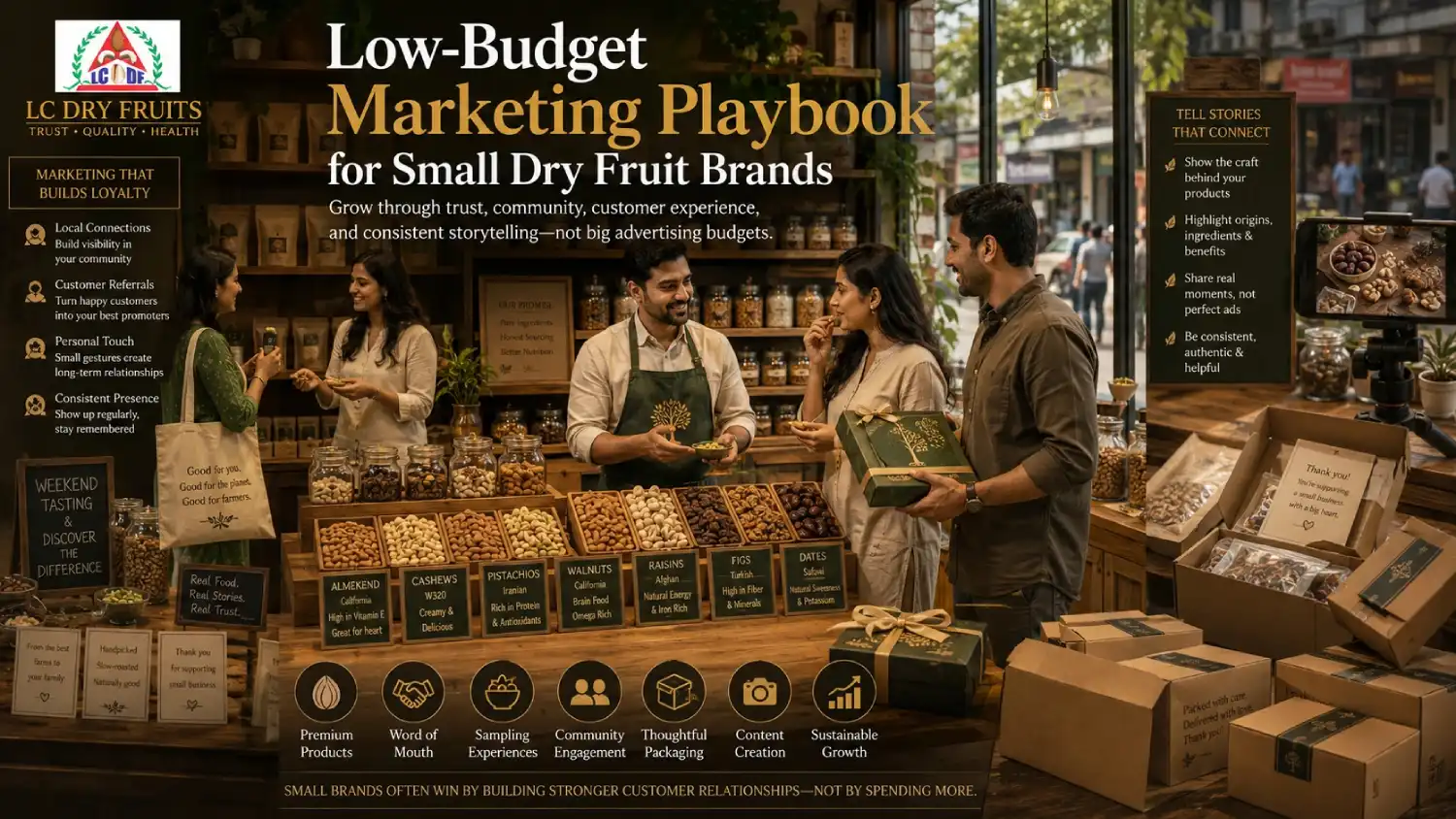
You don't need a big marketing budget to build visibility. You need consistency and the right channels.
WhatsApp Catalog Business Is Your Free Storefront
Set up a WhatsApp Business catalog with clear photos, prices, and product details. It costs nothing, and for a huge number of Indian buyers, WhatsApp is where the actual purchase decision happens, especially for repeat customers who'd rather message you directly than browse an app.
Win Your Own Neighborhood First
Before trying to sell across the country, focus on hyperlocal marketing. Get known in your own area first. Local Facebook groups, resident welfare association WhatsApp groups, and nearby offices are all easier wins than competing nationally on day one.
Instagram Content That Doesn't Need a Big Budget
You don't need expensive shoots. Simple reels showing your sourcing process, your packing station, or a quick "how to store almonds properly" tip perform well because they feel real. This kind of small business branding builds familiarity over time without spending on ads.
Community-Based Marketing Works Better Than You'd Expect
Partner with local gyms for a snack tie-up, offer a small discount to nearby offices for bulk orders, or set up a stall at a local event. These relationships compound. One trusted connection in a gym or office often brings in a dozen repeat customers.
Win Where Big Brands Are Slow - Festive and Corporate Opportunities
Big brands are built for volume, not personalization, and that opens up specific windows where small brands can win clearly.
Diwali Gifting Is a Small Brand's Moment
During festive season dry fruit sales, customers often want something that feels thoughtful, not mass-produced. A small brand offering customized gift boxes, personal notes, or flexible quantities has a real edge over a big brand's standard packaged options.
Wedding Hampers Are a High-Margin Niche
Wedding season brings steady demand for dry fruit hampers, and this is a category where big brands rarely offer customization. If you can offer flexible packaging, branding on request, or mixed hampers at different price points, you're serving a need big brands aren't built to handle.
Corporate Gifting Rewards Personal Touch
Corporate gifting dry fruits is another space where personalization wins. A company ordering fifty gift boxes wants something that feels considered, not generic. Small brands that can quickly customize orders, add company branding, or adjust based on budget will consistently win this business over big brands with rigid catalogs.
Packaging and Presentation - Compete Without Big Brand Budgets
You don't need expensive packaging to look premium. Simple choices like kraft paper pouches, resealable zip pouches, or reusable glass jars can look more premium than plastic packaging at a lower cost than you'd expect. Good packaging also directly protects freshness, since dry fruits are sensitive to humidity and lose quality quickly when storage isn't handled properly. Getting this right solves two problems at once: it improves shelf life and it improves how your product feels when a customer opens it.
Small Dry Fruit Brand vs Big Brand - Quick Comparison
Pricing: Big brands usually win on bulk pricing, but small brands can offer better value on curated or premium selections.
Freshness: Small brands generally win due to shorter supply chains and smaller batch sizes. Customization: Small brands clearly win, especially for gifting and bulk orders.
Personal Touch: Small brands win by a wide margin.
Delivery Speed: Big brands often win in metro cities due to established logistics.
Packaging Cost: Small brands can match or beat big brands with smart, simple packaging choices.
This comparison isn't about proving small brands are better across the board. It's about knowing exactly where you have the advantage and building your marketing around those specific points.
Reaching Beyond Your City - Tier 2 and Tier 3 Opportunity
Tier 2 and Tier 3 city dry fruit demand is growing fast, and it's an area big brands haven't fully saturated yet. Selling direct through your own WhatsApp catalog, Instagram, or a simple website lets you operate as a D2C dry fruit brand without needing the overheads a big brand carries. You skip warehouse costs, large distribution networks, and heavy advertising spends, which means you can offer better freshness and often better pricing to customers in areas that big brands are still slow to reach properly.
Building Long-Term Brand Loyalty as a Small Player
The businesses that grow steadily in this category aren't the ones trying to out-discount big brands. They're the ones building real relationships. Personalized customer service, remembering repeat customers, following up after an order, and being genuinely reachable when something goes wrong all add up over time. Brand loyalty in the dry fruit category isn't won through one great sale. It's won through consistency, order after order, until a customer stops even checking other options.
Frequently Asked Questions
Can a small dry fruit brand survive against Nutraj or Happilo?
Yes, especially by focusing on freshness, trust, and personalized service rather than trying to compete purely on price or scale.
How much investment is needed to start a dry fruit brand in India?
It varies widely based on scale, but many small dry fruit businesses start with modest capital focused on sourcing, basic packaging, and an FSSAI license, growing gradually as orders increase.
Is quality more important than price in dry fruits?
For repeat buyers, yes. Customers who eat dry fruits regularly notice quality differences quickly, and consistent quality is often what keeps them loyal even at a slightly higher price.
How can I market my dry fruit business with a small budget?
WhatsApp Business catalogs, Instagram content, and local community partnerships are all low-cost channels that work well for small dry fruit brands.
What makes customers switch from big dry fruit brands to smaller ones?
Inconsistent quality, stale batches, and impersonal service are the most common reasons. Small brands that fix these specific pain points tend to win those customers over.
About the Author
This piece comes from the team at Lake City Dry Fruits Pvt. Ltd. (LCDF), and honestly, we didn't write it from the outside looking in. We've been on both sides of this story, small and scaling, over a 60-year journey that started in 1964 as a modest retail dry fruits shop in Vallabhnagar, Rajasthan.
We know what it's like to compete without a big budget, because that's exactly where we began. Long before LCDF became a name trusted across 14+ states, with hubs in Udaipur, Pune, Delhi, and Mumbai, we were the small brand in the room, building trust one customer, one order, one honest conversation at a time. That part of our story never really left us, even as we grew into a HACCP, ISO, and FSSAI-certified operation sourcing from origins like the USA, Australia, Afghanistan, and Iran.
So when we talk about batch consistency, sourcing transparency, or why a customer's trust matters more than shelf space, it's not theory. It's what got us from a single shop to a facility processing up to 9,000 kilograms of dry fruits a day, without ever losing the part of the business that made people come back in the first place.
We write these guides for the same reason we run our B2B and white-labeling programs the way we do: because we'd rather see small dry fruit businesses in India build something real than watch them try to out-spend players who were never going to lose that game on price alone.
Conclusion
At the end of the day, no small dry fruit business is going to out-spend Nutraj or out-stock Happilo, and that was never really the game to play. The real opportunity lies in everything big brands can't offer once they cross a certain size: a batch that's actually checked by someone who cares, a reply that comes in minutes instead of days, a sourcing story that's real instead of rehearsed. Trust is slow to build and easy to lose, and that's precisely why it's so hard for a big brand to fake at scale, but so natural for a small one to earn. If you show up consistently, stay honest about where your product comes from, and treat every customer like they matter (because they do), you're not just competing with the big names. You're building something they've lost the ability to offer. And that's what keeps a customer coming back long after the first order.
For More Info Contact Us
Author

LCDF Pvt. Ltd.
Lake City Dry Fruits Pvt. Ltd. has been a pioneer in the dry fruits and spices industry for over 60+ years. From humble beginnings in Udaipur to a pan-India presence, we’ve built a reputation for sourcing the best global produce, ensuring uncompromising quality at every step.