

| LCDF Pvt. Ltd.
Summary
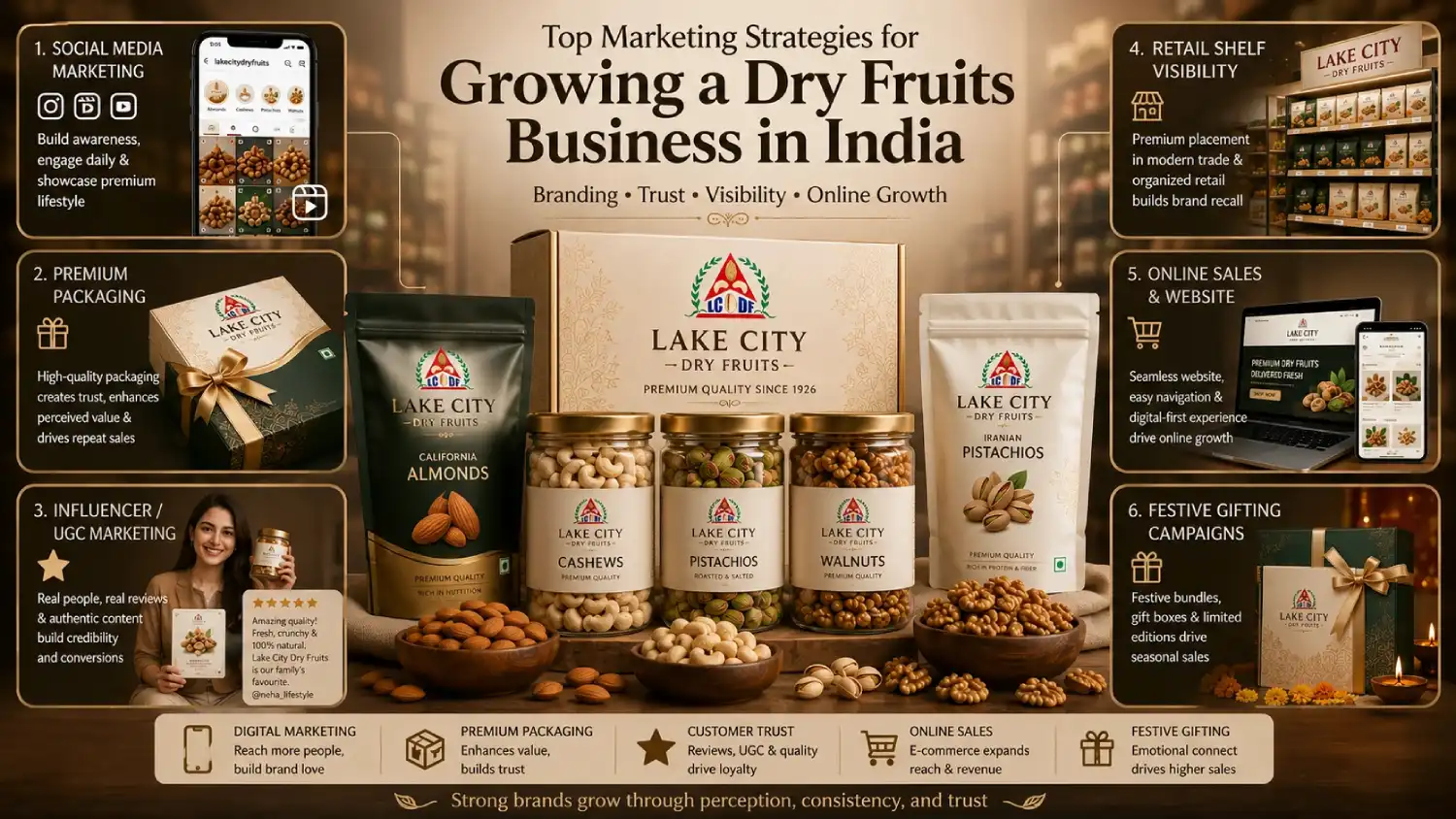
Marketing a dry fruits business requires more than discounts and social media posts. This guide explains the complete marketing system modern dry fruits brands use to grow through premium positioning, trust-building packaging, customer reviews, WhatsApp B2B communication, seasonal gifting campaigns, marketplace optimisation, and repeat purchase strategies.
It also covers how UGC, product page optimisation, influencer marketing, subscription models, and pricing strategy improve long-term profitability and customer loyalty. From D2C and wholesale to export and corporate gifting, the guide breaks down the highest-ROI marketing channels for Indian dry fruits businesses. The focus is on building sustainable growth systems instead of relying only on short-term promotions.
Key Takeaways
- Premium positioning helps dry fruits brands charge higher prices
- Packaging strongly affects trust and conversion rates
- Reviews and UGC improve sales and customer confidence
- WhatsApp Business is highly effective for wholesale buyers
- Seasonal gifting campaigns drive major revenue growth
- Marketplace optimisation improves visibility and conversions
- Instagram and YouTube build long-term brand authority
- Subscription models improve repeat purchases and cash flow
- Strong product pages increase marketing ROI across channels
- Long-term growth comes from systems, not random campaigns
Why Dry Fruits Marketing Is Different From Every Other Food Category
Dry fruits sit in an unusual position in the Indian food market. Demand is rising. Gifting budgets are growing. Health-conscious buyers are actively seeking quality sources. And at the same time, prices have gone up 20 to 40 percent in recent years due to global supply pressures, which means buyers are more selective, more price-aware, and more in need of trust signals before they commit to a purchase.
That combination creates a specific marketing challenge. You are not selling a commodity. You are not selling an impulse snack. You are selling something that people buy for their health, for gifts, for daily nutrition, and for celebrations. That means a single marketing approach will not work. A strategy that works brilliantly for Diwali hampers does nothing for a wholesale reseller looking for monthly supply. A social media campaign that converts urban D2C buyers does not move stock for a corporate gifting client.
This guide is built for all four buyer types: the D2C retail customer, the wholesale or reseller buyer, the corporate gifting client, and the export-focused business. Depending on which of these you are focused on, different sections will be immediately actionable. Most brands would benefit from building toward all four over time.
According to a Statista report on the Indian food and grocery market, India is among the world's largest importers and processors of dry fruits, and the organised food retail sector continues to grow as health trends, gifting culture, and online grocery penetration all move in the same direction. The brands that build a proper marketing system now will be very difficult to dislodge later.
That system starts with premium positioning.
Step 1: Premium Positioning — Charge More and Convert Better
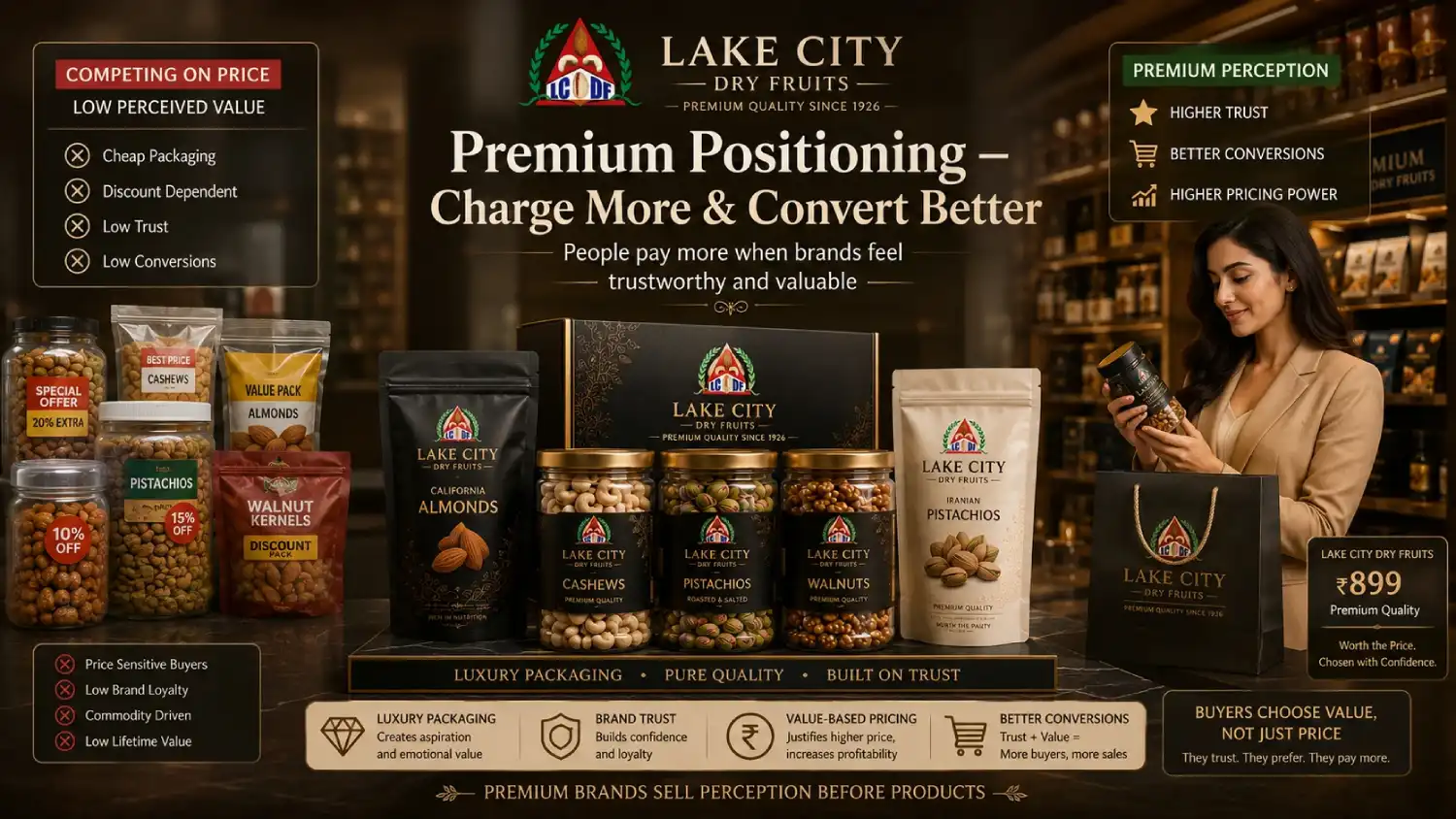
Most dry fruits brands underestimate the power of positioning. They compete on price because they have not given buyers a reason to pay more. The brands that grow consistently are the ones that give buyers an obvious, understandable reason why their product is worth the premium.
Premium positioning in dry fruits does not require a rebrand or a redesign. It starts with two things: grade transparency and origin storytelling.
Grade transparency means telling the buyer exactly what they are purchasing. California almonds come in several grades. Cashews are sorted by size and colour. Walnuts differ by harvest year and moisture content. Most brands either ignore this information entirely or bury it in product descriptions. The brands that explain grades clearly on the product page build instant credibility with buyers who have been disappointed before by unmarked products.
Origin storytelling means telling the buyer where the product comes from and why that matters. Kashmiri walnuts carry a specific flavour profile. Iranian pistachios have a different sweetness compared to American ones. Afghan dry fruits have a recognised quality reputation in the Indian market. A product page that explains origin is not just informative. It is doing the work of justifying the price without appearing defensive about it.
Price anchoring is the third element of premium positioning. When you display a standard SKU and a premium SKU side by side on the same page, the premium option looks like a rational upgrade rather than an expensive choice. The science behind this behaviour is well documented in research on consumer pricing psychology published by Harvard Business Review, which shows that buyers anchor to the first price they see and evaluate all subsequent options relative to that reference point. Without the comparison, the premium price has no reference point and buyers default to looking for the cheapest option available.
Step 2: Packaging and Trust — The Silent Salesperson
Packaging is marketing. In the dry fruits category, it may be the highest-leverage marketing investment available to a small or mid-size brand because it works at the exact moment of purchase and again at the moment of opening.
The World Health Organization's front-of-pack nutrition labelling guidance makes a specific point that applies directly to dry fruits: consumers make faster, more confident purchase decisions when key information is clear, large, and immediately readable on the front of the pack. This is not just a regulatory trend. It reflects how buyers actually behave. When the net weight, grade, origin, and FSSAI number are prominent and easy to read, buyers feel more confident. When those details are small, buried, or absent, doubt enters the purchase decision.
Clear window packaging solves the single biggest anxiety in online dry fruits purchasing. Buyers cannot pick up the packet and feel the weight. They cannot see whether the almonds are plump or shrivelled. A clear window that shows the actual product inside removes that uncertainty in a way that no amount of photography can fully replicate. For brands selling through marketplaces or their own website, clear window packaging is a direct conversion improvement.
The specific label elements that build trust for dry fruits buyers are: prominently stated net weight, a harvest or batch date, a visible resealable closure shown in the product photo, the FSSAI licence number, and origin of the product. The Food Safety and Standards Authority of India (FSSAI) labelling regulations require several of these elements by law, but the brands that treat them as trust signals rather than compliance checkboxes consistently outperform those that do the minimum required.
Seasonal packaging is a separate but equally important opportunity. A product that comes in a standard kraft pouch all year can generate meaningfully higher revenue during festive periods if it is also available in a gift-ready tin or decorative box. The product inside is identical. The perceived value is substantially higher. Brands that offer a gifting version of their core products unlock the corporate and personal gifting market without developing any new products.
Step 3: UGC and Customer Proof — Your Highest-ROI Marketing Channel
User-generated content, which means reviews, customer photos, videos, and Q&A, is the marketing channel with the lowest cost and the highest leverage for dry fruits brands at any stage of growth.
The reason is straightforward. When a buyer visits your product page, they are asking a question your brand copy cannot answer honestly: does this product actually deliver what it promises? Your description says the cashews are fresh and premium. But another customer who received the order, opened the pack, and wrote a review that says "arrived perfectly sealed, cashews were plump and fresh, already on my third order" answers that question in a way no brand can replicate.
According to the PowerReviews 2023 Conversion Impact Study, product pages with UGC convert at rates 74 to 161 percent higher than pages without it. Forty percent of shoppers will not complete a purchase if there are no reviews on the product page. These numbers apply directly to dry fruits because the category shares the same trust barrier that makes UGC so powerful across all food products.
The most underused UGC feature in dry fruits e-commerce is the product page Q&A section. According to the same PowerReviews research, shoppers who interact with a Q&A section convert at a rate 177 percent higher than those who do not.
The reason is that Q&A catches a buyer at the exact moment of hesitation. A shopper who is almost convinced but unsure whether the pistachios are dry-roasted or oil-roasted, or whether the packaging is resealable, or how long the product stays fresh after opening, gets their question answered immediately and publicly. Every answer benefits every future buyer with the same question.
Set up Q&A on every major product page. Seed each section with five questions you know buyers commonly have. Answer them completely as the brand. The most effective seed questions for dry fruits product pages are: how long does this stay fresh after opening, are these dry-roasted or roasted in oil, does the packaging include a resealable closure, what is the country of origin, and are these suitable for someone with a specific nut allergy.
Photo and video UGC from customers is the second most powerful type. An unboxing video where a customer shows the seal condition, fill level, and product quality on camera substitutes for the physical store experience. A recipe photo showing your walnuts in a homemade brownie proves versatility and makes the product feel like a normal part of daily life rather than a one-time purchase.
For wholesale and B2B buyers, WhatsApp testimonials are a particularly effective trust signal. A screenshot of a bulk-order customer's WhatsApp message saying "received the consignment, quality is consistent as always, placing next month's order now" is more persuasive to another wholesale buyer than a formal review. Collect these with permission and display them on your wholesale inquiry page or B2B landing page.
Step 4: Seasonal and Festival Marketing — Where Dry Fruits Money Is Made
The dry fruits business in India has a rhythm. Understanding that rhythm and building marketing campaigns around it is the difference between a business that struggles to maintain flat revenue and one that grows year on year.
The primary demand windows and how to approach each one are as follows.
Diwali is the single highest-value window. Begin promotions six weeks before Diwali. The first two weeks are for awareness and gift box pre-orders. Weeks three and four are for urgency messaging around limited stock and price lock. The final two weeks are peak order period. The channel priority for Diwali is Instagram and email for D2C buyers, WhatsApp for corporate gifting clients, and marketplace advertising for impulse buyers. Premium gift boxes and hampers should be your flagship offering during this window.
Eid is the second major gifting occasion and is underserved by most dry fruits brands. Dates, dried figs, and mixed nut boxes perform especially well. Begin four weeks before Eid. The messaging angle is generosity and quality rather than price. Corporate gifting is a significant opportunity here for brands that have an established B2B presence.
Raksha Bandhan is a high-frequency gifting occasion where dry fruits hampers pair naturally with traditional gifts. Start three weeks before. The D2C buyer is the primary audience here. Instagram Reels showing gift packaging and unboxing perform well in this window.
Wedding season, which runs from October through February with regional variation, is a consistent and high-volume opportunity for bulk dry fruits supply. Hotels, caterers, sweet shops, and event planners all need reliable bulk sources. The marketing approach for wedding season is B2B outreach and WhatsApp, not consumer social media.
New Year corporate gifting in December is an underused window for dry fruits brands that have not yet built a corporate gifting programme. HR managers and procurement teams in mid-to-large organisations send employee gifts every December. A well-designed hamper with a company branding option is a compelling pitch.
Price volatility is an angle no competing content has addressed, yet it is directly relevant to how you market during any festive period. When almonds or pistachios rise 30 percent in price, the instinctive response is to apologise for higher prices or discount to compensate. The more effective approach is a price-lock offer:
"Our Diwali gift boxes are priced at today's rate. Stock is limited and prices will increase after this batch."
This turns a supply cost problem into a purchase trigger that actually accelerates buying decisions rather than delaying them. The Reserve Bank of India's commodity price monitoring data consistently shows that food commodity price announcements drive forward-buying behaviour among informed consumers, which is exactly the psychology this approach activates.
Step 5: Channel Strategy — D2C, Wholesale, Marketplace, and Export
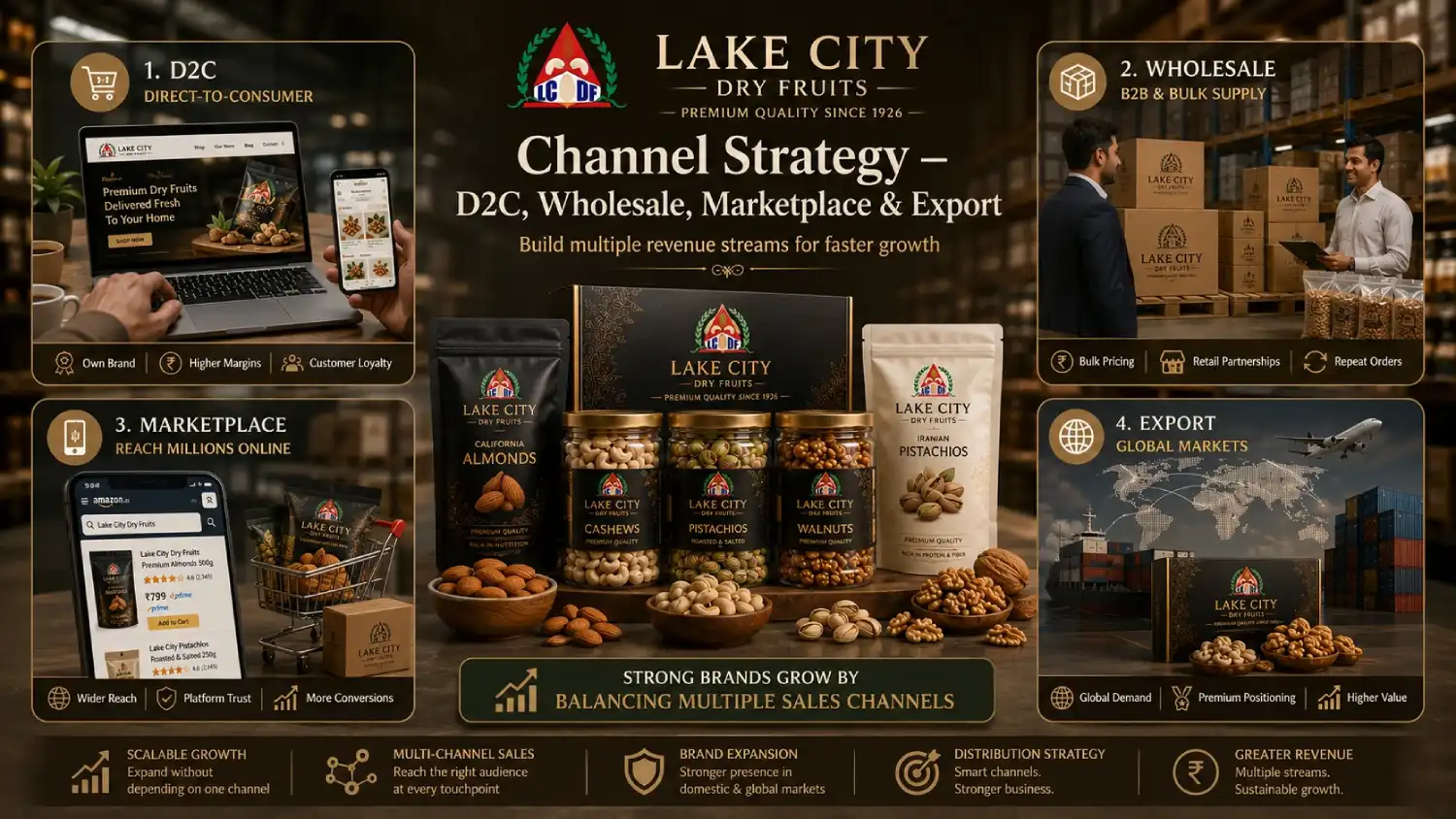
A dry fruits business with a single-channel strategy is permanently fragile. One algorithm change on Amazon, one bad festive season on Instagram, or one large wholesale client switching supplier can remove a significant portion of revenue overnight. Building across multiple channels takes time, but the brands that do it create compounding advantages that single-channel competitors cannot match.
Here is how to think about each channel and who it serves best.
Your own website or D2C store is the highest-margin channel and the one that gives you the most control over brand experience and customer relationships. It suits buyers who have already decided to trust you and are returning to reorder, as well as buyers who arrive from organic search, Instagram, or email. The key investment for this channel is content product descriptions, Q&A, UGC, and a recipe or health blog and email marketing for repeat purchase activation. Subscription pricing, where buyers get five to ten percent off for monthly deliveries, works especially well for dry fruits because the natural use pattern is regular and predictable.
Marketplace channels, primarily Amazon and Flipkart, suit buyers who are searching by product name and comparing options by price and reviews. Your priority on these platforms is listing quality: keyword-rich titles, A-plus content with clear imagery, and review accumulation. Amazon's own seller central guidance on A-plus content confirms that enhanced content consistently improves conversion rates on product listings. Quick commerce platforms like Blinkit and Zepto suit smaller pack sizes and urban buyers making impulse or top-up purchases. Do not try to compete on price alone on marketplaces. Compete on review volume, listing quality, and packaging differentiation.
WhatsApp Business is the most important channel for wholesale and B2B growth, yet it is the one most systematically neglected. Most Indian dry fruits businesses already use WhatsApp informally to communicate with resellers and bulk buyers. The brands that formalise this into a system grow their wholesale revenue significantly.
According to Meta's WhatsApp Business research, businesses that use structured broadcast lists and catalogues see significantly higher response and order rates than those using informal personal messaging. The system involves a WhatsApp Business account with a proper catalogue, broadcast lists segmented by buyer type, resellers, retailers, corporate clients, a weekly or fortnightly update covering new stock, pricing changes, and seasonal offers, and PDF catalogues formatted for easy sharing.
Export through APEDA, the Agricultural and Processed Food Products Export Development Authority of India, is a realistic channel for brands that have established domestic operations and want to access diaspora markets in the Middle East, the United Kingdom, and the United States.
The APEDA official export registration portal outlines the complete pathway, which involves registration as an exporter, relevant certifications including FSSAI and organic certification where applicable, and compliance with importer-specific requirements for the target market. The Middle East market is the most accessible entry point for Indian dry fruits exporters given existing trade relationships and diaspora demand. The UK and US diaspora markets respond well to origin-specific products like Kashmiri walnuts or Khajoor from specific growing regions.
Step 6: Social Media Marketing That Actually Sells Dry Fruits
Social media for dry fruits is not about follower counts. It is about producing content that answers real buyer questions and shows the product in contexts that make the purchase decision easier.
Instagram works best for dry fruits when the content falls into one of three categories. The first is freshness and quality proof: short videos showing the product as it arrives, being opened, showing fill level and texture.
This is the visual equivalent of picking up the packet in a store. The second is recipe integration: showing your almonds in overnight oats, your walnuts in a brownie, your dates blended into an energy ball. Recipe content expands the buyer's imagination about how they will actually use the product and directly reduces the objection of buying more than they know what to do with. The third is sourcing and origin content: a reel showing the almond orchard in California, the walnut harvest in Kashmir, or the drying process for figs. This content builds brand authority in a way that no amount of product photography can match.
YouTube and YouTube Shorts are a significant underused opportunity for dry fruits brands. Search-intent content on YouTube ranks for queries that product pages and Instagram posts cannot capture.
Videos with titles like "how to store dry fruits at home," "what almond grade means and which to buy," "5 ways to use walnuts in daily cooking," and "difference between California and Mamra almonds" attract buyers who are in the research phase of their purchase decision. Google's own research on the consumer decision journey consistently shows that video content on YouTube influences purchase decisions across food and grocery categories more than any other platform. These videos rank on YouTube, appear in Google video results, and can be embedded on product pages to add credibility and dwell time for SEO.
WhatsApp status is the most underrated social channel for dry fruits businesses with an existing customer base. A daily or twice-weekly status post showing new stock arrivals, a freshness video, or a limited-time offer reaches every contact in your phone who saves your number. For small and mid-size businesses, this drives more direct purchase decisions than organic Instagram posts to a small following.
Micro-influencer partnerships work better for dry fruits than celebrity or macro-influencer partnerships. A nutritionist with 15,000 followers who recommends your almonds as a daily snack reaches a more relevant and trusting audience than a lifestyle influencer with 500,000 followers who mentions them once. Food bloggers, fitness creators, and ayurveda or wellness accounts are the three most effective influencer categories for dry fruits brands. The Influencer Marketing Hub's annual benchmark report confirms that micro-influencers in the food and wellness category generate three to five times higher engagement rates than macro-influencers, with significantly lower cost per engagement. Identify five to ten creators in your city or language market, send them a sample, and ask for an honest review rather than a scripted post.
Step 7: Pricing and Margin Strategy — How to Grow Without Racing to the Bottom
Price is where most dry fruits businesses feel trapped. The category is competitive, buyers compare prices easily on marketplaces, and imported raw material costs fluctuate significantly with global supply and currency movements. The brands that grow profitably are the ones that build margin into their product architecture rather than fighting for it on every individual transaction.
Bundle pricing is the most immediately actionable margin tool. A mixed nut box that combines high-margin cashews and pistachios with lower-margin almonds and walnuts blends the margin profile of the range while delivering perceived value to the buyer.
Trail mix and snack mix formats blend small quantities of premium items with lower-cost ingredients to create a product that retails at a strong price point with a healthy margin. Hamper formats for gifting allow you to set prices based on perceived gift value rather than cost-plus calculation, which is where the strongest margins in the category exist.
Subscription pricing locks in repeat revenue and reduces the cost of customer reacquisition, which is one of the highest hidden costs in D2C food businesses. Offering five percent off for a monthly subscription and ten percent off for a quarterly subscription creates a base of predictable revenue that makes cash flow planning significantly easier.
Dry fruits are particularly well-suited to subscription because the use pattern for health-conscious buyers is genuinely regular: a daily handful of almonds, weekly baking with walnuts, or monthly replenishment of a gift supply are all natural repeat purchase triggers.
Research published by McKinsey on subscription e-commerce found that subscribers in the food category spend an average of 30 to 40 percent more per year than non-subscribers buying the same products on an ad hoc basis.
When raw material prices rise, communicate proactively with your customers. A short email or WhatsApp message that explains why prices are increasing, references the global supply situation, and offers a price-lock option for buyers who order within the next two weeks converts the price increase from a negative event into a sales trigger. Buyers who understand the reason for a price increase are far less likely to switch supplier than buyers who receive a price increase without explanation.
Step 8: Channel ROI Comparison — Where to Put Your Next Marketing Rupee
If you are a dry fruits business with a limited marketing budget and limited time, the question is not which channels exist. The question is which channels to prioritise in which order given your current stage, buyer type, and available resources.
The sequencing that works for most dry fruits businesses at the growth stage is as follows.
Start with reviews and UGC on your existing product pages. The cost is near zero, the conversion impact is immediate, and the compounding effect means every review you collect makes future marketing cheaper. A product page with fifty strong reviews converts paid traffic at a significantly higher rate than one with five. This is the highest-leverage first move available.
Add WhatsApp Business formalisation second if you have any wholesale or repeat buyer relationships. Broadcast lists, a proper catalogue, and a consistent update cadence can increase B2B repeat order frequency without any advertising spend. For most small and mid-size dry fruits businesses, this single change produces more revenue in the first three months than any social media campaign.
Build marketplace listing quality third. Improve product titles, upload A-plus content, and implement a systematic review collection process on Amazon and Flipkart. This is infrastructure work that pays dividends over a long time horizon and costs time rather than money.
Invest in Instagram organic content and YouTube fourth. This builds brand authority and search visibility over time but is slower to produce direct revenue than the first three steps. Treat it as a medium-term investment, not a short-term revenue channel.
Run paid social advertising last, once you have UGC to use as creative and a product page that converts the traffic you send to it. Paid advertising on a product page without reviews, without a Q&A section, and without customer photos is a direct route to wasted spend. The Meta Ads Manager best practices guide explicitly recommends using authentic customer content as ad creative, noting that UGC-based ads consistently outperform branded creative in the food and grocery category.
The ROI comparison across these channels: UGC and reviews require zero direct cost and produce a 74 to 161 percent conversion lift on existing traffic. WhatsApp B2B formalisation requires low cost and produces high direct revenue impact for businesses with existing wholesale relationships. Marketplace listing optimisation requires time investment and produces medium-term compounding returns. Instagram organic requires consistent content creation and produces slow but lasting brand equity. Paid social advertising requires a budget and produces immediate but non-compounding returns that stop when spend stops.
Your 30-Day Dry Fruits Marketing Action Plan
This plan does not require significant budget. It requires consistency and the willingness to build systems rather than run one-off campaigns.
Week one: audit your top five product pages. Confirm that each has a visible star rating and review section, a seeded Q&A section with at least five answered questions, at least one customer photo, and clear grade and origin information in the product description. Fix anything that is missing.
Week two: set up a WhatsApp Business account with a catalogue if you have not already done so. Build a broadcast list of your top twenty wholesale or repeat customers. Send a festive season preview message that covers upcoming stock, gift box options, and pricing. Keep it professional and brief.
Week three: create one Instagram Reel showing either the sourcing journey of a key product or a freshness check of a recent delivery. Run it as a boosted post with a modest daily budget targeted to your city and relevant interest categories. Measure reach and profile visits, not just likes.
Week four: identify one corporate gifting prospect — either a mid-size company, a hotel, or an event planner — and send them a WhatsApp message with a formatted PDF catalogue of your gift box range, prices, and a minimum order quantity. Attach a photo of your best-looking hamper. This single outreach, done consistently every week, builds the corporate gifting channel that most dry fruits businesses talk about but never systematically pursue.
At the end of thirty days you will have stronger product pages, a functioning B2B communication system, one piece of social proof content in market, and your first corporate gifting outreach in motion. The compounding begins from here.
FAQ
How do I start marketing a dry fruits business with a small budget?
Start with zero-cost, high-leverage actions before spending on advertising. Set up reviews and Q&A on your product pages, formalise your WhatsApp communication with existing customers, and optimise your marketplace listings. These three steps consistently produce more revenue impact per rupee of effort than any paid advertising campaign for a business that is still building its customer base.
Which platform works best for selling dry fruits online in India?
The answer depends entirely on your buyer type. For D2C retail buyers, a combination of your own website and Amazon or Flipkart works best. For wholesale and reseller buyers, WhatsApp Business is more effective than any social platform. For corporate gifting clients, email and WhatsApp outreach with a formatted catalogue produces the best results. For export buyers, APEDA registration and B2B trade platforms are the relevant channel. Building toward all four creates the most resilient long-term business.
How can a small dry fruits brand compete with Nature's Basket or Amazon Pantry?
Large platforms compete on breadth, price, and convenience. A specialist dry fruits brand can win on origin transparency, product expertise, and trust. A customer who wants to know the specific grade of their almonds, the harvest year of their walnuts, or the sourcing story behind their Iranian pistachios will find more value in a specialist brand than in a grocery platform that sells 50,000 SKUs. Own the expertise and the trust signals. Large platforms cannot fake either.
Is export a realistic option for a small dry fruits brand?
Yes, for brands that have established domestic quality systems and consistent supply. The APEDA registration process is accessible to registered food businesses with FSSAI certification. The most practical entry point for most Indian exporters is the Middle East market, where existing trade relationships and Indian diaspora demand create a natural first customer base. The UK and US diaspora markets are viable next steps. Expect six to twelve months from registration to first export shipment for a business doing this for the first time.
How should I price dry fruits during a festive season when raw material costs have risen?
Use a price-lock positioning approach rather than discounting or apologising. A message that says "our Diwali boxes are priced at today's rate for the next two weeks before we adjust for the new season" creates genuine urgency based on real market conditions. Buyers who understand the supply context respond positively to this approach. It also trains your customer base to purchase earlier in the festive window rather than waiting for last-minute deals.
What content works best for dry fruits on Instagram?
The three content types that consistently perform are freshness and quality proof videos, recipe integration content, and origin or sourcing stories. Freshness proof is the most directly conversion-linked because it answers the online buyer's primary anxiety. Recipe content extends use occasions and reduces the "I would not know what to do with 500 grams" objection. Origin stories build brand authority over time and create the kind of content that buyers share and remember.
About Author
Lake City Dry Fruits is one of India’s trusted dry fruits and spices companies, with a legacy that began in 1964 in Rajasthan. Over the years, the company has grown from a regional retail business into a large-scale dry fruits brand serving wholesalers, retailers, distributors, hospitality businesses, corporate gifting clients, and consumers across India.
The company sources premium-quality almonds, cashews, pistachios, raisins, walnuts, dates, and spices from trusted origins including the USA, Australia, Afghanistan, Iran, and India. Lake City Dry Fruits combines traditional sourcing expertise with modern processing and packaging systems to maintain freshness, hygiene, and consistency across every batch.
With operations across Rajasthan, Delhi, Mumbai, Pune, Ahmedabad, and other business hubs, the company serves both B2B and B2C markets through wholesale supply, private labeling, custom packaging, and its consumer-focused “20-20 Dry Fruits” brand.
Lake City Dry Fruits focuses on:
- Premium sourcing and quality control
- Hygienic processing and packaging
- Long-term supplier relationships
- Transparent business practices
- Reliable bulk supply systems
- Modern branding and marketing strategies
This content is created using practical industry experience, dry fruits market research, consumer buying psychology, packaging trends, eCommerce insights, and real-world business strategies observed across the Indian dry fruits industry.
Conclusion
The dry fruits industry is growing rapidly, but growth alone does not guarantee success. Competition is increasing across marketplaces, social media, and wholesale channels, while buyers are becoming more quality-conscious and trust-focused than ever before.
That is why successful dry fruits brands do not grow through random marketing tactics alone. They grow by building systems.
This guide was written to show how modern dry fruits businesses actually scale in India — through premium positioning, trust-building packaging, customer reviews, WhatsApp B2B systems, seasonal gifting campaigns, marketplace optimisation, and repeat purchase strategies.
The biggest lesson is simple: marketing works best when every part supports the next. Better packaging improves trust. Better trust improves reviews. Strong reviews improve conversions. Repeat customers reduce advertising costs. Over time, these systems compound and create long-term business growth.
As Philip Kotler writes in Marketing Management, the most effective marketing is built on genuine customer satisfaction rather than promotional spend. In the dry fruits business, that trust becomes your biggest competitive advantage.
The good news is that most competitors are still not building these systems properly. That creates a major opportunity for brands willing to focus on consistency, customer experience, and long-term trust instead of only chasing short-term sales.
Start with the basics. Improve your product pages. Collect reviews and UGC. Build WhatsApp communication systems. Create stronger packaging. Focus on repeat customers. Once these foundations are in place, your marketing becomes more effective, your customer loyalty becomes stronger, and your dry fruits business becomes much easier to grow sustainably.
Sources: APEDA Agricultural Export Policy, WHO Front-of-Pack Nutrition Labelling Guidance, PowerReviews Conversion Impact Study, Bazaarvoice Shopper Experience Index, FSSAI Food Labelling Regulations, McKinsey Subscription E-commerce Research, Think With Google Consumer Insights, Influencer Marketing Hub Benchmark Report.
Author

LCDF Pvt. Ltd.
Lake City Dry Fruits Pvt. Ltd. has been a pioneer in the dry fruits and spices industry for over 60+ years. From humble beginnings in Udaipur to a pan-India presence, we’ve built a reputation for sourcing the best global produce, ensuring uncompromising quality at every step.