

| LCDF Pvt. Ltd.
Summary
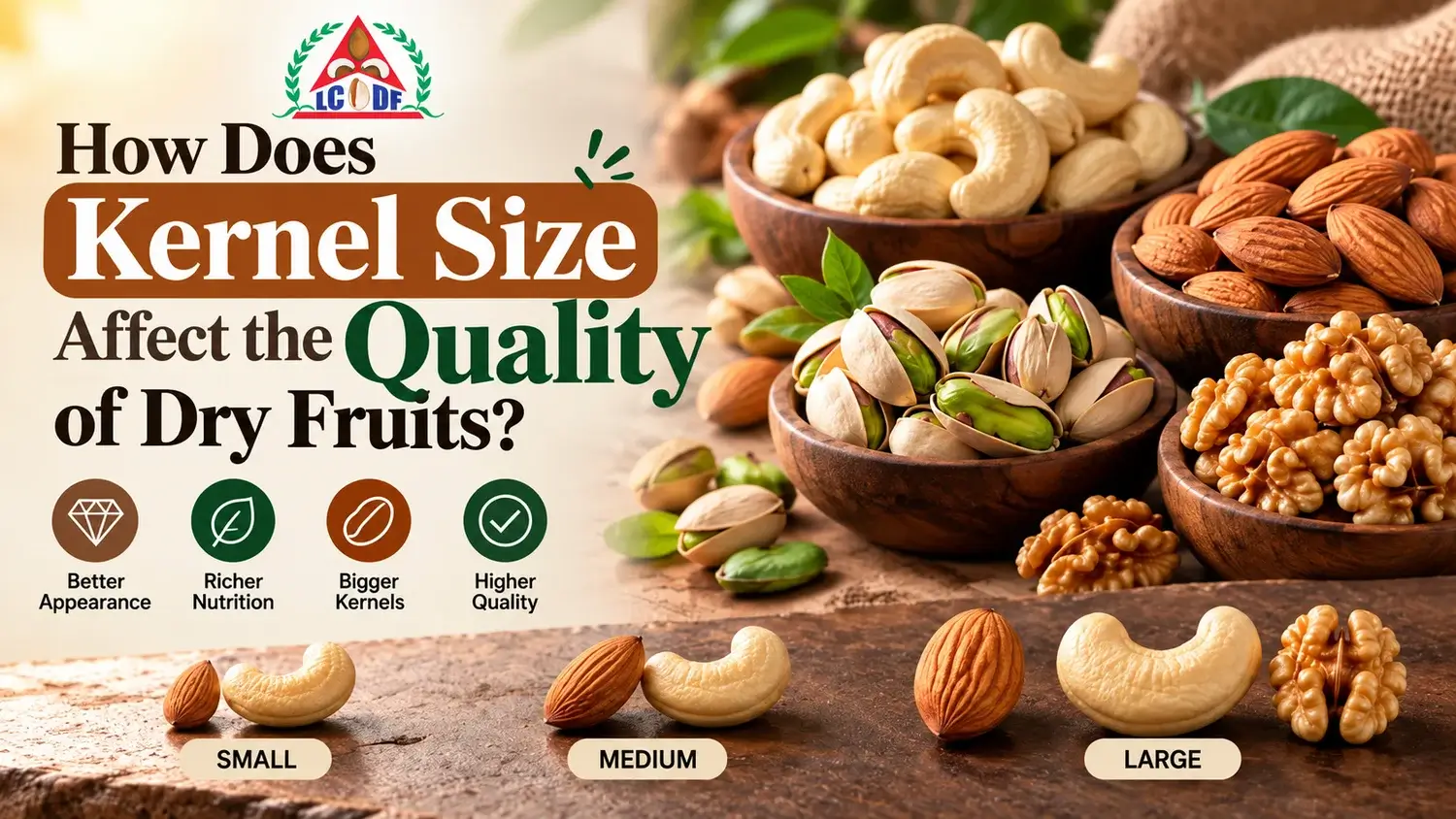
Kernel size is one of the first things you notice on a pack, so it is easy to treat it as the whole story. Standards say otherwise. They measure size on one scale and quality on another, and each answers a different question. In this guide, we explain how traders count kernels, what size really changes (looks, price, roasting and breakage) and what it does not change, such as nutrition. We also show why a very small kernel is sometimes a warning sign, why moisture, peroxide value and defects tell you more than size, and how a simple 100 gram kitchen test lets you check any pack yourself. Our family has graded and sold dry fruits since 1964, and we point out where the evidence runs thin.
Key Takeaways
- Size and quality sit on different scales. The Almond Board says the parameters that decide almond grade apply whatever the variety or size. The AFI cashew specification also treats size as its own axis, apart from colour, wholeness and defects.
- A size label describes a range, not every kernel. Cashews are counted per pound, so W180 covers 140 to 180 kernels, W240 covers 220 to 240 and W320 covers 300 to 320. Almonds work the same way, per ounce. Neither label promises that every kernel matches.
- Size mainly changes looks, price and the job a kernel suits. One 2026 European trade table lists W180 cashews at more than double the per kilo price of W320. You pay most for size where people can see it, such as gift boxes and clear pouches.
- Even sizing gives even roasting. The AFI specification tells roasters to adjust time and temperature for butts, splits and small kernels. A pack with mixed sizes roasts unevenly, so uniformity matters as much as big kernels.
- Smaller kernels probably stale a little sooner, but nobody has proved it. Almonds hold about 50% fat, and cutting or blanching exposes more surface to oxygen. Smaller kernels show more surface for their weight, so we expect the same effect. We found no direct test on whole almond size grades, and we say so.
- Nutrition does not follow size. A study of cashew grades found little variation in composition across the grades. Per gram you get about the same, and per piece a bigger kernel simply gives you more because it weighs more.
- Small by grade is fine, but small by defect is not. The FDA calls an unshelled nut shriveled when the kernel is under half its normal size, and a blank when it is so shrunken that it is inedible. Learn to tell a healthy small kernel from a shriveled one.
- You cannot judge safety by size. In one Iranian pistachio study, 77.1% of small nuts carried aflatoxin against 28.8% of normal size nuts, and early splitting explained the gap. That study covers one variety, so we read it as a warning sign. Aflatoxin needs careful sourcing, sorting and lab testing, because your eyes cannot reliably catch it.
- Four numbers beat size. Moisture, peroxide value, free fatty acids and defect limits tell you far more about freshness and safety. The AFI specification puts cashew moisture at 3 to 5%. A big kernel can be damp, and a small one can be perfectly dry.
- Compare size within one variety, then check the pack yourself. Genuine Mamra almonds look small, plump and curved, yet they cost several times more than California almonds. Size never ranks two varieties fairly. Use the 100 gram kitchen test at home. For bulk orders, ask for the count range, tolerance, moisture reading and a certificate of analysis. A good supplier welcomes those questions.
Introduction
Picture two packs of cashews on a shelf. The colour matches, the curve matches, and one costs far more. Most of us guess that the bigger kernels must be the better ones, and plenty of shopkeepers say the same.
The real story helps you more as a buyer. Our family has sorted and sold dry fruits since 1964, across three generations, so this question reaches us from home shoppers and bulk buyers alike. In this guide, we explain what kernel size really changes, what it never changes, and how you can check a pack yourself. We lean on official standards and published studies, and we tell you plainly when the evidence runs thin.
The short answer
Kernel size changes how a dry fruit looks, what it costs and how it behaves in the roaster and the kitchen. It does not decide nutrition, and it does not decide freshness or safety. Quality standards judge those things separately, through defects, moisture and overall condition. Size can still give you a clue, because very small kernels are sometimes shriveled or immature. So compare size within one variety, then check the count, the moisture and the defects.
Size and quality sit on two different scales
Trade standards ask two separate questions. Size asks how big a kernel is. Quality asks how sound it is.
Almonds show the split clearly. The Almond Board's grading kit says the parameters that decide an almond's grade apply whatever the variety or size. Those parameters include doubles, chipped skin, split and broken kernels, foreign material and serious defects such as decay, rancidity, insect injury and mould damage. The word Supreme on a pack is an industry habit. It is not a USDA grade, and it usually points to U.S. No. 1.
Cashews follow the same logic. The AFI specification grades cashews by colour, wholeness and defects, and it treats size as its own axis. It makes sizing compulsory only for first quality fancy kernels. The UN standard for inshell almonds sorts them into classes by defects and leaves sizing optional in every class.
Walnuts show it too. For walnuts, size mostly means halves or pieces, while the real grade comes from kernel colour, from extra light to amber.
So a small kernel can be top quality, and a big kernel can be a poor one. Size alone guarantees nothing.
How kernel size is measured
Traders count kernels. Almonds go by count per ounce, so 23/25 means about 23 to 25 whole almonds in one ounce, and a lower number means a bigger kernel. Cashews go by count per pound. Under the AFI table, W180 holds 140 to 180 kernels per pound, W210 holds 180 to 210, W240 holds 220 to 240, W320 holds 300 to 320 and W450 holds 400 to 450.
The counting rules matter more than most buyers realise. The almond trade weighs samples of 8 or 10 ounces and leaves out doubles and broken kernels before it counts. A double is two kernels grown in one shell, and one side comes out flat or dented. For cashews, the standard allows no more than 10% of whole kernels by weight to come from a lower size grade. A cashew still counts as whole if no more than one eighth has broken off.
So a W240 label or a 23/25 label describes an average inside a range. It does not promise that every kernel matches. That is why even sizing matters as much as big sizing.
What kernel size really changes
Price and looks
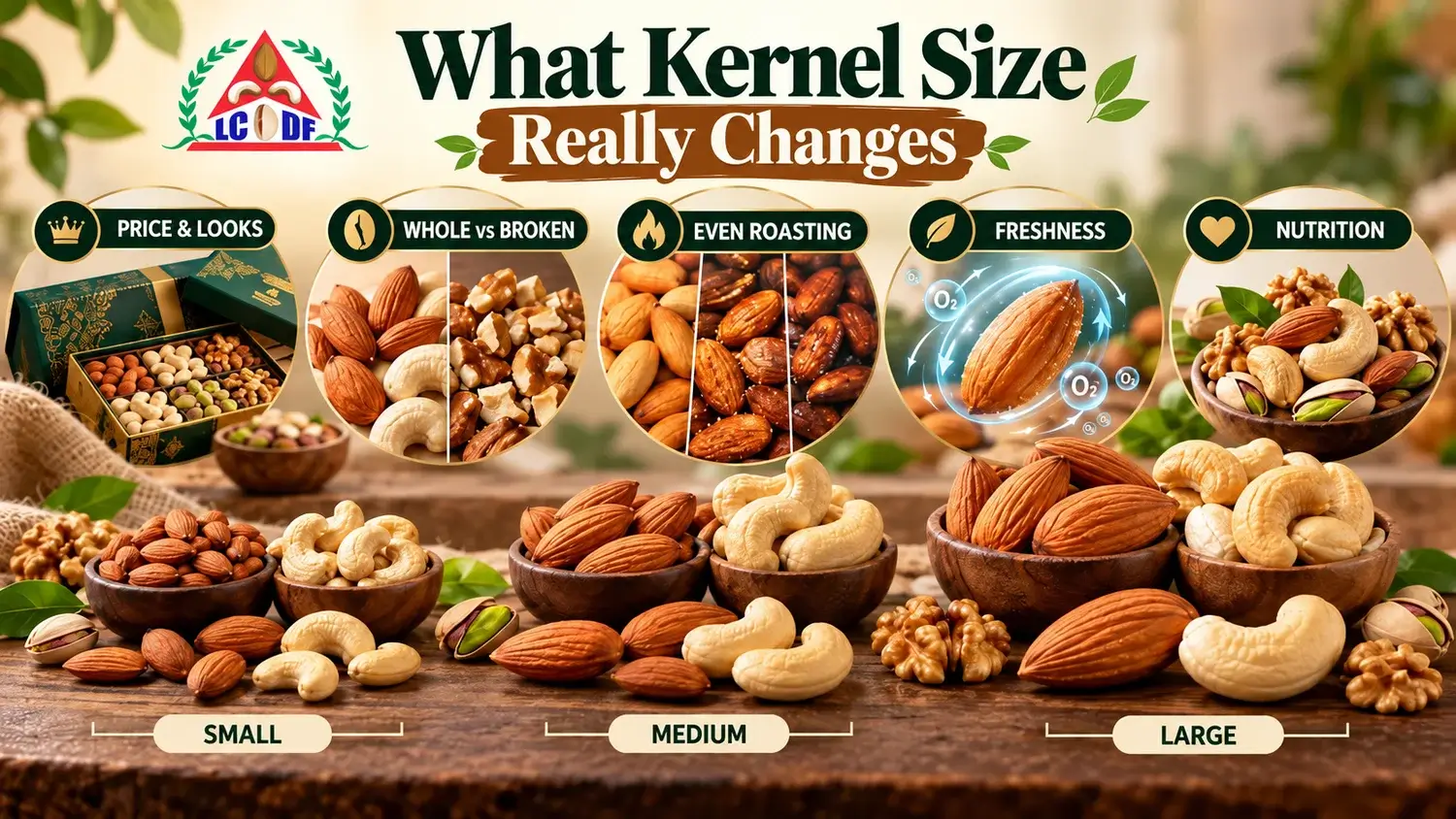
Traders pick larger almonds for snack packs, premium retail and coated almonds, and smaller ones for slicing, dicing and grinding. Price follows the same pattern. One 2026 European trade table puts W180 cashews at more than double the per kilo price of W320. You pay for looks, and looks matter most when kernels sit on show, in a gift box or a clear pouch.
Why kernels differ in size at all
Variety sets the starting point. Growing conditions and crop year then move size up or down. Maturity matters too, because a kernel that stops filling out early stays small. Even pollination plays a part. In a study of macadamia, the authors raised the possibility that the pollen parent affects kernel size directly.
Whole kernels and breakage
That macadamia study found that small nuts of all three cultivars gave lower kernel recovery than large nuts, which means less edible kernel from the same nut in shell. Small nuts also gave fewer whole kernels in two of the three cultivars. The finding covers macadamia only, so we do not claim it for almonds or cashews. It still points to a useful idea: size and breakage often travel together, and whole kernels cost more to produce.
Roasting and cooking evenly
Smaller kernels heat through faster. That is why the AFI specification tells roasters to adjust time and temperature when they roast butts, splits and small kernels. A pack with mixed sizes roasts unevenly, with some kernels pale and others dark. Even sizing gives you even flavour.
Shelf life and surface area
Almonds hold about 50% fat, and that fat reacts with oxygen. The Almond Board's shelf life guide lists piece size as a shelf life factor for cut almonds, and it says cutting and blanching expose more surface to oxygen.
By the same logic, a smaller kernel shows more surface for its weight than a large one, so we expect it to turn stale a little sooner. We found no published test that compares whole almonds across size grades. Treat this as what science predicts, not as something proven.
Dried fruit follows a similar pattern. Smaller fresh cut pieces dry faster and keep more quality, and the ratio of a piece's volume to its exposed surface explains why. That matters for figs, dates and dried apricots.
Nutrition, and a surprise about chewing
A study of cashew kernel grades found little variation in composition across the grades. Per gram, a large kernel and a small kernel give you about the same. Per piece, the large one gives more, simply because it weighs more.
Size matters in one more way, and it surprises people. Almond Board material explains that larger particles resist digestion, so the body absorbs fewer calories from them, while smaller particles release more. That describes how finely food breaks down, not the kernel you buy. Still, it explains why a spoon of almond butter and a handful of whole almonds behave differently in your body.
Small and sound versus small and shriveled
Small kernels come in two kinds. Some are small by grade: healthy kernels sorted into a smaller size class. Others are small by defect: kernels that never filled out or dried up.
The FDA calls an unshelled nut shriveled when its kernel is under half its normal size. It calls a nut a blank when the kernel is so shrunken or badly matured that it is inedible. The AFI cashew specification lists immature and shriveled kernels among its defects. Those kernels can hide inside any grade label until someone sorts them out.
Safety enters here. The FDA notes that aflatoxin in peanuts is most often linked to moldy, discolored, shriveled or insect damaged kernels. A pistachio study from Iran found a similar pattern. Some 77.1% of small nuts carried aflatoxin, against 28.8% of normal size nuts, and the researchers linked this to early splitting, since early split nuts run smaller. That study covered one variety, so we read it as a warning sign and a reason to screen out small nuts. It does not prove that small nuts are unsafe.
So do not judge safety by size. Aflatoxin comes from mould, and your eyes and nose cannot reliably catch it. Careful sourcing, sorting and lab testing do that work, and that is where a trustworthy supplier earns its place.
How sorting keeps size and quality apart
After shelling, drying and peeling, cashew kernels pass over graders with screens that separate them by size. Those screens judge size and nothing else. Colour and defects come next, when optical sorters and trained eyes check each kernel. A final inspection then confirms that every grade stays inside its limits.
Kernels that break along the way leave the whole kernel line. They become butts, which break crosswise, or splits, which are one half cut lengthwise. Cooks use both happily.
Sorting by machine is standard and works well, though a stray smaller kernel can still slip through. That is why a last look from trained hands matters. At our factory, machines and people work together for exactly this reason. If you want the full story behind a finished pack, read
Where common buying advice goes wrong
You will find plenty of buying guides that repeat the same shortcuts. We suggest you treat these with care.
- Bigger means better. The standards above show that size and quality sit on different scales.
- Copied numbers. Guides quote W180 as 170 to 180 kernels per pound, or as 180 to 200. The AFI table says 140 to 180.
- Mixed up codes. Some guides expand almond codes wrongly. UOS means unless otherwise specified, and Supreme is not a USDA grade.
- Oil percentages. Guides on Mamra almonds quote 45 to 50%, 49 to 51% and about 60% oil. The Almond Board puts almonds at about 50% fat. Without a lab report, treat these figures with doubt.
Four numbers that tell you more than size
Moisture. Almonds keep best at 6% moisture or less, and 3 to 6% is common in the trade. The AFI specification puts cashew moisture at 3 to 5%. Water activity measures how freely the water inside can react. Almond oil oxidises slowest at a water activity of about 0.25 to 0.35.
Peroxide value. This is the early sign that oil has started to react with oxygen. Under 5 meq per kg is a common standard for almonds. Labs read it alongside other tests, because peroxides rise, peak and then fall, so a low reading alone does not prove freshness.
Free fatty acids. Under 1.5% is a common almond standard, and this number tracks fat breaking apart, which speeds up when moisture climbs above 6%.
Defect percentage. This counts how many kernels break the limits for their grade, from doubles and chips to serious defects.
Size tells you none of these four. A big kernel can be damp, and a small one can be perfectly dry.
When small is premium
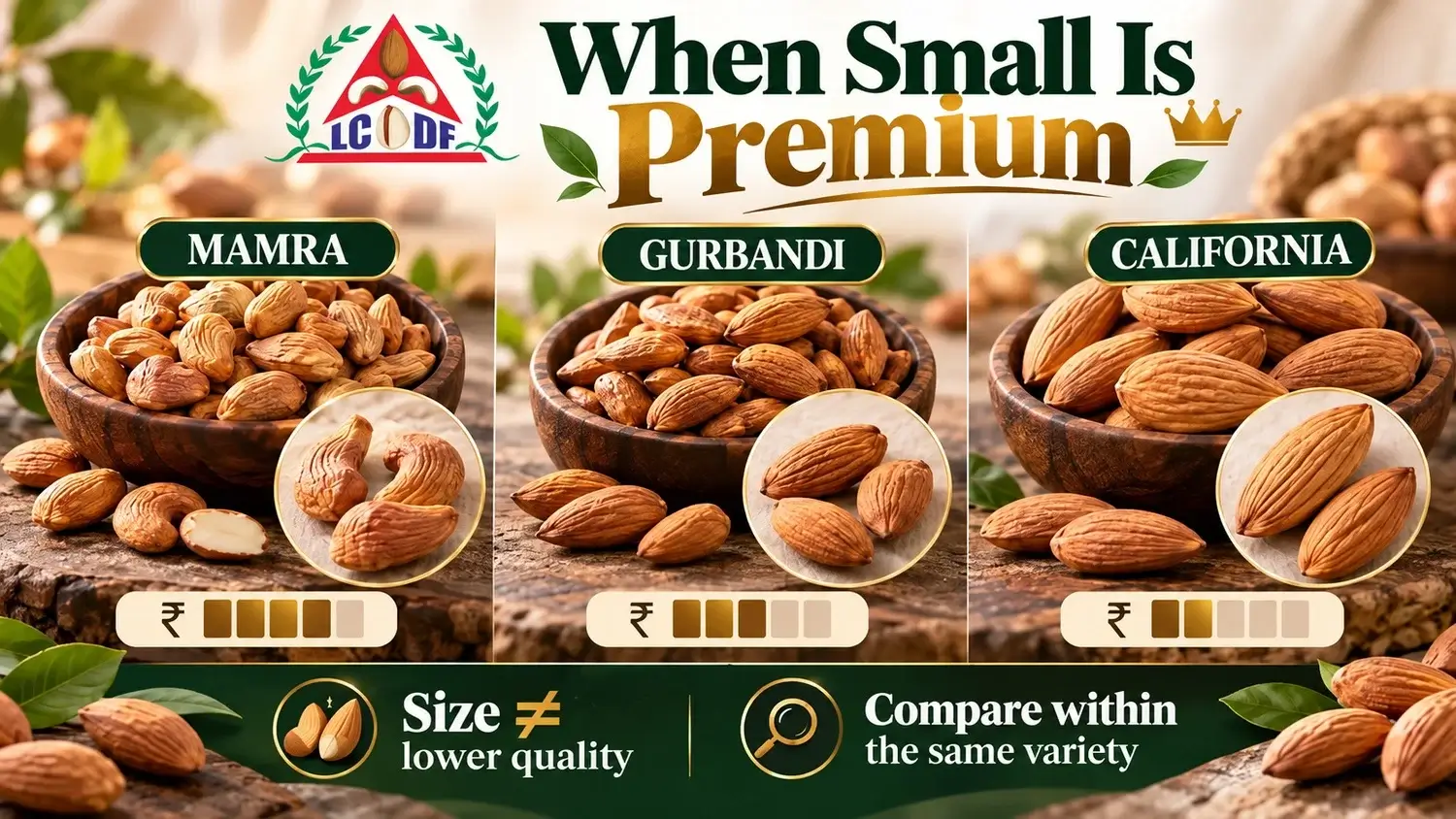
Mamra and Gurbandi almonds run smaller than California almonds, yet they cost more. Retail listings in 2026 show Mamra at ₹2,800 to 4,500 per kg, Gurbandi at ₹1,400 to 1,900 and California almonds at ₹700 to 1,200. Genuine Mamra looks small, plump and curved, never large, flat and uniform. One buying guide also warns that Mamra and Kashmiri almonds are common targets for mislabelling. Sellers explain the price gap through stony soil, smaller yields and hand cracked supply.
The lesson is simple. Size compares fairly only within one variety. Nonpareil, California and Mission types differ in size and shape before any sorting begins. A small Mamra and a small California almond are different kernels with different stories.
Matching size to the job in an Indian kitchen
Pay for size where people can see it, and save your money where it disappears.
Gifting and festive hampers. Choose large, even kernels. Looks carry the gift, and uneven sizes spoil the box.
Daily snacking and soaking. Medium kernels give you the best value, because you crunch through them in seconds either way.
Kaju katli, barfi, gravies and pastes. Grinding hides size completely. The almond trade makes the same point: once you grind almonds, size and cosmetic grade matter very little, so price should lead. Splits and pieces do the same job for less.
Laddoo, kheer and halwa. Chopped kernels and pieces work well, since the dish hides the shape.
Biryani garnish. Even sizes fry to an even golden colour and look tidy on the plate.
For a plain guide to each cashew grade and how families use them, see
Try the 100 gram kitchen test
You can check a pack at home with a kitchen scale.
- Weigh 100 g from the middle of the pack, not the top layer.
- Count the whole kernels, and set aside pieces and doubles.
- Compare your count with the numbers below.
- Pick out the biggest and smallest kernel. A wide gap tells you the pack is uneven.
Cashews, whole kernels per 100 g:
- W180: about 31 to 40
- W210: about 40 to 46
- W240: about 48 to 53
- W320: about 56 to 71
- W450: about 88 to 99
Almonds, whole kernels per 100 g:
- 18/20: about 63 to 71
- 20/22: about 71 to 78
- 23/25: about 81 to 88
- 27/30: about 95 to 106
- 30/32: about 106 to 113
We converted the trade counts using 28.35 grams to the ounce and 454 grams to the pound. Lots vary inside their tolerance, so treat your result as a guide, not a verdict. The trade counts whole kernels only, so a pack full of pieces will show a low count. That tells you something useful too.
Questions to ask before you buy in bulk
Sweet makers, caterers, shops and gifting companies can use the same thinking at scale. Ask your supplier for:
- The count range and the size tolerance
- The moisture reading
- The defect limits
- The variety, origin and crop year
- A sample lot that you count yourself
- A certificate of analysis for moisture and peroxide value, plus aflatoxin test results
Also remember that a stated size is a nominal figure, and the real lot can perform differently, so agreed tolerances and inspection matter. A good supplier welcomes these checks.
Frequently asked questions
Does kernel size affect taste?
Not by itself. Variety, freshness and roasting shape flavour far more. Size mainly changes how evenly a kernel roasts.
Are bigger almonds better?
Bigger almonds look better and suit snacking and gifting. Grade depends on defects, though, so bigger does not mean higher quality.
Is W240 better than W320?
W240 is larger and costs more. Composition varies little across cashew grades. Better depends on your use.
Are small cashews lower quality?
Only when they are small by defect, meaning shriveled or immature. Small by grade is perfectly good.
Does size affect shelf life?
Probably a little, through surface area. We found no direct study on whole kernels. Cut and blanched forms clearly shorten shelf life.
Are bigger nuts healthier?
Per gram, they are about the same. Per piece, a bigger nut gives more because it weighs more.
What does 23/25 mean?
It means about 23 to 25 whole almonds per ounce.
How do I count almonds per 100 grams?
Use the kitchen test above. As a rough shortcut, multiply the count per ounce by about 3.5.
Why are Mamra almonds small but expensive?
Sellers point to stony soil, smaller yields and hand cracked supply. Variety matters more than size here.
Is a small kernel a sign of old stock?
No. Age shows in smell, taste, moisture and oil tests. Harvest sets size.
About the Author
LCDF Pvt. Ltd.
Lake City Dry Fruits Pvt. Ltd. has been a pioneer in the dry fruits and spices industry for over 60 years. From humble beginnings in Udaipur to a pan-India presence, we have built a reputation for sourcing the best global produce and ensuring uncompromising quality at every step.
Grading and sorting sit at the centre of that promise. Our team works with kernel counts, size grades and defect standards every single day, so we know firsthand where size tells you something useful and where it tells you nothing at all. This guide reflects that experience, checked against official trade specifications and published research rather than shortcuts and shop floor myths.
At Lake City Dry Fruits, we believe a buyer who understands grading buys better and wastes less. That is why we write guides like this one, alongside our HACCP, ISO and FSSAI backed sourcing and processing standards, so every pack we sell holds up to the questions we are asking you to start asking.
For questions about kernel grades, sourcing or bulk orders, you can reach out to us.
Final thoughts
Size and quality answer two different questions. Use size to choose looks, price and the right job for a kernel. Use moisture, peroxide value, free fatty acids and defect limits to judge whether the kernel is good. When a very small kernel looks dull or shrivelled, take that as a reason to look closer.
We work under HACCP, ISO and FSSAI systems, and we build our grading around exactly these checks. Next time you pick up a pack, count a handful, feel the crunch and ask for the numbers. You will buy better, and you will waste less.
Author

LCDF Pvt. Ltd.
Lake City Dry Fruits Pvt. Ltd. has been a pioneer in the dry fruits and spices industry for over 60+ years. From humble beginnings in Udaipur to a pan-India presence, we’ve built a reputation for sourcing the best global produce, ensuring uncompromising quality at every step.