

| LCDF Pvt. Ltd.
Summary
Dry fruit businesses can reduce food waste by checking moisture levels before removing products from the dryer, sorting and grading fruits correctly the first time, and using proper storage and packaging to keep them fresh. Broken pieces and leftover parts can also be sold at a fair price instead of being thrown away. Businesses should track all types of waste to understand where losses happen and how to reduce them. The main goal is to prevent waste first and dispose of it only as a last option.
Key takeaways
- Most dry fruit waste gets decided at the dryer, the grader and the filler, long before anything reaches a bin.
- Hullers, shellers, packers and traders lose product at different stages, so each needs its own loss map.
- Badly dried stock turns into rework, rejects and safety risk, so drying control saves more than late sorting.
- Sorting still matters, but it works best as a safety net after good drying, not as a replacement for it.
- Broken kernels and cut fruit spoil faster than whole pieces, so handle them quickly and sell them as their own grade.
- Oxygen control, cool storage and sealed packs protect the value that you already paid to produce.
- Broken dry fruits have real buyers in bakeries, sweet makers and mix brands.
- Nut byproducts can earn money or energy, but you must keep them apart from food streams and test them first.
- A one week waste audit shows you where money leaks, and it costs almost nothing.
- Indian standards, HACCP routines and small unit schemes can help you build waste control into daily work.
Introduction
Walk past a dry fruit line at the end of a shift and look at what sits beside it. Broken cashew pieces. A tray of kernels that missed the grade. Skins, dust and a few doubtful lots waiting for a decision. Many owners treat this as the normal cost of doing business. It is not. Much of it is avoidable, and every kilogram carries the full price of the raw nut, the energy spent drying it and the labour spent handling it.
Lake City Dry Fruits has worked with almonds, cashews, pistachios and raisins since 1964. We source from the USA, Australia, Afghanistan and Iran, and we process in a semi automated plant. Over those years we have learned that waste rarely comes from one big mistake. It builds up in small gaps between stages. This guide shows you where those gaps sit and how to close them, whether you run a factory, a packing unit or a trading business.
Where food waste really starts in dry fruit processing
Most people picture waste as whatever lands in the bin. In dry fruit processing, the bin is the last place the story ends. The story starts earlier, at the dryer, the sorter, the cutter and the filler.
Start by splitting waste into two kinds. Unavoidable waste covers shells, hulls and skins that you cannot eat. Avoidable waste covers broken kernels from rough handling, rancid lots from poor storage, overfilled pouches, rejected batches and expired stock. Your goal in dry fruit wastage reduction is to shrink the second kind.
An EU study estimated that manufacturing and processing account for about 34.8 million tonnes of food waste, close to 39% of the total, and the main causes at the production stage are technical malfunctions, equipment failures and inefficient processes. You can read the full EU best practice page on avoiding food waste in manufacturing. The lesson fits dry fruits well. A worn cutter, a badly set grader or a rushed drying schedule costs you far more than a careless employee does.
Waste looks different for hullers, packers and traders
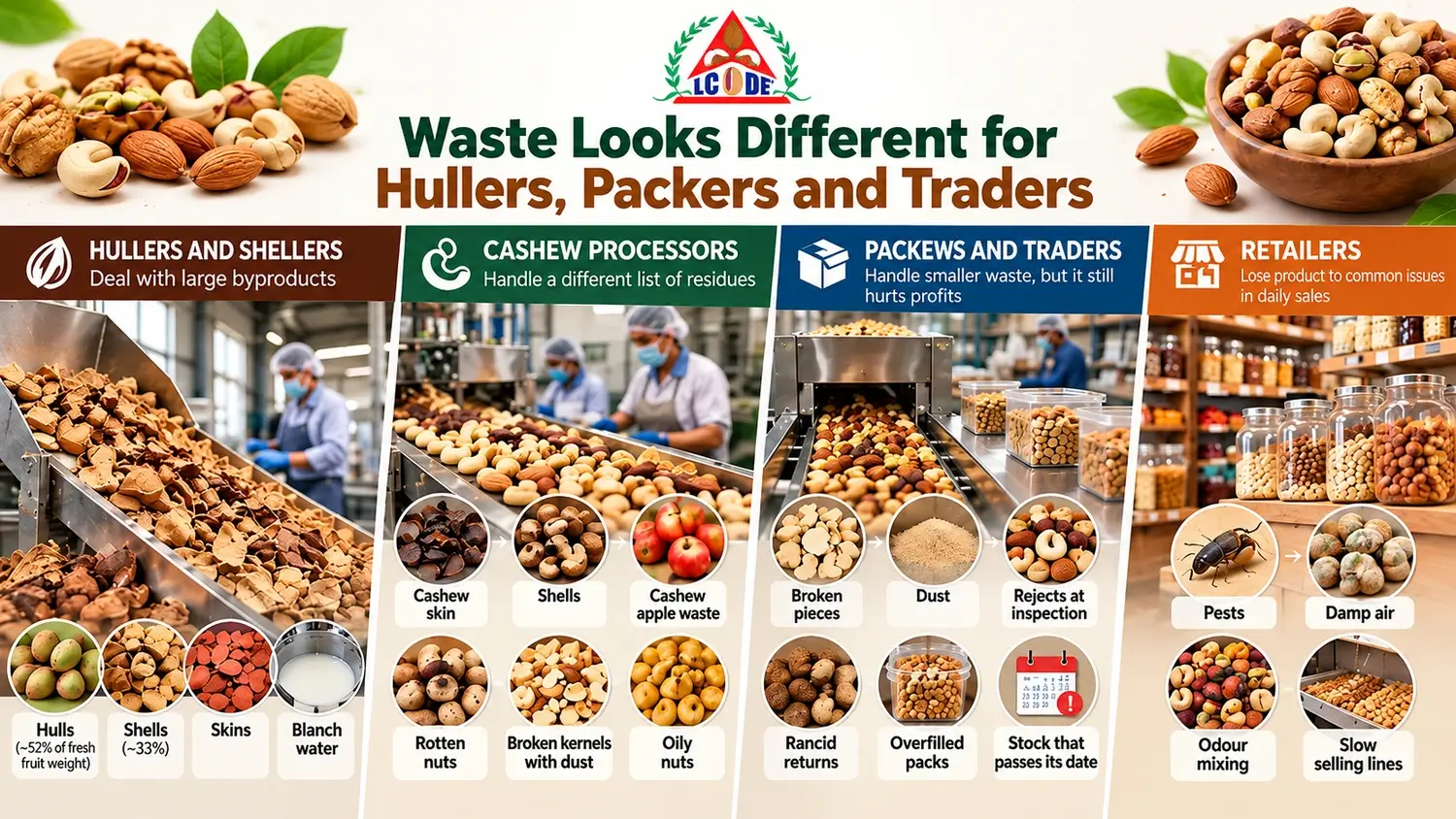
Before you fix anything, find your own business type, because each one loses product in a different place.
Hullers and shellers deal with large byproducts. In almonds, hulls make up about 52% of the fresh fruit weight and shells about 33%, and skins and blanch water add to the pile. People have long burned these or fed them to livestock, and research now explores better dry fruit byproducts uses.
Cashew processors handle a different list. Their residues include cashew skin, shells, cashew apple waste, rotten nuts, broken kernels with dust, and oily nuts. Each stream needs its own plan, because the shell, the skin and the rotten nut have nothing in common.
Packers and traders usually buy kernels that someone else has already hulled and shelled. Their waste looks smaller but hurts just as much: broken pieces, dust, rejects at inspection, rancid returns, overfilled packs and stock that passes its date. If you run a trading business, your biggest levers sit in storage, packaging and stock planning.
Retailers lose product to pests, damp air, odour mixing and slow selling lines. Small shops can fix most of this without any machinery.
Drying decides how much you lose later
We already explain water activity and safe moisture ranges in our guide on how moisture affects dry fruits, so we will not repeat that here. This section looks at drying from a waste angle instead, because a badly dried lot does not only lose quality. It creates rework, rejects and safety risk.
A three year hazelnut study compared two drying methods. In the good method, nuts sat in the sun, got turned and stayed protected from rewetting. In the bad method, nuts sat in shade, piled up and got wet again. Badly dried nuts carried about seven times the Aspergillus fungal load of well dried ones, and storage temperature and shell condition mattered very little once the nuts were dried properly. Traced, well dried samples stayed below the EU limit for aflatoxin B1, while a few market samples went far above it. The study covers hazelnuts, but the pattern holds for any nut: drying is the step that sets your risk for the whole chain. You can read the hazelnut postharvest study for the full results.
Before packing the dry fruits there is process of checking the moisture after drying them from which only you can control it make it thin or thick as they treat it as a control point, and save their time from doing it again
A stage by stage guide to reducing yield loss in nut processing
Use this section as your checklist. For each stage you will see where loss happens and what to do about it.
Receiving and cleaning
Waste starts at the gate. Check moisture, defects and smell on a sample before you accept a lot, because a rejected lot costs far less at the gate than on your line. Vibrating screens and destoners then pull out sticks, leaves, dirt and stones before they damage equipment or end up in a pack. Good records help here too. When a lot turns out poor, traceability lets you track it back to its source and fix the problem with your supplier.
Sorting and grading
Grading is where yield and value meet. Set your grades to match what you actually sell, so fewer kernels fall into the reject tray by accident. The FSSAI almond kernel standard, which took effect on 1 July 2021, lists defects such as chipped and scratched kernels, doubles or twins, shell or skin fragments, rancid kernels and gummy or brown spots, and it also covers moisture and oil content. Use that list as your sorting guide.
Machines help once volume grows. One Indian maker says its grader handles about 200 kg of nuts an hour against 30 to 35 kg by hand, though you should test it on your own product. Colour sorters catch dark defects that tired eyes miss. Smart lines also loop product back. In a typical nut plant, nuts that are still in their shells return to the cracking step instead of leaving as waste.
If you work with cashews, grade names such as W180, W240 and W320 decide price, so read our guide to the top types of cashews in India before you set your sorting rules.
Cutting, blanching and roasting
Every heating step can affect your product yield. Overcooking or undercooking can lead to waste, while extra trimming and leftover pieces increase it further. Record the time, temperature, and batch size for every roast. Change only one thing at a time to find out what works best.
Sticky fruits need special care. Their sugar and moisture levels, along with the temperature, affect how easily they can be cut or break apart. Sticky fruit can also clog machines. Clean and adjust the cutting equipment regularly to prevent good fruit from being damaged and wasted.
Packing and filling
Overfill is a quiet form of waste because nobody sees it leave. A pack that holds 10 grams too much on every unit adds up fast across thousands of packs. Check fill weight on random samples through the shift, and check seals and labels at the same time. A leaking seal or a wrong label turns a good pack into a return.
Storage and dispatch
Move oldest stock first, keep floors clear and keep strong smelling goods away from nuts. The next sections explain why storage and packaging deserve their own attention.
Sort better or prevent earlier? What the evidence says
Many businesses answer every quality problem with more sorting. Sorting works, but it works best as a safety net.
A review on pistachios says that removing damaged nuts, by hand or by machine, can cut aflatoxin levels by up to 98%. That sounds like a strong reason to sort harder. But a groundnut study in Ghana adds a useful twist. Pods that farmers dried well had very low aflatoxin, and extra sorting of the dried lots cost money without changing the result, while undried pods reached extremely high contamination and became a total loss.
Put those two findings together and the rule is clear. Dry first, then sort to catch what remains. A business that fixes drying spends less on sorting and loses fewer lots. For a deeper look at aflatoxin, Salmonella and other risks, read our guide to food safety standards for dry fruit businesses.
Storage and packaging that protect your stock
Storage decides whether the value you built in the factory survives until the customer opens the pack. The UC Davis postharvest guide gives several facts worth acting on, and you can read the UC Davis guide to nuts and dried fruits yourself.
First, broken nut kernels keep for less time than whole ones, and cut fruit pieces deteriorate faster than halves. That means your broken grades need quick turnover and tighter packaging.
The most common reason for rancidity is oxygen: keep it below 1% to stay away from the rancidity and to a staleness and vacuum or nitrogen flushing. As there is saying that dry fruits can stay for 4-8 months if they are kept in the air but can stay for more than 1 or 2 year in packaging with the protective gas, so take that advise and do apply that on you own products.
Third, cool rooms help. Storage below 13°C stops insects from feeding and breeding, and 5°C or lower controls an infestation. Raisins, figs, prunes and dates can also develop sugar crystals on or inside the fruit, and that gets worse as storage temperature and time go up.
Fourth, protect against smell and chemicals. Nuts absorb odours easily and react badly to ammonia, so never store them beside strong smelling goods or cleaning agents.
Our guide on how packaging technology preserves dry fruits covers the packaging side in more detail.
Sell it, don’t bin it: smart uses for broken dry fruits
Broken pieces are not scrap. They are a different grade, and a good business prices them that way.
Think of a value ladder. Whole kernels sit at the top, then splits, then pieces, then granules, then powder and paste. Each rung has buyers. Small dried fruit pieces are a popular ingredient in baking, trail mixes and cereals, and bakeries, sweet makers and mix brands also use broken almonds, cashews and pistachios. You can turn pieces into almond flour, nut paste or granola mix, and you can sell them as honest “pieces” packs at a fair price.
Keep one rule firm. Sell broken grades only from healthy, safe lots, and label them clearly as pieces. Never blend rancid, mouldy or doubtful stock into a pieces pack. A trusted brand protects its name by moving unsafe stock out of the food chain entirely, and our guide on what goes into a premium pack shows how grading protects that trust.
The food waste hierarchy for a zero waste dry fruit factory
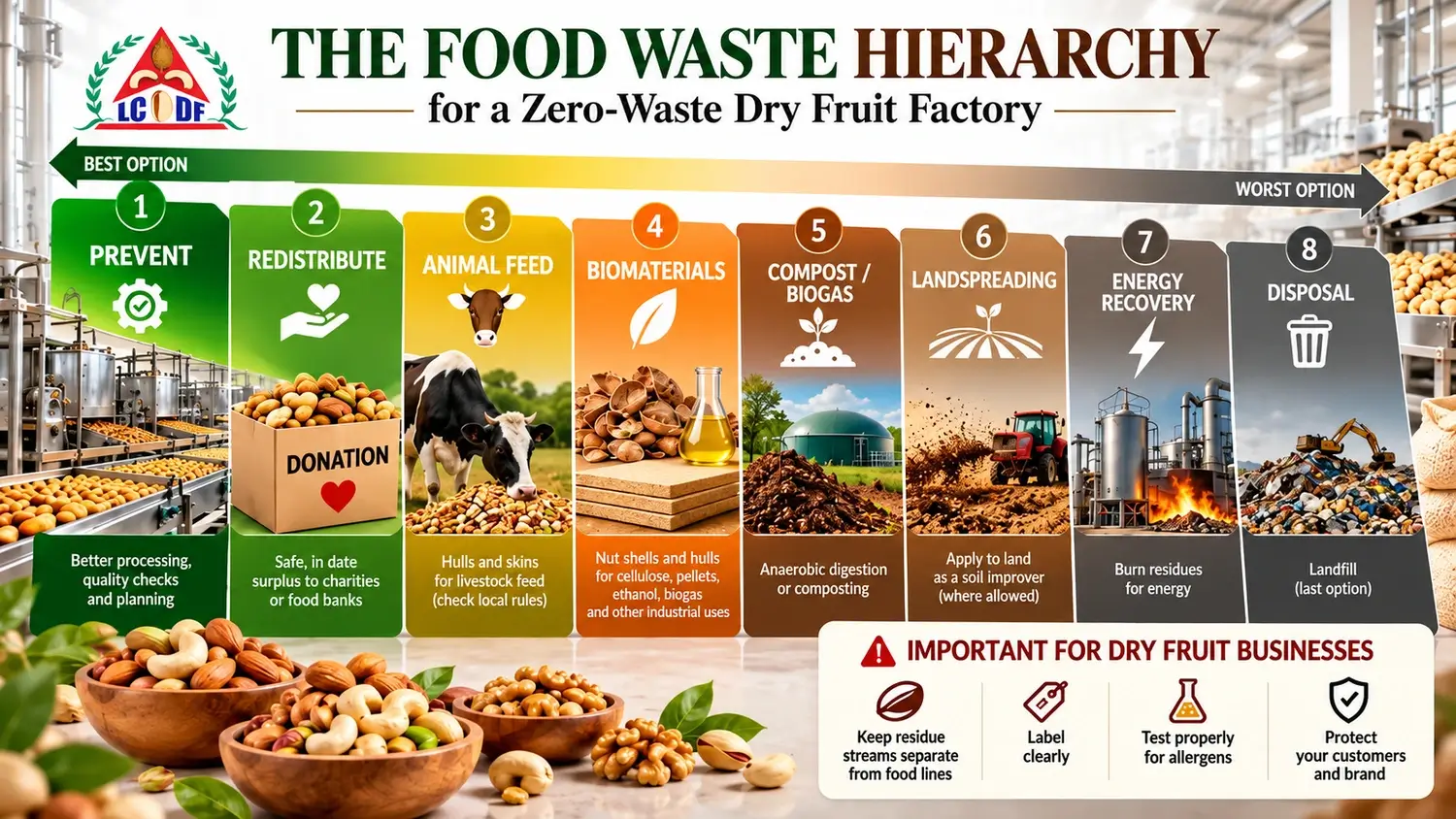
There is a misconception about the zero waste factory as they don't know about the hierarchy to manage the wastage and thought that it means not waste at all.The UK government lists eight steps, from best to worst: prevent, redistribute, make animal feed, process into biomaterials, recycle through anaerobic digestion or composting, recover through landspreading, recover energy, and dispose. You can read the full food and drink waste hierarchy from GOV.UK.
Here is how those steps look in a dry fruit business.
Prevent. Everything in the earlier sections lives here. It always beats every other option.
Redistribute. Safe, in date surplus that you cannot sell can go to charities or food banks. Never donate stock that is unsafe or past its date.
Animal feed. Hulls and skins often become livestock feed. Check local feed rules before you start, because standards differ by place.
Biomaterials. Research is finding uses for nut shells as a source of cellulose, for almond hulls and shells in pellets, and for cashew shell liquid in industry. Almond hulls also work as a feedstock for ethanol and biogas.
Recycle, recover, dispose. Digestion, composting and landspreading come next. Burning shells for fuel recovers energy, which beats landfill but ranks lower than reuse.
Some of the research provides the information that the residues of almonds are present so take it as a warning and keep the nut residues streams and food lines distinct from each other, properly label it, test it properly so that it does not hamper your customers and most importantly your brand image.
How to run a dry fruit waste audit
You cannot cut what you do not measure. A waste audit sounds heavy, but a small team can run one in a week. Food authorities such as Singapore’s food agency recommend that manufacturers work out the cost of food waste, audit each stage, record the types and amounts of waste, then set goals and share them with staff. Follow the same path.
- Pick a normal week and brief every shift on what you are measuring and why.
- Place labelled bins at each stage: receiving, drying, sorting, cutting or roasting, packing and storage.
- Weigh each stream at the end of every shift and write down the weight, the product and the cause.
- Sort the causes into groups such as breakage, moisture rejects, rancid lots, overfill, expiry and equipment faults.
- Put a rupee value on each group by multiplying the weight by your landed cost per kilogram and adding handling or disposal cost.
- Pick the top two causes, set one clear target for each and review results every month.
Two simple numbers help. Yield equals finished kilograms divided by raw kilograms, times 100. Waste cost equals lost kilograms times landed cost per kilogram, plus handling cost. Planning matters too. Ordering enough raw material for a volume that you then fail to produce is one of the biggest sources of waste in food businesses, so match purchases to a realistic production plan.
Standards and schemes that help Indian processors cut waste
Good standards double as waste control. The FSSAI almond kernel standard gives you a clear defect list, and HACCP and ISO 22000 routines force you to monitor critical points such as drying and storage instead of guessing. Lake City Dry Fruits holds HACCP, ISO and FSSAI certifications, and the daily checks behind them keep problems small. Agmark grading gives you a common language for quality with buyers.
If you plan a new dry fruit processing unit, write waste handling into your project report from day one. Micro units can also look at the PM FME scheme for food processing support, but check the current terms on the official portal before you apply. For the business side of stock loss, our guide on why dry fruits businesses fail shows how small losses add up over time.
Waste reduction tips for a small dry fruit business
Small shops and traders can cut waste without any machinery. Buy in lots that you can sell before they age. Pour bulk stock into smaller sealed containers so you open only what you need. Keep nuts away from strong smelling goods. Sell broken pieces as a low margin mix instead of mixing them back into premium jars. Record what you throw away for just two weeks, because the pattern will surprise you. Then fix the biggest cause first.
Frequently asked questions
What should I do with broken dry fruits?
Grade them as pieces and sell them at a fair price to bakeries, sweet makers and mix brands. You can also turn them into flour or paste. Use only safe, healthy lots, and never blend doubtful stock into a pieces pack.
How can I reduce wastage in a dry fruit business?
Control drying and moisture, sort and grade accurately, store in cool, sealed conditions, sell broken grades separately, and run a short waste audit to find your biggest leak.
Why do dry fruits go rancid?
Nuts contain oils that react with oxygen. Warm rooms, long storage and open packs speed this up. Lower oxygen, cooler storage and sealed packaging slow it down.
How does moisture affect dry fruit shelf life?
Extra moisture invites mould and speeds spoilage. Our guide on how moisture affects dry fruits explains the science in depth.
Can almond skins and shells be reused?
Yes, in several ways. People use hulls and skins as animal feed, turn shells into pellets or fuel, and study them as sources of cellulose and plant compounds. Keep these streams away from food lines unless you test them.
How much waste does cashew processing produce?
It depends on your method and lot quality. Residues include shells, skin, rotten nuts, oily nuts and broken kernels with dust. Weigh each stream in your own plant to get a true number.
How do you prevent aflatoxin in nuts?
Dry nuts quickly and fully, protect them from rewetting, store them cool and dry, and remove damaged nuts at sorting. Drying matters most.
What is the food waste hierarchy?
It ranks waste options from best to worst: prevention first, then redistribution, animal feed, biomaterials, recycling, recovery and disposal last.
How do you do a food waste audit?
Weigh each waste stream at each stage for a week, record the cause, put a cost on it, set a target and review monthly.
Is it safe to reuse nut waste in food?
Only after careful control. Allergens and mycotoxins can limit reuse, so segregate streams, label them and test before any food use.
Conclusion
Food waste in dry fruit processing looks like a disposal problem, but it behaves like a process problem. You prevent most of it by drying well, sorting smartly, storing cool and sealed, and pricing every grade at its real value. You then handle what remains with a plan instead of a bin.
You do not need new machinery to start. Run a one week waste audit, find your top two causes and fix them. Small, steady gains in yield protect your margin, your customers and your name.
About the author
This guide comes from the team at Lake City Dry Fruits Pvt. Ltd., a name trusted since 1964 for sourcing, processing and packing almonds, cashews, pistachios and raisins. We hold HACCP, ISO and FSSAI certifications and serve customers across more than 14 states in India. We write from daily work in this industry, and we share what we know so that every business in the chain can waste less and earn more.
Author

LCDF Pvt. Ltd.
Lake City Dry Fruits Pvt. Ltd. has been a pioneer in the dry fruits and spices industry for over 60+ years. From humble beginnings in Udaipur to a pan-India presence, we’ve built a reputation for sourcing the best global produce, ensuring uncompromising quality at every step.