

| LCDF Pvt. Ltd.
Summary
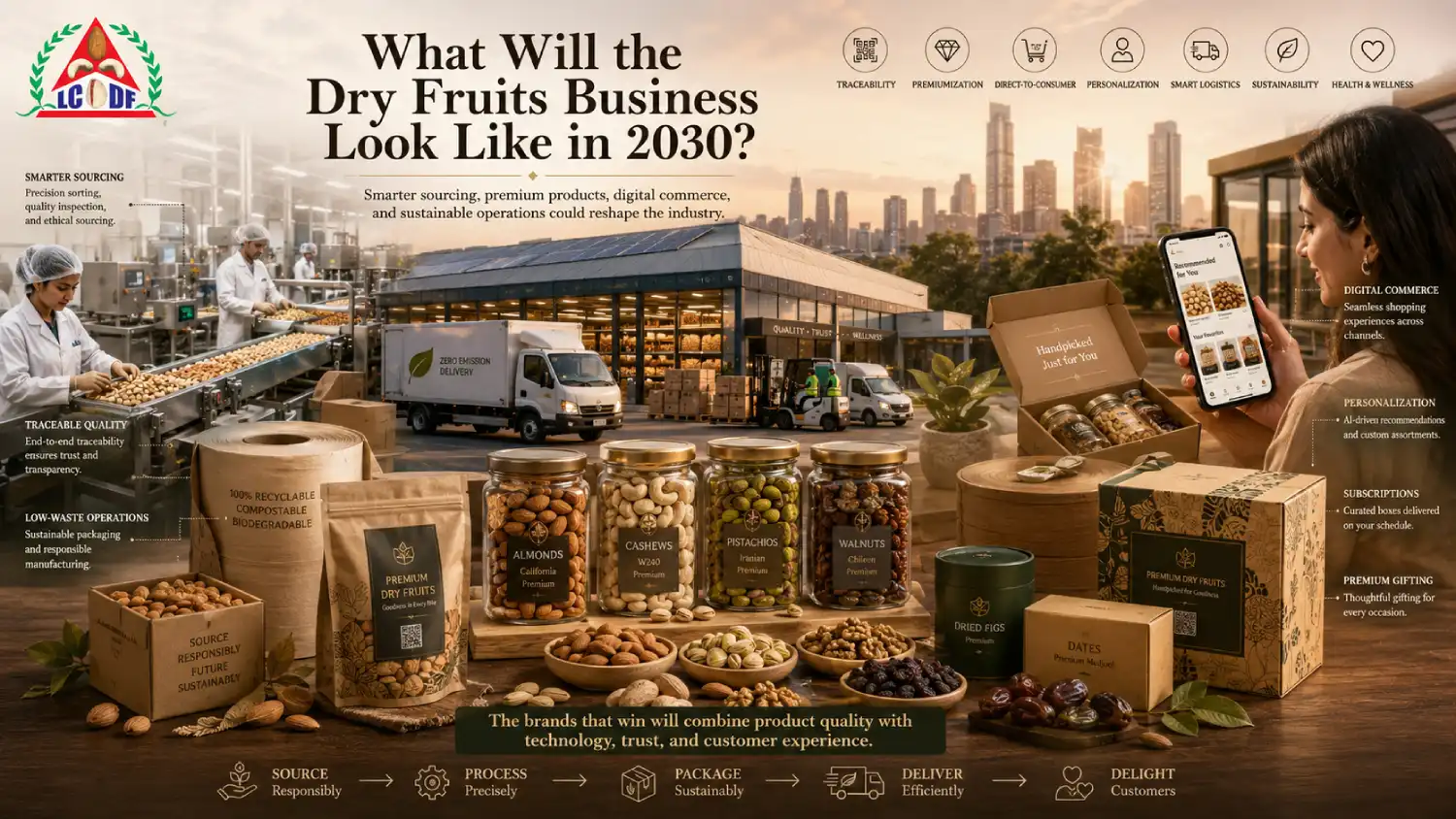
The dry fruits business isn't standing still, and by 2030, it won't look quite like the industry we've grown up with. Somewhere between changing weather patterns testing almond and cashew orchards, and makhana quietly rising from Bihar's ponds to become one of India's most promising superfood exports, the ground beneath this category is genuinely shifting. Buyers, too, are changing alongside it - asking real questions about where their dry fruits come from, whether the certifications on the pack actually mean something, and whether freshness is being protected or just promised. Layer in a younger generation treating dry fruits as a daily habit rather than an occasional festive gift, and a shopping experience that's moved almost entirely onto phones and screens, and what emerges is an industry that isn't just growing bigger - it's growing up.
If anything, this shift feels overdue rather than worrying. It's the market finally catching up to something certain brands have quietly believed for decades: that where your food comes from, and how carefully it's handled along the way, matters just as much as how it tastes on your palate. The brands that hold onto real transparency, genuine certification, and honest sourcing practices are the ones that will still be trusted a decade from now, long after the louder, trend-chasing names fade. And for you as a buyer, the takeaway is refreshingly simple - the more you understand what's changing behind the label, the easier it becomes to keep choosing real quality, no matter how fast this industry evolves around it.
Key Takeaways
- Climate change is already affecting almond and cashew supply, with drought and shifting bloom patterns in major growing regions making long-term pricing and availability less predictable than they used to be.
- Makhana is emerging as India's next big superfood story, backed by government support, a GI tag for the Mithila region, and export potential that's barely been tapped so far.
- Trade dynamics like shifting tariffs are pushing Indian exporters to diversify beyond single markets, which should help stabilize domestic supply and pricing over time.
- Trust is becoming a real currency in this industry, as growing consumer awareness around quality inconsistencies makes certifications matter more than marketing claims.
- FSSAI, HACCP, and ISO certifications are shifting from "nice to have" badges to genuine markers of accountability that careful buyers are starting to look for before they purchase.
- Freshness technology like vacuum sealing and nitrogen flushing is moving from a premium feature into an industry standard, simply because consumers can tell the difference once they've experienced it.
- Younger buyers are reshaping demand in specific ways - through flavour innovation, value-added formats like nut butters and trail mixes, and a shift from occasional treat to everyday wellness habit.
- E-commerce and D2C brands are becoming the default way people discover and repurchase dry fruits, which means a brand's online transparency matters almost as much as the product itself.
- Price alone is becoming a weaker signal of quality, and buyers who learn to look at sourcing, certification, and packaging will make far better choices than those chasing the lowest number on the shelf.
- Brands with a long-standing commitment to quality and certification, rather than ones built quickly around trends, are best positioned to earn and keep consumer trust as this industry continues to grow through 2030.
Introduction
If you picture the dry fruits industry as something static - the same almonds, the same cashews, the same steel tins passed around during Diwali - you're not entirely wrong about today. But you're about to be wrong about tomorrow.
Over the next few years, the business behind that tin is going to change more than most people expect. Not because dry fruits are going out of fashion - quite the opposite - but because the forces shaping how they're grown, sold, and trusted are shifting all at once. Climate patterns are testing the orchards these nuts come from. A quiet Indian ingredient is stepping into the global spotlight. Buyers are asking harder questions about where their food actually comes from. And the way we shop for all of it is moving almost entirely online.
This isn't a market research report dressed up as a blog post. It's an honest look at where this industry is actually headed by 2030, and what that means for the person standing in front of a shelf (or a screen) trying to pick a good pack of almonds.
The Market by the Numbers
Let's get the numbers out of the way quickly, because they matter, but they're not the interesting part.
Globally, the dried fruit market was valued at around USD 12 billion in 2024 and is expected to reach roughly USD 16.5 billion by 2030, growing at a little over 5.5% a year. Closer home, the picture looks even more energetic - India's dry fruits market is projected to touch USD 12 billion by 2028 alone, growing at 8 to 10% annually, powered by both what we eat at home and what we send abroad.
One detail worth sitting with: online sales are expected to grow faster than any other distribution channel through 2030, simply because more people now have a smartphone and a reason to use it for grocery shopping. That single shift is going to rewire a lot of what "buying dry fruits" even means by the end of the decade - more on that shortly.
But growth charts don't tell you why an industry changes. For that, you have to look at what's happening upstream - literally, in the orchards.
The Climate Wildcard: What's Really Happening to Almonds and Cashews
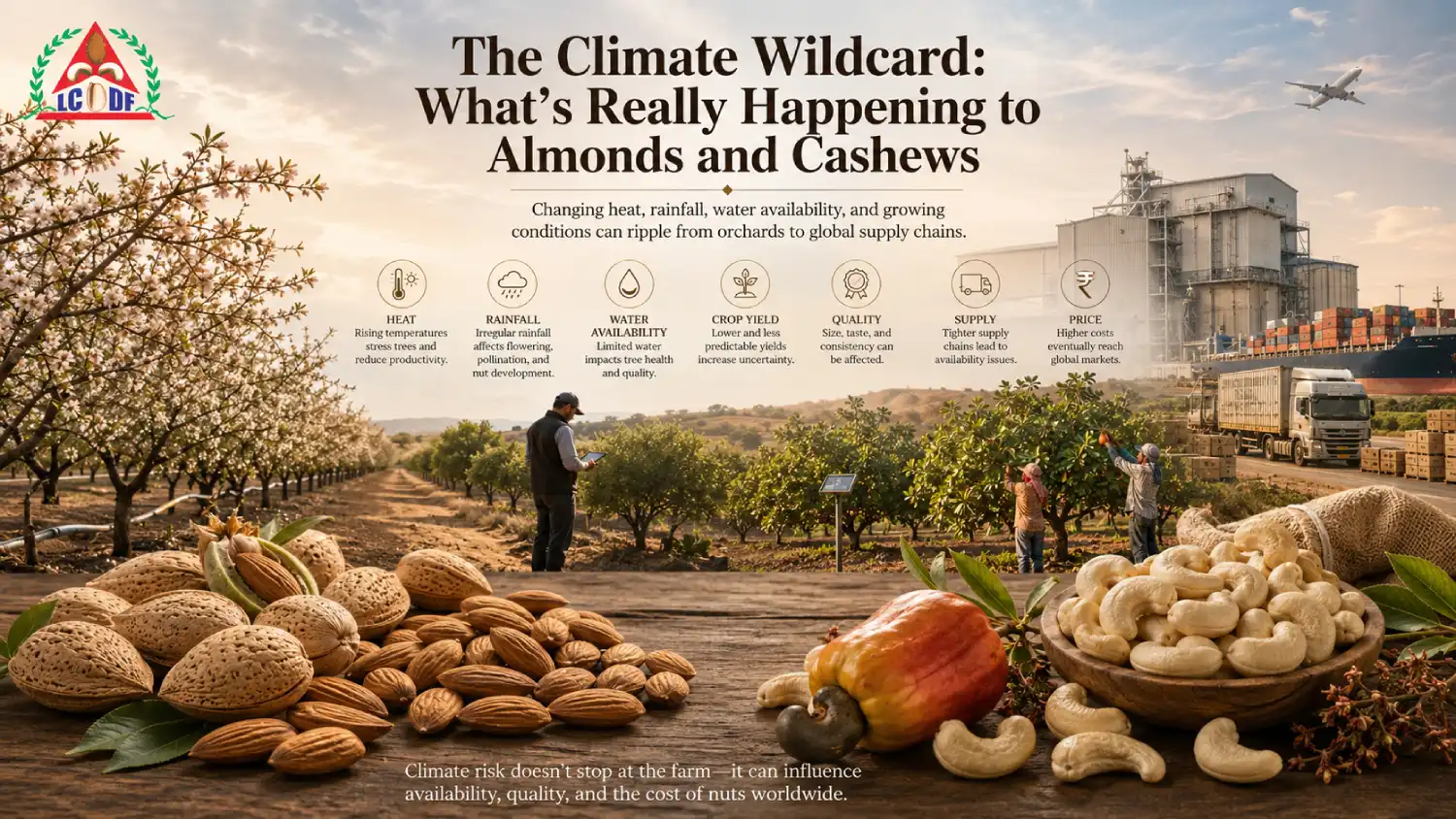
Here's something most "future of dry fruits" content skips entirely: the nuts sitting in your kitchen jar are more climate-sensitive than almost anyone realizes.
Take almonds. California grows roughly 80% of the world's almonds, and a deepening drought has already pushed farmers there to ration water to their orchards, with some abandoning trees years earlier than planned. This isn't a distant, hypothetical risk - it's already reshaping how much almond supply the world can count on.
Scientists studying this more closely have found something even more specific. Research modeling almond bloom timing under different climate scenarios found that while suitable growing land may hold steady for the next few decades, it could shrink by 48 to 73% by the end of the century under high-emission pathways, with blooming shifting to happen far earlier in the year than it has historically. Early blooming might sound harmless, but for farmers, it means a much narrower, riskier window to protect a year's harvest from frost and unpredictable weather.
Cashews aren't immune either. Producer groups have already flagged how erratic weather patterns, including El Niño-driven drought, have damaged plantations and made some farmers hesitant to keep investing in the crop.
None of this means dry fruits are disappearing from your kitchen by 2030 - they're not. But it does mean that consistent quality and steady pricing will increasingly depend on how well suppliers adapt: better irrigation planning, diversified sourcing regions, and stronger relationships with growers who take these risks seriously. Sourcing is quietly becoming one of the most important words in this industry, and it's going to matter more with every passing year.
The Makhana Disruption: India's Homegrown Superfood Going Global
While almonds and cashews deal with climate pressure, something interesting is happening much closer to home - and it's a story most 2030 industry predictions completely miss.
Makhana, or fox nuts, has quietly gone from a regional Bihar staple to a genuine national priority. The Indian government announced a dedicated Makhana Board in the 2025-26 Union Budget, and the Prime Minister has personally promoted it at global platforms, even gifting it to visiting heads of state.
The numbers behind this are hard to ignore. India already accounts for around 90% of the global makhana industry, growing at nearly 9.7% a year - faster than the global snacking category as a whole - with Bihar alone responsible for 85% of world production. And yet, only 1 to 2% of that production currently makes it to export markets, which points to enormous untapped headroom.
Prices tell the same story from a different angle. Makhana prices have climbed sharply since the pandemic, moving from roughly ₹300–350 per kg to somewhere between ₹700 and ₹1,700 per kg by 2025, largely on the back of rising global demand for plant-based, high-protein snacks.
Even trade friction hasn't slowed this down much. When steep US tariffs hit Indian exports, fox nut sellers responded by actively looking beyond the US market rather than retreating, since strong domestic demand continued to cushion the impact.
By 2030, don't be surprised if makhana sits right alongside almonds and cashews as a default entry in "healthy Indian snacking" - not a niche health-food aisle item, but a mainstream category in its own right.
Trade Winds: Tariffs, Exports, and Why Markets Are Diversifying
Trade policy rarely makes it into "future of snacking" conversations, but it's already shaping this industry in real time. The tariff pressure on Indian exports mentioned above isn't an isolated incident - it's part of a broader pattern where Indian dry fruit and superfood exporters are learning not to over-depend on any single market.
Expect more of this diversification by 2030: more government-backed export incentives, more GI-tag recognition for regional Indian produce, and more emphasis on international food safety compliance so Indian brands can access markets that were previously harder to enter. For a business like this, geography is no longer just about where a nut is grown - it's about how many doors that origin can open.
The Trust Gap: Why Certification Will Matter More, Not Less
Here's a conversation happening quietly in comment sections and review forums that most industry blogs won't touch: consumers are starting to notice inconsistency in the packaged dry fruits they buy.
There have been public complaints about almonds marketed as premium imports turning out to be something else entirely, with similar quality concerns raised across several well-known Indian brands. This isn't about naming and shaming anyone - it's about recognizing a pattern. As more brands enter this space chasing the growth we talked about earlier, not all of them will have the sourcing discipline or quality systems to back up their packaging claims.
This is exactly why certification is going to matter more by 2030, not less. Buyers are getting better at asking simple but pointed questions: Where was this actually grown? Who tested it? Is there a food safety license backing this claim? Look for FSSAI licensing as the baseline, HACCP certification as a sign of serious hazard control in processing, and ISO certification as evidence of consistent quality systems - not marketing badges, but actual accountability. Brands that have been building these systems for decades, rather than bolting them on after a funding round, are going to have a real advantage as scrutiny increases.
How Freshness Technology Will Change
Trust isn't only about where a nut comes from - it's also about what happens to it after it's packed. This is a subject close to home for us, since we've spent a lot of time explaining how oxidation and rancidity quietly rob dry fruits of freshness.
By 2030, expect the technology that fights this to become standard rather than a premium add-on. Vacuum sealing and nitrogen flushing, once used mainly by higher-end brands, are likely to become the norm across the mid-market too, simply because consumers are learning to notice the difference between fresh and stale. Moisture-resistant packaging and better cold-chain handling during transport will increasingly separate serious players from brands cutting corners. If you want to go deeper on why this matters at a molecular level, our earlier piece on how oxidation causes rancidity in dry fruits walks through exactly what's happening inside that packet before it ever reaches your kitchen.
What Gen Z and Millennials Are Actually Changing
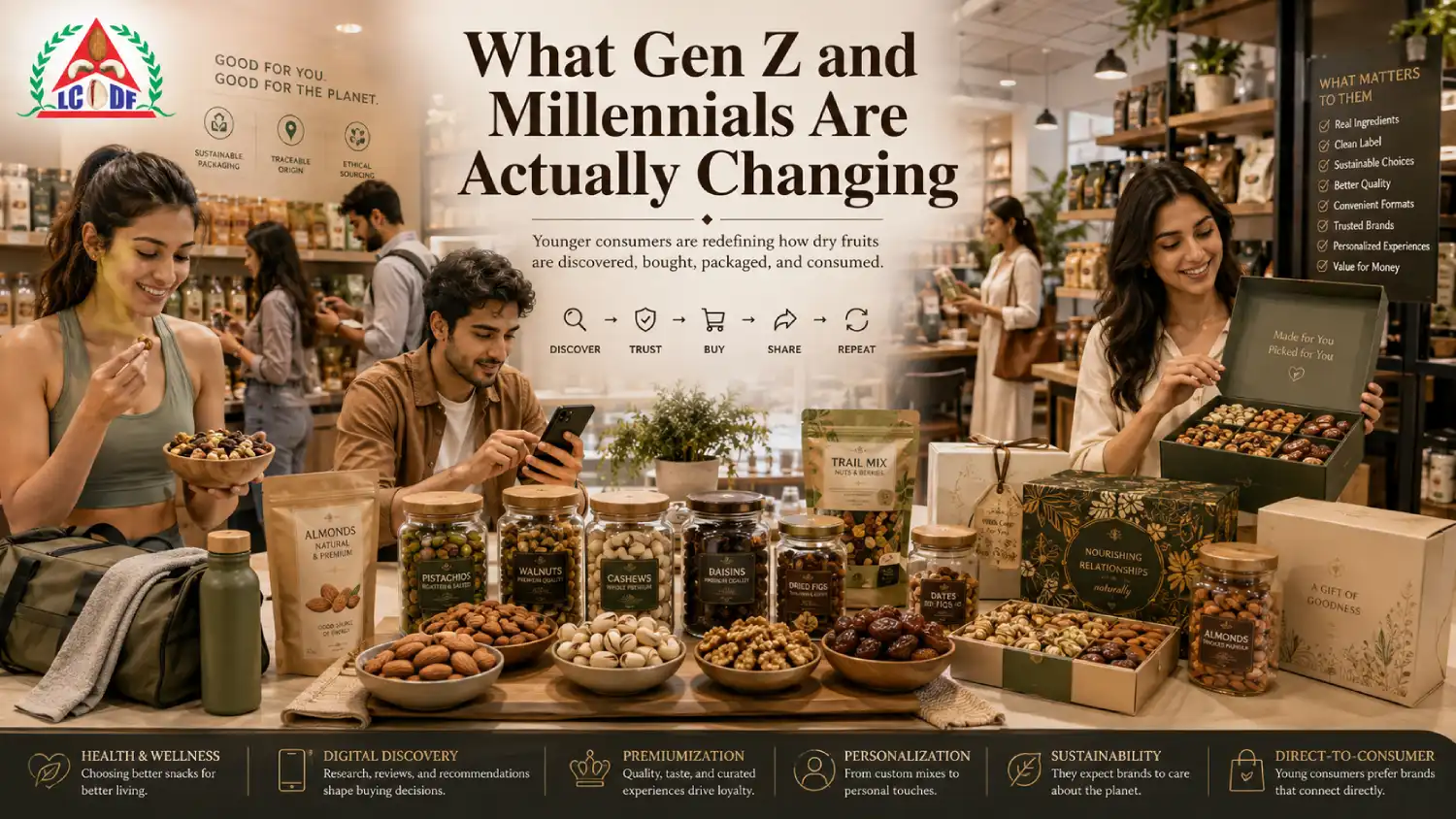
Most content on this topic stops at "young people like healthy snacking," which is true but not very useful. The more interesting shift is in the details.
Younger buyers are redefining what dry fruits even mean - moving the category away from being a festive, occasional treat and turning it into an everyday wellness habit. Flavour experimentation is a big part of this, with peri-peri raisins, rose-flavoured cashews, and paan-flavoured pistachios showing up on shelves that used to only stock plain, unsalted versions. Value-added formats like nut butters, granola bars, and breakfast bowls built around dry fruits are also seeing rapid growth, appealing to buyers who want convenience without giving up on nutrition.
What's notable is that this generation isn't spending freely just because something is trendy. They're price-sensitive, but only up to a point - they're willing to pay more when a brand can clearly explain why. That combination - flavour innovation plus honest value - is likely to define which brands actually grow between now and 2030, and which ones simply fade into the background noise of a crowded shelf.
The E-Commerce and D2C Shift
Circling back to that online growth statistic from earlier: the way people discover and repurchase dry fruits is changing structurally, not just incrementally.
Subscription-based snacking boxes, quick commerce apps delivering groceries in minutes, and direct-to-consumer brands selling straight from their own websites are all chipping away at the old model of walking into a local store and picking whatever's on the shelf. This matters because it changes what earns trust. When you can't physically inspect a nut before buying it, the brand's transparency - clear sourcing information, visible certifications, honest photography - becomes the entire basis for that purchase decision. By 2030, a brand's digital trust signals may matter just as much as its actual product quality, because for a growing number of buyers, the website is the only "store" they'll ever see.
What This Means for You as a Buyer in 2030
Strip away all the market forecasts and here's the practical version of everything above.
Expect prices on certain climate-sensitive nuts, particularly almonds and cashews, to see more volatility than they have in the past - not necessarily a straight upward line, but more unpredictable swings tied to weather events in growing regions. Expect makhana and other homegrown superfoods to become far more visible and affordable as domestic production scales up. Expect certification labels to become something you actually check, the way ingredient lists became mainstream over the last decade. And expect buying dry fruits online to feel less like a gamble and more like a routine, as long as you're buying from brands that are transparent about sourcing and freshness practices.
The single most useful habit you can build between now and 2030 is simple: stop judging a pack of dry fruits by price alone, and start looking for the story behind it - where it was grown, how it was tested, and how it was packed to stay fresh.
Where Lake City Dry Fruits Fits In
We didn't build our approach around a market forecast - we've been doing this since 1964, long before "sourcing transparency" was a phrase anyone used. But it turns out that everything this industry is slowly waking up to - certified quality systems, honest sourcing, freshness that's actually protected rather than just promised - is exactly what we've spent six decades building.
We're HACCP, ISO, and FSSAI certified, and we supply across 14-plus states in India, which means the standards we hold ourselves to aren't just a claim on a website - they're tested against real scale, every single day. If you want to see how this actually works behind the scenes, our piece on how our factory processes and packs dry fruits is a good place to start. And if you're a business looking to source at volume with that same level of accountability, our B2B page walks through exactly how that partnership works.
Frequently Asked Questions
Will dry fruits get more expensive by 2030?
Some categories, especially almonds and cashews, are likely to see more price volatility due to climate pressures on growing regions like California. Others, like makhana, may actually become more affordable domestically as Indian production and processing scale up.
Is makhana the next big superfood export from India?
It's already heading that way. With strong government backing, a GI tag for the Mithila region, and exports currently representing only a small fraction of total production, makhana has significant room to grow as a global category over the next few years.
How is climate change affecting almond and cashew prices?
Drought conditions in almond-growing regions like California and erratic weather affecting cashew plantations elsewhere are both creating supply uncertainty, which historically translates into price volatility rather than a simple steady increase.
Which dry fruit brands can be trusted for quality?
Look beyond marketing claims to actual certifications - FSSAI licensing is the legal baseline in India, while HACCP and ISO certifications indicate a brand has invested in serious quality and food safety systems, not just packaging design.
How can I tell if dry fruits are fresh when buying online?
Check for details on packaging technology like vacuum sealing or nitrogen flushing, look for clear manufacturing and best-before dates, and prefer brands that are transparent about where and how their products are sourced and processed.
What role will certifications like FSSAI and HACCP play in the future?
As more brands enter this growing market, certifications are likely to become one of the clearest ways for buyers to separate serious, accountable brands from ones cutting corners on quality and safety.
About the Author
This article comes from the team at Lake City Dry Fruits - a name that's been part of Indian kitchens since 1964, long before "clean label" and "sourcing transparency" became things people looked for on a packet. Over the decades, that's simply been our way of doing business: source honestly, process carefully, and never treat quality as something you compromise on to save a rupee.
We're certified under HACCP, ISO, and FSSAI standards, not as a badge for the website, but because we believe trust has to be earned through consistency, batch after batch, year after year. Today, our products reach households and businesses across 14-plus states in India, but the intent behind every pack hasn't changed since the day we started.
If this piece got you thinking about what actually goes into the dry fruits you buy, we'd love for you to see it for yourself. Explore our range at lcdf.co.in, and experience the same freshness and honesty that's kept generations of Indian families coming back to us.
Conclusion
So, what will the dry fruits business actually look like in 2030? Not unrecognizable, but certainly more thoughtful than it is today. The almonds and cashews we've always relied on will face real pressure from a changing climate, pushing sourcing and adaptability to the front of the conversation. Makhana will likely go from a regional favourite to a name recognized well beyond India's borders. And through all of it, the brands that earn people's trust won't be the loudest ones on social media - they'll be the ones that can actually back up their claims with real certification, honest sourcing, and packaging that protects freshness rather than just looks good on a shelf.
If there's one thing worth carrying forward from everything we've covered here, it's this: the future of this industry isn't just about bigger numbers or fancier flavours - it's about accountability. Buyers are getting more discerning, and rightly so. And for a brand like ours, one that's been doing this quietly and carefully since 1964, that shift doesn't feel like a challenge to adapt to. It feels like the rest of the industry finally catching up to what we've believed all along - that good dry fruits start with honest sourcing, and trust is something you earn one pack at a time, not something you claim overnight.
Whatever 2030 brings, we'll be here doing what we've always done - sourcing carefully, packing thoughtfully, and standing behind every product with the certifications to prove it.
Author

LCDF Pvt. Ltd.
Lake City Dry Fruits Pvt. Ltd. has been a pioneer in the dry fruits and spices industry for over 60+ years. From humble beginnings in Udaipur to a pan-India presence, we’ve built a reputation for sourcing the best global produce, ensuring uncompromising quality at every step.