

| LCDF Pvt. Ltd.

Summary
Nuts have a genuinely strong case in the longevity conversation. Large studies link a daily portion of nuts with a lower risk of early death, and the benefit seems to level off at a modest amount. Dried fruits like raisins, dates and figs have a thinner evidence base, and their sugar deserves respect. The blue zones story is also contested, so this guide shows you what holds up, what does not, and how to eat nuts and dry fruits the Indian way.
Key Takeaways
- The strongest longevity evidence belongs to nuts, not to every item in a dry fruit box.
- A large review of 20 studies linked about 28 grams of nuts a day with a 22 percent lower risk of dying during follow up.
- Most of that benefit showed up by roughly 15 to 20 grams a day, so more is not always better.
- Blue zone residents eat nuts daily, but the diet also includes beans, whole grains, vegetables and very little added sugar.
- Critics argue that some blue zone age records may be wrong. The nut research stands on its own without them.
- Dried fruit shows early promise in a few studies, but the evidence is far weaker than for nuts.
- These studies show association, not proof. People who eat nuts also tend to live healthier lives overall.
- Freshness and safety matter. The studies measured how much people ate, not what condition the nuts were in.
- A small Indian study found aflatoxin in some loose dry fruit samples, with figs and cashews the worst affected.
- You can build a blue zone style plate with dal, rajma, millets, chai and a measured portion of nuts.
Introduction
Dan Buettner once met a 104 year old man in Sardinia who was chopping wood at nine in the morning. He was one of the people who inspired the blue zones. In many Indian homes, a similar morning ritual exists: a few soaked badam before anything else. So the question is fair. Do dry fruits and longevity really belong in the same sentence?
The honest answer has layers. The blue zones diet gives us a useful pattern, nuts and longevity have real research behind them, and a few popular claims fall apart under close reading. This guide walks through all of it in plain words. You will see the evidence, the criticism, the gaps most articles skip, and a practical way to apply it in an Indian kitchen.
The Short Answer
Can nuts and dry fruits help you live longer? Probably yes for nuts, and possibly for some dried fruits, but no food can promise extra years on its own.
Big studies link a daily handful of nuts, about 28 grams, with a lower risk of early death. Most of the benefits appear at 15 to 20 grams a day. The evidence for raisins, dates and figs is smaller and earlier. These findings show a pattern across large groups of people. They do not prove that nuts alone cause longer life.
What Are the Blue Zones, and What Do They Eat?
The blue zones are five places where researchers say people reach very old age at unusually high rates. They are Ikaria in Greece, Sardinia in Italy, Okinawa in Japan, the Nicoya Peninsula in Costa Rica, and the Adventist community of Loma Linda in California. Buettner and his team worked with National Geographic to identify them. Supporters say people in these places reach 100 at about ten times the rate seen in the United States.
The food looks different in each place, but the pattern is similar. Meals are mostly plants, built on beans, whole grains, vegetables and fruit. People eat little meat and avoid added sugar, favouring foods sweetened naturally with fruit and honey. Okinawan plates lean on sweet potatoes, while Sardinian and Ikarian kitchens use olive oil and some sheep and goat dairy. Many people also follow hara hachi bu, an Okinawan habit of stopping when you feel about 80 percent full.
Nuts show up almost everywhere, in different forms.
| Blue zone | Nuts commonly eaten | What else shapes the plate |
|---|---|---|
| Ikaria, Greece | Almonds | Olive oil, vegetables, beans |
| Sardinia, Italy | Almonds | Whole grain bread, beans, vegetables |
| Nicoya, Costa Rica | Pistachios | Beans, tropical fruit, corn |
| Loma Linda, California | A mix of nuts | A mostly plant based Adventist diet |
| Okinawa, Japan | Less central | Sweet potatoes, vegetables, tea |
The Netflix series Live to 100: Secrets of the Blue Zones introduced this idea to millions of people. Many viewers came away thinking the diet is the whole story. It is not. Movement, community and a sense of purpose sit alongside the food, and researchers cannot easily separate one from another.
Dry Fruits Means Two Different Things
Most people in India use “dry fruits” for everything in the box: badam, kaju, pista, akhrot, kishmish, khajoor and anjeer. Science splits them into two groups, and the evidence for each looks very different.
Almonds, cashews, walnuts and pistachios are tree nuts. Raisins, dates, figs, apricots and prunes are dried fruits. Nuts bring unsaturated fats, fibre, vitamin E and magnesium. Dried fruits bring fibre and minerals, but they also bring concentrated natural sugar.
This matters because blue zone nut data is about nuts. When an article says “dry fruits help you live to 100,” it quietly borrows nut evidence for the whole box. We will keep them separate here, so you know exactly which claim rests on which food.
There is one honest bridge between the two. Blue zone households do not only eat fresh food. They pickle or dry their surplus produce to eat in the off season. Drying food is part of the pattern, but the amount of sugar and the way you eat it still matter.
What Big Studies Say About Nuts and Longevity
The Adventist Health Study 2
The Loma Linda Adventists give researchers a rare chance to study diet in a group that shares many other habits. Buettner says Adventists who eat nuts tend to outlive those who do not, by about two to three years. In one analysis of about 80,000 Adventists, people who ate more tree nuts had a 17 percent lower risk of dying from cardiovascular disease. Their risk of dying from ischemic heart disease was 27 percent lower.
What the biggest review found
A large nut consumption meta analysis pooled 20 prospective studies, with up to 819,448 participants and 85,870 deaths. For every 28 grams of nuts eaten per day, the researchers found:
- A 22 percent lower risk of dying from any cause.
- A 29 percent lower risk of coronary heart disease.
- A 15 percent lower risk of cancer overall.
- Lower risks of dying from respiratory disease and diabetes, though fewer studies measured those.
Most of the benefit appeared by about 15 to 20 grams a day. After that, the curve flattened. So a small, steady portion looks smarter than a large bowl.
The PREDIMED trial
PREDIMED followed older adults in Spain. People who ate nuts more than three times a week had a 39 percent lower risk of dying compared with people who ate none. The researchers worked within a trial that included a Mediterranean diet, so nuts were part of a bigger pattern.
Why nuts might help
Nuts contain unsaturated fats, fibre, vitamin E, magnesium, potassium, folate and plant compounds such as polyphenols. Trials show that eating nuts can lower LDL cholesterol and reduce signs of oxidative stress. These effects plausibly explain part of the pattern, though researchers are still working out how much each one matters.
Are the Blue Zones Real? The Criticism, and Why Nuts Still Hold Up

You will not find this section in most blue zones articles, so we will lay it out fairly.
Demographer Saul Justin Newman argues that the world’s extreme old age records contain many errors and pension fraud. In a preprint on supercentenarian records, he notes that blue zone regions often have low incomes, low literacy and short average lifespans compared with national figures. He also points to cases such as Costa Rica, where 42 percent of people aged 99 and older were found to have misstated their age in an earlier census. He says Loma Linda’s measured lifespan looks unremarkable in an independent estimate.
Blue zone researchers disagree strongly. They issued a joint statement in 2024 calling the critique ethically and academically irresponsible. They say Newman looked at much wider regions than the small blue zone areas, and that they validated ages carefully against historical records. Some of them also admit that the longevity edge in these places may be fading.
What should you take from this? Treat the blue zones as an interesting set of clues, not settled proof. Newman’s work is a preprint, so it has not passed formal peer review, and the debate continues.
The good news is that the nut evidence does not depend on the blue zones. The big meta analysis pulled from studies across the United States, Europe and Asia. PREDIMED ran in Spain. So you can doubt a Sardinian birth certificate and still take the nut findings seriously.
You should also hold one more caution in mind. The review authors note that people who eat many nuts tend to smoke less, weigh less, move more and eat less red and processed meat. Many studies adjusted for these habits and the pattern held, but a healthier lifestyle can never be fully separated from the nuts themselves. A daily handful may be a marker of a good routine, as well as a contributor to it.
Dried Fruits and Longevity: Promising, but Early
Raisins, dates and figs deserve a fair hearing, and so does their sugar.
A review in the journal Advances in Nutrition looked at nine prospective cohort studies and seven case control studies on raisins, prunes and dates and cancer. Eating about three to five or more servings a week was linked with fewer precancerous colorectal polyps, lower prostate cancer incidence and lower pancreatic cancer deaths. The authors were clear, though. The number of studies was small and the results varied, so they called the evidence initial. A large UK study of 186,168 adults also linked adding dried fruit to breakfast cereal with a lower risk of early death. That was based on reported habits, so it only shows an association.
Blue zone guidance points to a clear rule on sugar. People in these communities mostly avoid added sugar and prefer foods sweetened naturally by fruit and honey. So plain dried fruit fits the pattern, while sugar coated, candied or heavily sweetened versions do not.
Here is how we would score the evidence today:
| Food | Evidence for longevity | Our honest read |
|---|---|---|
| Almonds, walnuts, pistachios, cashews | Strong and consistent | Good daily habit in a measured portion |
| Raisins and prunes | Early, from a few studies | Fine in small amounts, plain only |
| Dates | Early | Enjoy 2 or 3, because they are sugar dense |
| Dried figs | Limited | Good fibre, mind the portion and the pack |
For a deeper look at how sweetness works in dried fruit, read our guide on natural sugars in dry fruits.
How Much Is Enough?
The research gives a clear starting point. A serving of about 28 grams a day matched the strongest results, and most of the gain arrived by 15 to 20 grams. Buettner's team uses a rough figure of two ounces, which sits at the higher end. A small daily portion is enough to match the evidence.
Rather than counting pieces, try this. Weigh your portion on a kitchen scale once, then look at it in your palm. After that, your eye will remember it. Nuts are calorie dense, so a portion that fits the evidence also fits most daily calorie budgets.
If you prefer piece counts by nut and goal, our guide on how much dry fruit to eat per day covers that ground. We will not repeat it here. If you eat dates and raisins as well, count their sugar as part of your day, not as a free extra.
Does Freshness Change the Benefit?
This is the question almost every longevity article skips. The studies measured how much people ate. They did not measure how fresh the nuts were. The longevity case assumes you are eating good nuts, and that assumption deserves a check.
Nuts are rich in oils that break down with heat and time. Buettner himself advises small quantities because the oils in nuts degrade. Walnut research shows how strong the effect is. In one study of storage conditions, storage temperature mattered more than the shell, the variety or the packaging method. In another, walnuts kept at 5 degrees Celsius held back oxidation markers for 12 months, and consumers disliked walnuts stored warm. An old, stale nut cannot deliver what the research promises. If you want the practical science of keeping nuts in good shape, we have written about how moisture affects dry fruits and how packaging technology preserves dry fruits.
Safety belongs in the same conversation. The authors of the meta analysis add a careful warning. In regions where nuts carry aflatoxin, they say, eating more nuts should only be encouraged if contamination is controlled. A study in the Defence Life Science Journal tested aflatoxins in dry fruits and nuts from Central India. Of 84 samples bought in Jabalpur, 15 contained at least one aflatoxin. Dried figs were the most affected, with 5 of 12 samples contaminated, followed by cashews. Loose samples fared worse than packed ones.
Keep this in proportion. It was one city, a modest sample size, and samples collected in 2017 and 2018, so it does not describe every pack in India. It does show why where you buy matters as much as what you buy. Our guide on branded dry fruits over loose counter picks explains the trade offs, and this piece on how to read the label on a pack of dry fruits helps you spot a good one.
Our family has handled dry fruits since 1964, and the most useful lesson across three generations is a simple one. The benefit you read about in a study begins with what is actually in your hand. We source from the USA, Australia, Afghanistan and Iran, and our certifications under HACCP, ISO and FSSAI exist for exactly this reason.
Building an Indian Blue Zones Plate
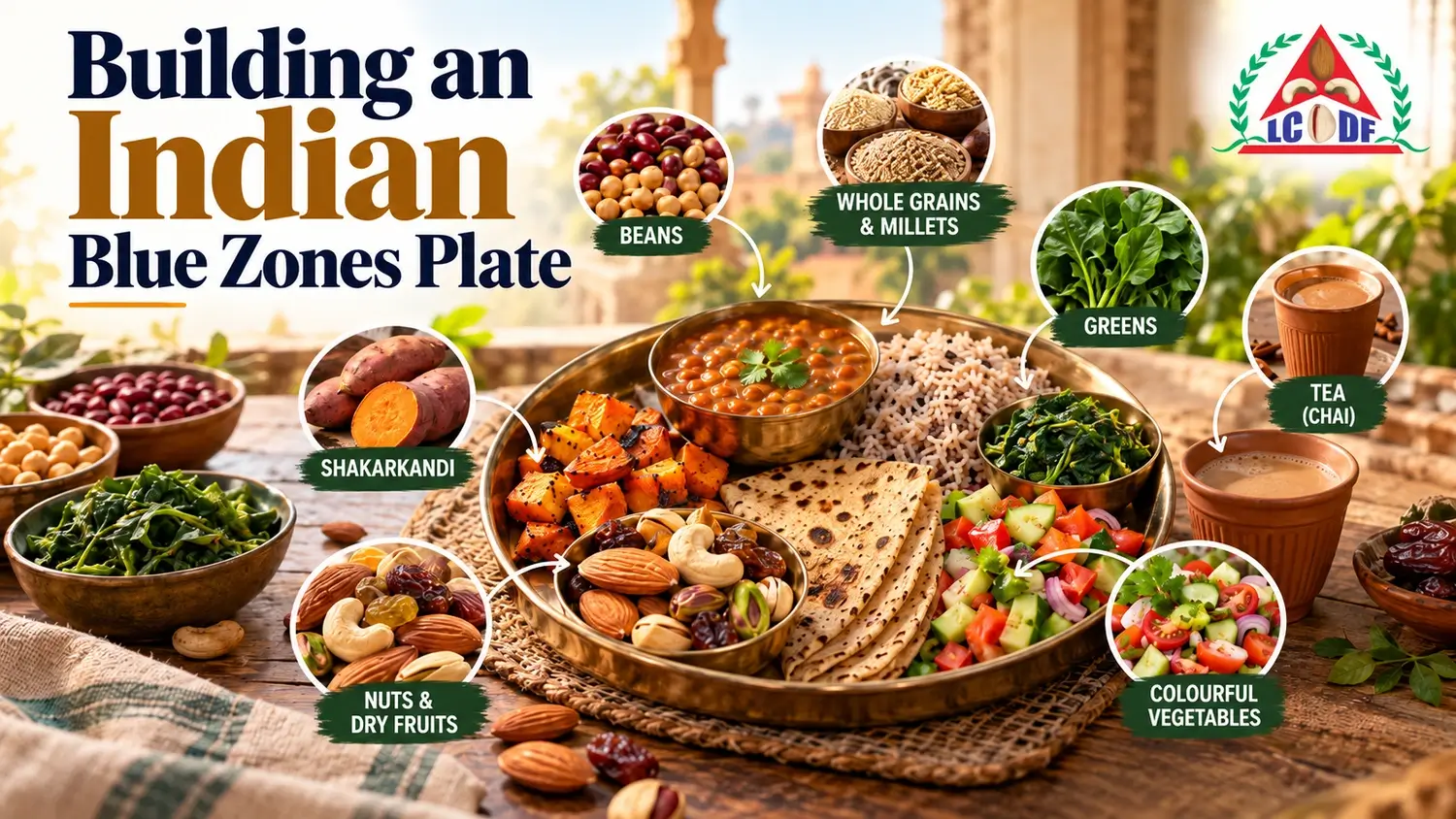
You do not need to move to Sardinia. You need a pattern that fits an Indian thali. Here is our suggested translation of the blue zone habits. It is a general guide, not a diet plan.
Beans are the cornerstone of most longevity diets, and blue zone residents eat at least half a cup of cooked beans a day. In India, that means rajma, chana and dal, which most homes already cook. Whole grains and millets replace refined flour. Shakarkandi mirrors the Okinawan sweet potato. Tea is a daily habit in every blue zone, so chai is already on your side, though you can cut the sugar. Greens such as palak and methi cover the vegetable side.
Then comes your measured portion of nuts, with a few figs or raisins if you like. Panchmeva, the traditional mix of almonds, cashews, pistachios, dates and raisins, fits this pattern well when you keep the portion sensible and skip the sugar coating.
A sample day
Start with chai made with less sugar and a small portion of mixed nuts. Lunch is dal, a millet or whole wheat roti, and a vegetable. In the evening, have roasted chana or a few plain pistachios. Dinner is rajma with salad. Stop eating when you feel about 80 percent full, in the spirit of hara hachi bu.
Easy swaps
- Replace a sugar heavy laddoo with a nut and date bite, and keep it small.
- Swap salted namkeen for plain roasted nuts.
- Save chikki and sweet dry fruit treats for occasions.
- Use a measured portion of nuts in your poha, curd or porridge instead of eating from the packet.
These small shifts follow the blue zone logic better than any single food.
Who Should Go Slower
Not everyone should follow the same advice. Nut allergy is the obvious case, and tree nuts and peanuts can cause serious reactions. People with diabetes or prediabetes should watch dates, raisins and figs, and speak with their doctor about portions. Anyone who is counting calories should remember that nuts are energy dense. Whole nuts can also be a choking risk for very young children. When you have a health condition, your doctor knows your situation better than any general guide.
Frequently Asked Questions
How many nuts should I eat a day to live longer?
The research points to about 15 to 20 grams a day as a sensible target, with 28 grams matching the larger studies. Weigh your portion once to learn what it looks like.
Which dry fruit is best for longevity?
Tree nuts have the strongest evidence, and almonds, walnuts and pistachios all appear in blue zone and research settings. No single nut has been proven the best.
Do blue zone people eat dry fruits?
They eat nuts daily in most blue zones, along with fresh fruit, and some dried produce in the off season. Dried fruit is not the centre of the pattern.
Are blue zones real or a myth?
The debate is open. Critics question some age records, and blue zone researchers defend their validation work. The nut research stands on separate evidence.
Are dried fruits as healthy as fresh fruit?
They bring fibre and minerals, but they pack more sugar into a small portion. Fresh fruit is easier to overeat less, and dried fruit works best in small amounts.
Can I eat dry fruits every day?
Yes, for most healthy adults, in measured portions. A small daily habit beats an occasional large bowl.
How many soaked almonds should I eat a day?
Weigh your portion rather than count pieces, since almond sizes vary. Our per day guide gives more detail by nut.
Do nuts really help you live longer?
Large studies link them with lower risk of early death. They show association, not proof, and healthy habits travel together.
How do I know if almonds or walnuts have gone rancid?
A sharp, paint like or bitter smell and taste is the usual sign. When in doubt, throw them out.
How should I store dry fruits in India?
Keep them airtight, cool and dry, and refrigerate oily nuts like walnuts in warm weather. Read our storage guides linked above for the detail.
Are loose dry fruits safe?
Many are fine, but one Indian study found more aflatoxin in loose samples than in packed ones. A sealed, labelled pack gives you more information about what you are buying.
Can diabetics eat dates, raisins and figs?
Often in small portions, but it depends on the person. Check with your doctor, and pair them with protein or nuts.
What is the Indian version of the blue zones diet?
Think dal, rajma, chana, millets, greens, shakarkandi, chai with less sugar, and a measured portion of plain nuts.
Conclusion
Dry fruits and longevity make a good story, and parts of it stand on solid ground. Nuts have strong, repeated evidence behind them, and the benefit appears at a modest daily portion. Dried fruits show early promise, and their sugar asks for care. The blue zones remain an interesting but contested set of clues.
So keep it simple. Weigh a small portion of plain, fresh nuts. Build your plate around dal, beans, whole grains and vegetables. Choose packs you can trust. Longevity comes from the whole pattern of how you live, and a daily handful of good nuts is an easy part of it to get right.
About the Author
This guide comes from the team at Lake City Dry Fruits. Our family has handled almonds, cashews, pistachios and raisins since 1964, first at a small counter in Rajasthan and now across hubs in Udaipur, Pune, Delhi and Mumbai. Three generations have taught us one thing: a nut only helps you if it reaches your kitchen fresh and clean. That is why we write about the research the way we run our packing floor, with checks at every step. We read the studies in full, we say where the evidence is thin, and we leave out claims we cannot support. We are food people, not doctors, so please speak with your own doctor about your health needs.
Author

LCDF Pvt. Ltd.
Lake City Dry Fruits Pvt. Ltd. has been a pioneer in the dry fruits and spices industry for over 60+ years. From humble beginnings in Udaipur to a pan-India presence, we’ve built a reputation for sourcing the best global produce, ensuring uncompromising quality at every step.