

| LCDF Pvt. Ltd.
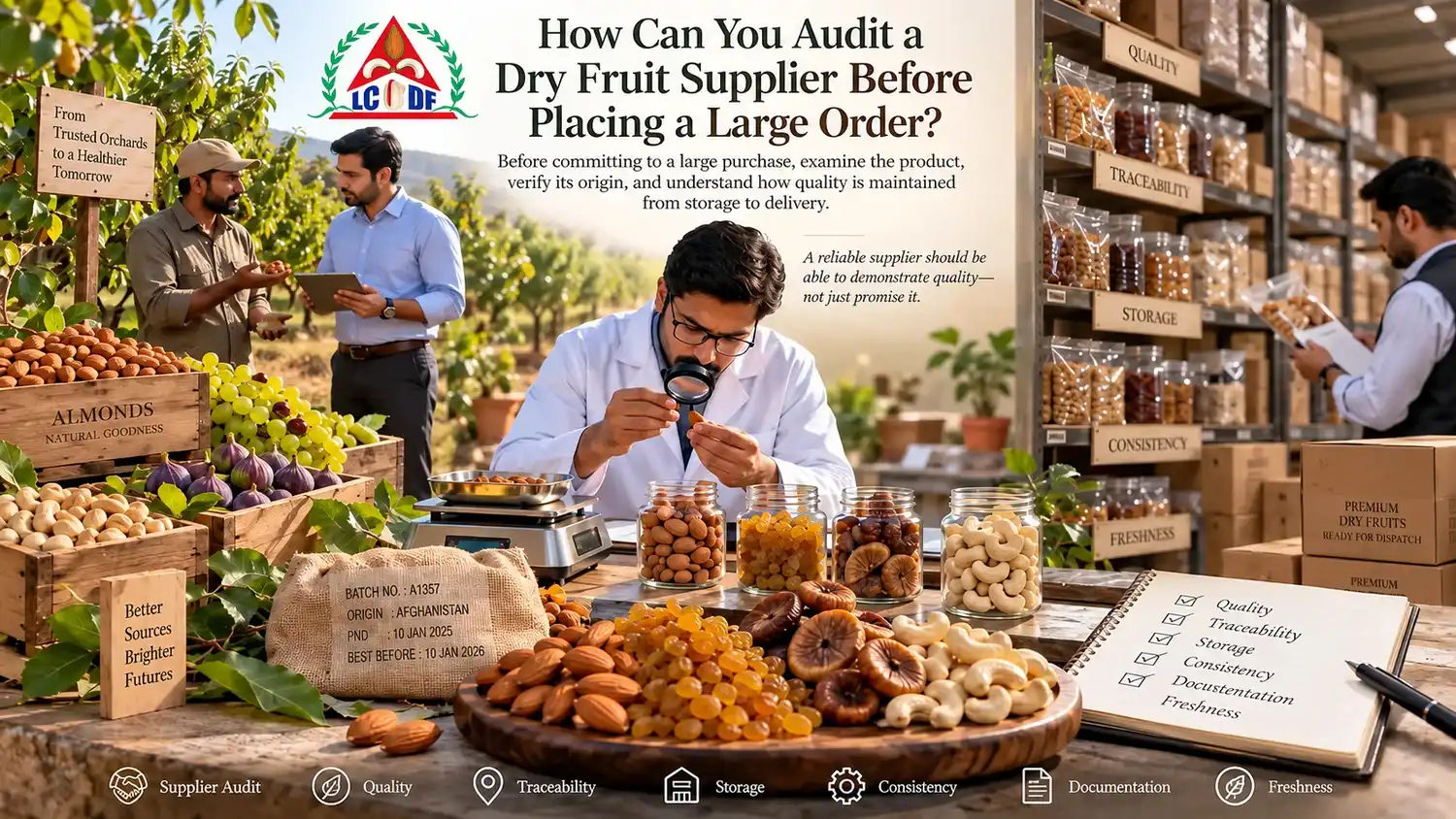
How Can You Audit a Dry Fruit Supplier Before Placing a Large Order?
Summary
Auditing a dry fruit supplier isn't about paperwork for the sake of paperwork. It's about protecting the trust your own customers place in you, whether that's a hotel guest reaching for a bowl of cashews, a retail shopper picking up a gift box before Diwali, or a distributor betting their season on your consistency.
The truth is, most supplier relationships don't fail because someone was dishonest from day one. They fail because nobody checked the moisture content, nobody asked for a fresh Certificate of Analysis, nobody agreed on a golden sample before the bulk order shipped. Small gaps like these are where good intentions quietly turn into expensive problems.
A proper audit closes those gaps. It doesn't need to feel adversarial, and it shouldn't. The suppliers worth working with, the ones who've genuinely earned their place in this trade, will welcome the questions rather than dodge them. If anything, how a supplier responds to being asked for a license number, a lab report, or a facility walkthrough tells you almost as much as the documents themselves.
We've spent over sixty years on the sourcing side of this industry, watching this trade shift from purely relationship-based mandi trading to something more structured and accountable. What hasn't changed is this: the buyers who take the time to verify before they commit are the ones who build supplier relationships that actually last. That's not a sales pitch, it's just what six decades in this business has taught us.
If you're placing your first large order or your fiftieth, the checklist doesn't get less important with experience. It gets more important with scale.
Key Takeaways
- A Good Sample Doesn't Guarantee A Good Bulk Order. Consistency across the full shipment matters far more than how the first 500 grams looked and tasted.
- An FSSAI license and an FSSAI registration are not the same thing. Always verify the actual license status on the FoSCoS portal rather than taking a number at face value.
- Moisture content is your earliest warning sign. Nuts and dry fruits carrying excess moisture are far more likely to develop mold and aflatoxin contamination during storage or transit.
- Always ask for a batch-specific Certificate of Analysis. A generic or outdated COA tells you nothing about the shipment actually headed your way.
- Sulfur dioxide and pesticide residue checks matter more than most buyers realize, especially for raisins, apricots, and figs, where these are commonly used in processing.
- Traceability isn't optional for a large order. A reliable supplier should be able to explain, and ideally document, exactly where their stock originated.
- Mandi-based sourcing and proper documentation aren't opposites. Even in traditional wholesale markets, the best traders will provide invoices and lot details once you simply ask.
- How a supplier reacts to scrutiny tells you more than any certificate. Resistance to an audit, evasiveness about references, or pressure toward cash-only payments are all worth pausing over.
- The golden sample method prevents most post-delivery disputes. A sealed, signed reference sample gives both sides a clear, objective standard to measure the bulk order against.
- Trust in this trade is earned through verification, not assumed through reputation. The buyers who ask the right questions upfront are consistently the ones who build supplier relationships that last, and that's a lesson worth carrying into every large order you place.
Introduction
Every bulk buyer has a version of the same story. The sample arrived, it looked perfect, the almonds were plump and evenly sized, the cashews were bright and whole, and the deal moved forward. Then the actual order landed a few weeks later, and something was off. Maybe the moisture felt different. Maybe a portion of the batch had gone slightly rancid by the time it reached the warehouse. Maybe the invoice didn't quite match what was promised on the call.
This gap between "the sample was great" and "the bulk order held up" is where most buyers lose money in the dry fruit trade. And it's rarely because they didn't care about quality. It's because most people equate a good first impression with a trustworthy supplier, without actually auditing what sits behind that first impression.
A proper supplier audit isn't about being suspicious of everyone you work with. It's about protecting your margins, your customers, and your reputation before you commit real money to a large order. And in a business like dry fruits, where quality can shift with a season, a warehouse, or a single humid truck ride, that audit has to go deeper than checking a certificate and calling it done.
This guide walks through what an audit should actually cover, across four layers: the legal paperwork, the science of the product itself, where it's really sourced from, and the human behavior of the supplier you're dealing with.
Why a Sample Looking Good Doesn't Mean the Supplier Is Reliable
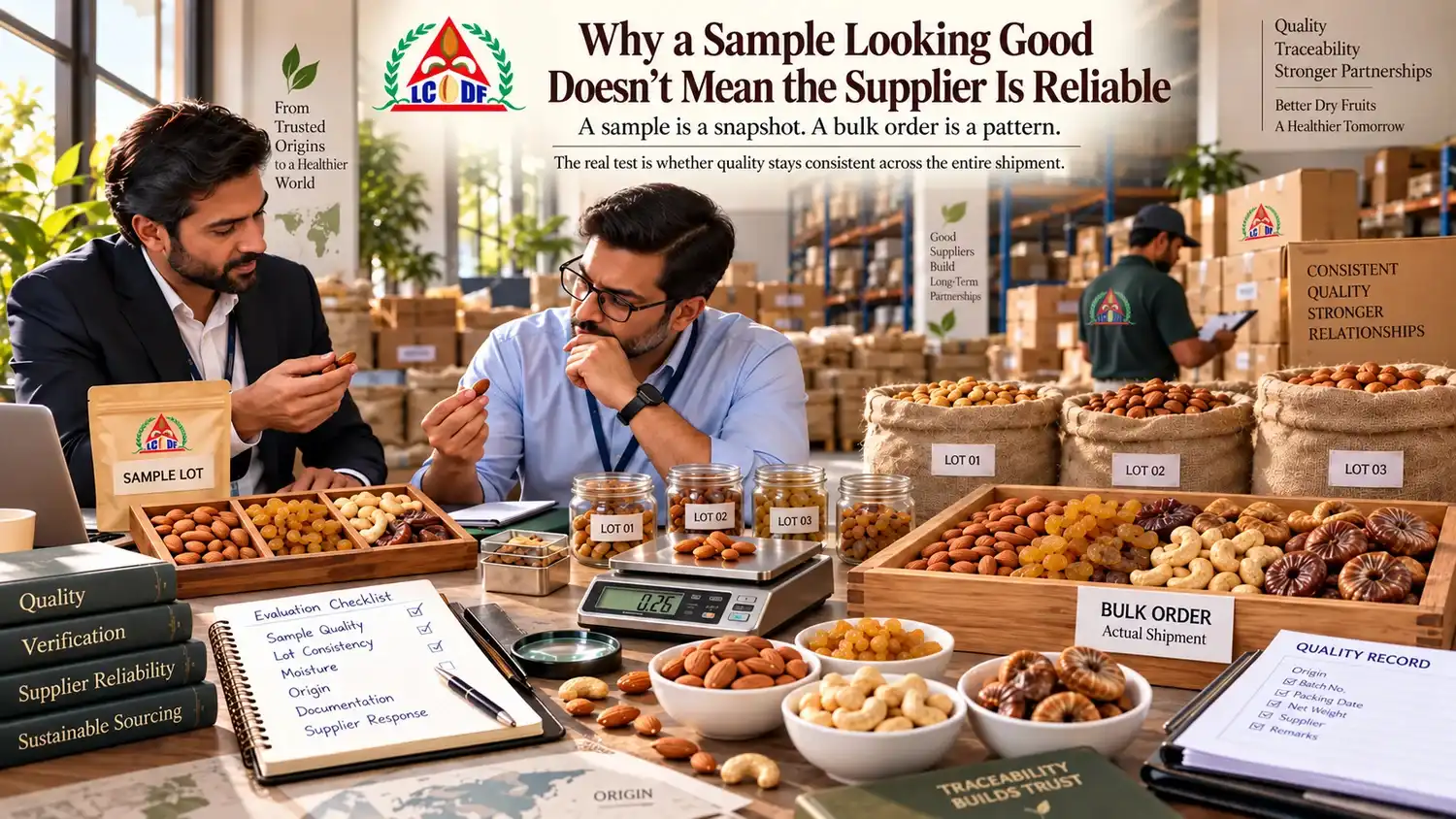
A sample is a snapshot. A bulk order is a pattern. And patterns are where suppliers either prove themselves or fall apart.
Here's the thing most buyers don't think about until it's too late: a supplier can absolutely send you their best 500 grams and still not have the systems in place to replicate that quality across 500 kilograms. Small operations sometimes hand-pick their sample batch. Larger ones might send you stock from a different, better-managed lot than the one that will actually ship. Neither is necessarily malicious, but both mean your sample tells you very little about consistency.
Consistency is the real thing you're auditing for. Will batch two look and taste like batch one? Will the moisture level hold steady across the whole shipment, not just the top layer of the bag? Will the supplier still answer your calls the same day once the payment has cleared?
That's why a real audit needs to work across four areas, and skipping any one of them is usually where the trouble starts:
- Legal and compliance documentation
- The product itself, examined at a food-science level
- Where the product is actually coming from
- How the supplier behaves, especially under scrutiny
Let's go through each one.
Step 1: Verify Legal and Compliance Documentation
FSSAI License, and Why "Registered" Isn't the Same as "Licensed"
If you're sourcing dry fruits anywhere in India, this is non-negotiable, and it's also one of the most misunderstood parts of the process.
There's a real difference between FSSAI registration and an FSSAI license, and a lot of small sellers lean on that confusion. Registration is a lighter form of compliance, usually meant for very small food businesses with limited turnover. A license, whether Basic, State, or Central, means the business has gone through a more thorough approval process, and in many cases, an actual premises inspection.
If a supplier is handling large-volume orders, storing bulk stock, repacking, or operating across state lines, they should hold a proper license, not just a registration. And you shouldn't have to take their word for it. Every FSSAI number can be checked directly on the FoSCoS portal (the government's official food licensing system). Enter the license number, and it will tell you whether it's active, what category it falls under, and whether the details match what the supplier has told you. It takes less than five minutes and it's one of the highest-value checks you can do before placing any large order.
GST and Business Legitimacy
Beyond the FSSAI license, there's another quiet check that catches problems most buyers never think to look for: does the supplier's GST number actually match the name they're doing business under?
Ask for the GSTIN upfront, and take the extra two minutes to check that it lines up with the name on their invoices and the name of the business you've actually been negotiating with. It sounds like a small, almost bureaucratic detail, but it catches more than you'd expect. It's not unusual in this trade to find a trader who operates informally under one name, the name on their shop sign, their WhatsApp business profile, or the name they've built a local reputation around, while their invoices come from a completely different registered entity. Sometimes this is entirely innocent, a family business restructured under a new company name, or a distributor invoicing through a parent firm. But sometimes it's a way of keeping a layer of distance between the person you're trusting and the entity that's legally accountable if something goes wrong.
If those two names don't match, that's not automatically a reason to walk away. But it is absolutely a reason to ask a direct, simple question before you send any advance payment: who exactly are we contracting with here, and why does the invoicing entity look different from the business we've been speaking to? A supplier with nothing to hide will answer this plainly. One who gets vague, defensive, or keeps redirecting the conversation is telling you something worth paying attention to.
This single check takes almost no time, but it's one of the clearest ways to protect yourself before real money is on the line, and it's exactly the kind of detail that separates a casual buyer from one who's actually done their homework.
Quality and Safety Certifications That Actually Matter
Certifications like HACCP and ISO 22000 are good signals, but it's worth understanding what each one is actually telling you. HACCP is about hazard control at critical points in the production process. ISO 22000 is a broader food safety management framework. Neither one is a direct guarantee of the exact batch you're buying, but together, they tell you the supplier has structured systems rather than ad hoc handling.
If you're sourcing organic dry fruits, ask for NPOP certification specifically, and verify it's current rather than expired. And for larger orders, it's fair to ask whether the supplier carries product liability insurance. Most established suppliers will have this, and the ones who hesitate to answer are telling you something too.
Step 2: Audit the Product Itself
This is the part most buyers skip entirely, and it's exactly where the real risk hides.
Moisture is one of the simplest things to check, and honestly, one of the most predictive. Dry fruits and nuts carrying too much residual moisture are far more likely to develop mold, and from there, aflatoxin contamination, particularly during storage or during a long transit that involves temperature and humidity swings. This matters even more for shipments that won't move straight to the end customer, but will instead sit in a warehouse for weeks before they're finally sold.
Here's the honest truth: this single check tells you more about a supplier than almost anything else on this list, because it separates suppliers who actually test their product from suppliers who simply hope it's fine. A supplier who can give you the exact moisture percentage of the batch, backed by real testing done consistently rather than occasionally, is operating on a completely different level than one who just says "don't worry, it's dry" and expects that to be reassuring enough.
That kind of vague confidence might sound fine over a phone call, but it isn't something you can rely on once real money and a large order are on the line. A number you can verify will always be worth more than a promise you can't.
Understanding Peroxide Value and Oxidation
Rancidity doesn't happen overnight, and it isn't always obvious from a quick sniff test. At a chemical level, nuts oxidize over time, and one of the markers labs use to measure this is peroxide value. As oxidation progresses, compounds like hexanal begin to form, which is part of what gives rancid nuts that stale, almost cardboard-like smell and taste. For a large order that will be stored for any length of time before resale, asking whether the supplier tests peroxide value, or at minimum understands what it means, tells you a lot about how seriously they take shelf life rather than just appearance.
Aflatoxin and Mycotoxin Testing: The Non-Negotiable Check
Aflatoxin contamination is the single biggest food safety risk in nuts and dry fruits, particularly in cashews, peanuts, pistachios, and figs. Different regulatory bodies set different limits, and it helps to know where India's standards sit relative to international ones so you're not caught off guard if you're supplying export clients or premium retail chains with stricter expectations than the domestic baseline.
Whatever the specific limit, the practical takeaway is the same: ask for a Certificate of Analysis for the batch you're buying, not a generic one from a previous shipment. A supplier who tests regularly and can produce a recent COA without hesitation is a supplier who has nothing to hide.
Sulfur Dioxide and Pesticide Residue
For raisins, dried apricots, and figs in particular, sulfur dioxide is often used to preserve color and prevent browning. Within permitted limits, this is standard practice. Beyond those limits, it becomes a health concern and a compliance issue. Similarly, pesticide residue testing matters more than most buyers realize, especially for products sourced from regions where agricultural practices aren't tightly regulated. If a supplier can't produce a residue test report on request, that's worth factoring into your decision, especially for a large order.
Grading, Shell-to-Kernel Ratio, and Visual Consistency
Beyond the lab-level checks, there's still value in the basics. Grading consistency (are the pieces uniform in size, color, and texture across the batch), shell-to-kernel ratio for in-shell products, and overall visual consistency all tell you whether the supplier sorts and grades properly before packing, or whether they're mixing grades to move volume faster.
Step 3: Trace the Sourcing Chain
Where Does the Product Actually Come From?
Here's something worth clearing up early, because it trips up a lot of newer buyers: India processes and distributes a massive share of the dry fruits sold across the country, but it doesn't grow all of it. Almonds, pistachios, and walnuts, for instance, often originate from places like the US, Iran, Afghanistan, and Australia, and are then processed, graded, and packaged once they reach India. That's not a red flag or a sign of anything shady, it's simply how this industry has always worked. India's real strength has always been in the processing and distribution side, not necessarily the growing.
What actually matters isn't where the product started its journey, it's whether your supplier can tell you that origin clearly and confidently, ideally backed by some form of traceability documentation that connects the product back to the farm or processing facility it came from. A supplier who can walk you through this without hesitation is one who has visibility into their own supply chain. A supplier who gives you a vague answer, or seems unsure themselves, is one who may just be buying from whoever had stock available that week, with little insight into what happened before it reached them.
If you're an exporter or a larger B2B buyer, it's also worth checking whether the supplier is APEDA registered. This adds a real layer of confidence, especially for products that will eventually move across borders, since it signals a level of documentation and compliance that casual traders often don't maintain.
At the end of the day, origin transparency isn't about interrogating your supplier, it's about working with someone who understands their own product well enough to answer a simple question honestly.
Mandi Sourcing vs. Direct or Organized Sourcing
A large part of India's dry fruit trade still runs through traditional wholesale markets like Khari Baoli in Delhi, where transactions have historically relied more on relationships and reputation than on paperwork. There's nothing inherently wrong with this system. It's been the backbone of the trade for generations, and plenty of reliable, honest traders operate this way.
But if you're placing a large order and want documentation you can rely on for your own business records, it's worth being upfront about that need. Ask for proper invoices, ask for lot numbers where possible, and don't assume that because a trader is well known in the market, verification isn't necessary. Reputation and documentation aren't mutually exclusive, and the best mandi traders will happily provide both once you ask.
Step 4: Protect Against Fraud and Bad-Faith Suppliers
Real Red Flags to Watch For
Some of the clearest warning signs aren't in the paperwork at all, they're in how a supplier behaves when you start asking questions. A supplier who gets defensive or evasive when you request an independent audit or a recent lab report is telling you something important. Genuine, established suppliers are usually comfortable with this kind of scrutiny because they have nothing to worry about.
Other behavioral flags worth watching for: an unwillingness to provide references from other business clients, pressure to pay in cash only, or unusual insistence on unconventional payment structures for a first-time large order. None of these guarantee fraud on their own, but together, they're worth pausing over.
What Real Dry Fruit Trading Fraud Looks Like in India
This isn't a hypothetical risk. India's dry fruit trade has seen real cases of buyers and traders being defrauded through classic trust-building schemes, where a party places smaller orders and pays on time initially, only to later default on larger payments once trust has been established, sometimes through partial payments followed by cheques that bounce. There have also been documented cases of adulteration in the market, including apricot kernels being mixed into almond batches because of how visually similar they can look once dried. This particular substitution matters beyond just quality, since certain apricot kernel varieties contain compounds that can be genuinely harmful if consumed regularly in any quantity.
None of this is meant to make bulk buying feel risky at every turn. It's meant to explain why the checks in this guide exist in the first place. They're not bureaucratic hoops, they're responses to real patterns that have played out in this industry.
Step 5: Test Before You Commit to Bulk
The "Golden Sample" Method
One of the most useful practices borrowed from broader B2B sourcing is the idea of a golden sample. Once you approve a sample, that exact unit gets sealed and signed by both you and the supplier, and it becomes the reference standard the entire bulk order is measured against. If the delivered batch doesn't match the golden sample in moisture, size, color, or packaging, you have a clear, mutually agreed basis for raising it, rather than a subjective argument about whether something "seems off."
This single practice prevents a huge share of the disputes that come up after large orders are delivered.
Third-Party Inspection and Facility Audits
For genuinely large orders, or for a first-time relationship with a new supplier, it's worth considering a third-party inspection, either in person or conducted virtually through video walkthroughs of the facility. This isn't about distrust, it's standard practice in serious B2B sourcing, and any supplier confident in their operation will accommodate it without much resistance.
Communication and Responsiveness as a Reliability Signal
It's easy to overlook, but how quickly and clearly a supplier communicates before you've placed the order is often a preview of how they'll communicate after something goes wrong. A supplier who takes days to answer basic questions during negotiation is unlikely to suddenly become responsive when there's a genuine problem with your shipment.
A Quick Pre-Order Audit Checklist
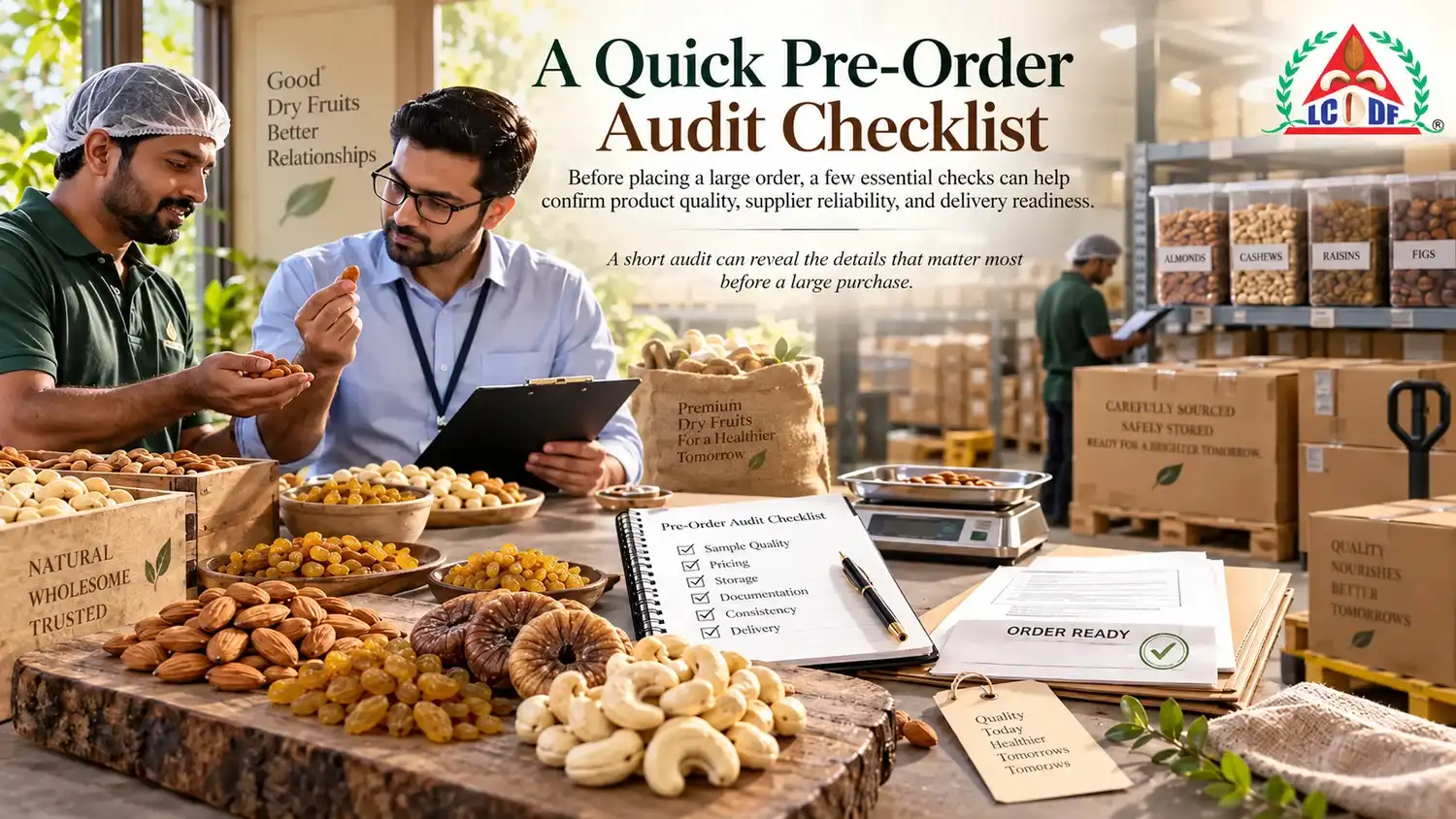
Before you place a large dry fruit order, run through this:
- Legal and compliance
- FSSAI license verified on FoSCoS, not just a registration
- GSTIN matches the invoicing entity
- Relevant certifications (HACCP, ISO 22000, organic if applicable) are current, not expired
- Product and quality
- Moisture content shared and within safe range
- Recent Certificate of Analysis for aflatoxin
- Residue test reports available on request
- Grading and visual consistency checked, not just sample-level
- Sourcing
- Origin of the product can be explained and, ideally, documented
- Lot numbers or traceability records available
- Behavior and process
- Supplier is comfortable with an audit or inspection request
- References from other business clients provided without pushback
- A golden sample is agreed upon and signed before bulk production
- Communication has been prompt and clear throughout
Notes by Buyer Type
Hotels and restaurants: consistency matters more than anything else here, since guests will notice if this month's cashews taste different from last month's. Prioritize suppliers who can commit to batch-to-batch consistency in writing.
Retailers: packaging integrity and shelf-life documentation matter as much as the product itself, since stock may sit on shelves for weeks before it sells.
Gifting businesses: visual grading and uniformity become especially important, since presentation is a large part of what you're selling.
Exporters: international certification requirements (EU or FDA-aligned limits, for instance) should be confirmed well before production, not after the shipment is packed.
Frequently Asked Questions
Is an FSSAI license enough to trust a supplier?
It's a strong starting point, but not the whole picture. It confirms basic legal compliance, but it doesn't guarantee batch-to-batch consistency or catch things like moisture issues or adulteration. Treat it as step one of the audit, not the whole audit.
How do I verify a dry fruit exporter's GST number?
You can check it against the official GST portal and confirm that the registered business name matches the name on your invoices and communication.
What documents should a supplier provide before a bulk order?
At minimum: a valid FSSAI license number, GSTIN, a recent Certificate of Analysis for the specific batch, and any relevant certifications like HACCP or organic status if applicable.
How much aflatoxin is safe in almonds and cashews?
Limits vary by regulatory body and by country, which is exactly why asking for a current, batch-specific COA matters more than relying on a general assumption of safety.
What is a golden sample in supplier sourcing?
It's a sealed, signed reference sample that both buyer and supplier agree represents the standard for the entire order. It becomes the benchmark the bulk shipment is measured against.
About the Author
Lake City Dry Fruits Pvt. Ltd. (LCDF)
This piece comes from the team at Lake City Dry Fruits, and it's written from experience rather than theory.
Our story didn't start with a checklist or a certification, it started in Vallabhnagar, Rajasthan, as a small retail dry fruits and spices business called Shah Madhavlal Pyarelal Jain & Sons. Over the decades, that business grew into Udaipur, then into Jodhpur, and eventually became what it is today: Lake City Dry Fruits, now run by the third generation of the same family, still guided by the same instinct that started it all, never compromise on quality, even when it would be easier and cheaper to.
Today, we source premium nuts and dry fruits from origins like the USA, Australia, Afghanistan, and Iran, process them through our own manufacturing facilities, and supply wholesalers, retailers, and hospitality businesses across 14+ states in India. We hold FSSAI certification along with ISO and HACCP compliance, not as a formality, but because we've been on the receiving end of enough supplier relationships over sixty-plus years to know exactly why those checks exist.
We didn't write this guide as outsiders looking in. We've sat across the table from both trustworthy suppliers and ones that weren't, we've had to walk away from deals that looked good on paper, and we've built our own sourcing standards around the same questions we're asking you to ask. If this article helps even one buyer avoid a bad bulk order, it's done its job.
For bulk enquiries, white-label packaging, or to know more about how we source and quality-check our own products, you can reach us directly through our contact page or explore our full range and bulk order options on lcdf.co.in.
Conclusion
At the end of the day, auditing a dry fruit supplier isn't about complicating a simple purchase. It's about making sure the trust you're placing, and the money you're committing, is backed by something more solid than a good first impression. A sample can look perfect and still not prepare you for what shows up in a 500-kilogram order three weeks later. That gap is exactly what this checklist exists to close.
None of this means approaching every supplier with suspicion. Most people in this trade, whether they're running a stall that's been in the family for generations or a modern processing unit with lab reports on file, take genuine pride in what they sell. A real audit simply gives that pride something concrete to stand on: a verified license, a recent test report, a sample both sides have agreed to and signed off on. It protects the supplier's reputation just as much as it protects your order.
If there's one thing worth remembering from all of this, it's that reliability in the dry fruit trade isn't something you can judge from a phone call or a single good batch. It's something you verify, step by step, before you commit to scale. The suppliers who welcome that process are usually the ones worth building a long-term relationship with.
We've been on the sourcing side of this industry for over sixty years now, through the shift from purely relationship-driven mandi trading to a business that runs on documentation, testing, and traceability. What's stayed constant through all of it is simple: the buyers who ask the right questions before placing a large order are almost always the ones who come back to place another one. That's not something we say to sound reassuring. It's just what six decades of doing this has shown us, order after order.
Author

LCDF Pvt. Ltd.
Lake City Dry Fruits Pvt. Ltd. has been a pioneer in the dry fruits and spices industry for over 60+ years. From humble beginnings in Udaipur to a pan-India presence, we’ve built a reputation for sourcing the best global produce, ensuring uncompromising quality at every step.